
Xiaomi MiMo-V2.5 Open Source: Distributing 100 Trillion Tokens Over 30 Days
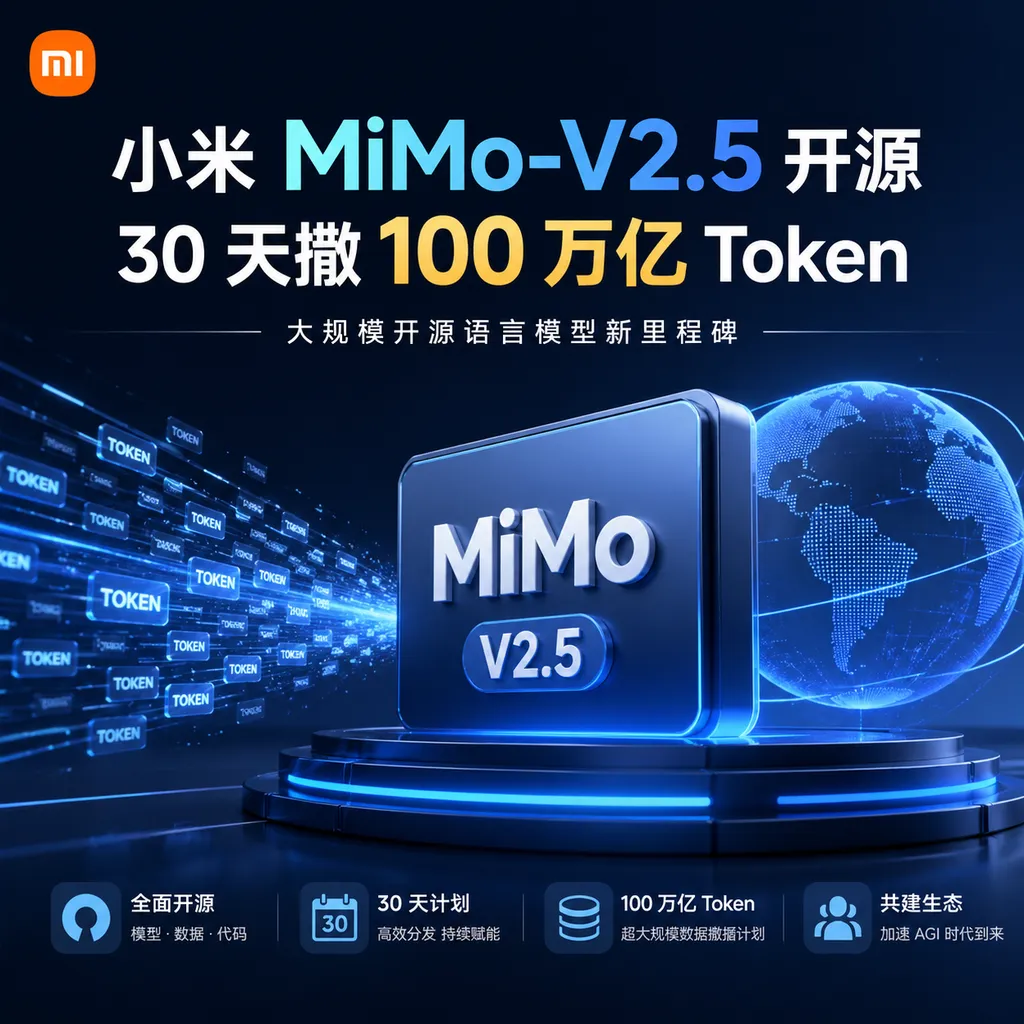
Early this morning, Xiaomi announced the global open-source release of the MiMo-V2.5 series under the MIT license, allowing for commercial use and fine-tuning. At the same time, it launched the **“Creator Quadrillion Token Incentive Program”**, distributing **100T Token** benefits within 30 days, with individual users eligible to receive up to **1.6 billion Credits** worth **659 RMB**.
Xiaomi MiMo-V2.5 Open Source: 100 Trillion Tokens in 30 Days
Early this morning, Xiaomi announced the global open-source release of the MiMo-V2.5 model series, along with the launch of the “MiMo Orbit Program” — distributing 100 trillion tokens to developers worldwide within 30 days. Individual users can receive up to 1.6 billion credits (worth 659 RMB). This represents another bold move in open-source strategy from a leading Chinese large-model enterprise.
The model weights and inference code are fully open-sourced under the MIT license, allowing commercial use, secondary training, and fine-tuning without additional authorization. This license is more permissive than Meta’s Llama Community License and more thorough than Alibaba’s Qwen clause that forbids “military use.”
Two Versions, Each with Its Own Emphasis
The MiMo-V2.5 series includes two models, both supporting a 1 million-token context window:
- MiMo-V2.5-Pro: Designed for complex scenarios, deeply adapted for Agent and Coding applications. Ranked No. 1 among open-source models globally on the GDPVal-AA and ClawEval benchmarks.
- MiMo-V2.5: A natively multimodal model supporting text, image, video, and audio understanding, with strong agentic capabilities.
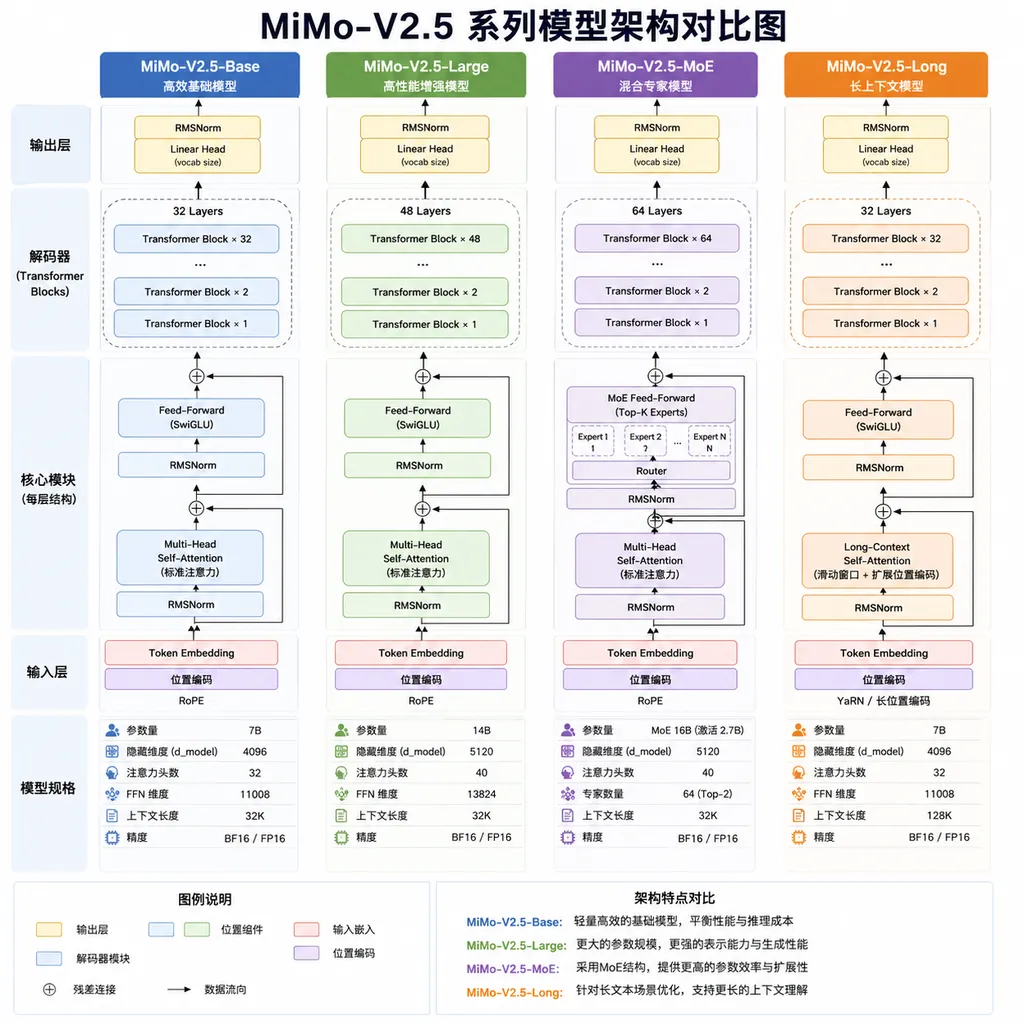
The Xiaomi technical team emphasized that the true value of a model lies not in leaderboard rankings, but in its ability to efficiently help developers solve real-world problems. On the Claw-Eval benchmark, MiMo-V2.5 sits on the optimal frontier for both task completion and token efficiency.
This claim is supported by real data. Official figures show that, at equivalent Agent evaluation scores, MiMo-V2.5-Pro uses 42% fewer tokens than Kimi K2.6, and MiMo-V2.5 uses 50% fewer tokens than Muse Spark. For Agent applications requiring large numbers of calls, this efficiency difference translates directly into cost savings.
How to Claim the 100 Trillion Tokens
The “Creator 100-Trillion-Token Incentive Program” starts today (April 28) at midnight and lasts until May 28. It follows an application-based system. Approved users can receive a Max-tier Token Plan containing up to 1.6 billion credits, officially priced at 659 RMB.
Application process:
- Visit 100t.xiaomimimo.com and complete the form
- Wait for the approval email (binding your Xiaomi Developer Account in advance is recommended)
- View your issued Token Plan in the “Subscription Management” section of the Developer Console
Note that the 100 trillion tokens are a total pool — once given out, they’re gone. Assuming the maximum 1.6 billion credits per user, this could theoretically support around 62,500 developers. In practice, since most users won’t get the Max tier, the number of participants will be higher.
This distribution scale is unusually aggressive among Chinese model vendors. For comparison, DeepSeek’s free quota is 50 million tokens per day, while Alibaba Qwen offers 1 million tokens per month. Xiaomi’s strategy brings the quota upfront and filters genuinely interested developers through the application process.
Agent Ecosystem Co-Building Program
Another facet of the MiMo Orbit Program is the “Agent Ecosystem Co-Building Program,” which targets Agent framework teams for dedicated support. Xiaomi will offer MiMo tokens free of charge to Agent frameworks, allowing their users to seamlessly integrate and experience the MiMo series.
The goal is clear: to make MiMo models one of the default options for developers through integration at the framework level — similar to how Anthropic and OpenAI are deeply integrated into frameworks like LangChain and LlamaIndex.
If you’re an Agent framework developer or vendor, you can reach out via business-mimo@xiaomi.com for partnership inquiries.
Day-0 Compatibility: Hardware Ecosystem in Place
On the first day of open-sourcing, MiMo-V2.5-Pro achieved compatibility with multiple chip vendors — a rarity among domestic open-source models. The list includes:
- T-Head Zhenwu 810E: Deep adaptation using a fully self-developed AI software stack
- AWS Trainium2: Deep integration via its proprietary chip design, Neuron SDK, and vLLM inference framework. The next-generation 3nm Trainium3 will further unleash agentic performance potential
- AMD: Supported from Day-0 through the ROCm open-source software stack, providing comprehensive optimization
- Enflame Technology L600: Deep optimization via its in-house TopsRider software stack, achieving high throughput and low latency
- Iluvatar CoreX (Tianshu Zhixin): Full-stack self-developed hardware and software, delivering high-quality compute with efficient, easy migration
Additionally, the MiMo-V2.5 models are fully compatible from Day-0 with both SGLang and vLLM inference frameworks.
This broad hardware coverage demonstrates Xiaomi’s extensive pre-launch preparation. By contrast, Meta’s Llama series typically requires the community several weeks to adapt to various hardware platforms. Xiaomi’s Day-0 readiness across major platforms sharply reduces deployment barriers for developers.
Pricing Adjustment: Context Window Multiplier Removed
At the start of public testing on April 23, Xiaomi optimized the Token Plan pricing structure. The most significant change was removing the previous 1 Token = 4 Credits billing multiplier — Token Plans no longer differentiate between 256k and 1M context windows.
This update is friendly to long-context applications. Many model providers charge more for extended contexts — for instance, OpenAI’s GPT-4 Turbo costs twice as much for 128k contexts. Xiaomi’s cancellation of this multiplier means developers can use 1M-token contexts freely without cost concerns.
Additionally, Xiaomi introduced new “Monthly Subscription” and “Annual Package” plans to further reduce long-term usage costs.
Business Logic Behind the Open-Source Strategy
Xiaomi’s open-source strategy is more aggressive than expected. MIT license + 100 trillion free tokens + Day-0 hardware support — this trio of actions clearly aims to rapidly capture developers’ attention and build an ecosystem moat.
Comparing with other Chinese large-model vendors:
- Alibaba Qwen: Open source but with usage restrictions, smaller free quota
- Baidu ERNIE Bot (Wenxin): Mainly closed-source, with limited open versions
- ByteDance Doubao: Primarily closed-source, focused on API price competition
- DeepSeek: Open source + low-cost API, but weaker in hardware ecosystem
Xiaomi’s strategy resembles Meta’s Llama approach: open-source to build ecosystem, free quota to attract developers, hardware compatibility to lower deployment barriers. But Xiaomi is even bolder — using the MIT license with no restrictions and no separate authorization for large-scale commercial use required, unlike Llama.
The risk lies in whether the model is strong enough; if not, developers may take free credits but not adopt it actively. However, based on current leaderboard results and token efficiency data, the MiMo-V2.5 series appears competitive at least in agentic and long-context applications.
Practical Impact for Developers
If you’re an AI app developer, here’s why this open-source release and free quota are worth attention:
- Clear cost advantage: The 1.6 billion free credits can support small and mid-size projects for quite some time. Even after using them up, MiMo’s API remains cheaper than GPT-4 or Claude.
- Friendly to long-context scenarios: 1M-token context + unified billing suits RAG, long-document analysis, and codebase understanding tasks.
- Strong agent capabilities: MiMo-V2.5-Pro’s top ClawEval performance shows advantages in complex task planning and execution — ideal for Agent applications.
- Flexible deployment: MIT license + multi-hardware support allows both cloud API and on-premise deployment options.
Note: The 100-trillion-token pool is finite, so apply early. It’s also recommended to bind your Xiaomi Developer Account beforehand — approved token plans are automatically issued to your account.
The MiMo-V2.5 models are now available via OpenAI Hub and other API aggregation platforms, fully compatible with the OpenAI format, ensuring minimal migration costs.
References
- Xiaomi MiMo Model Launches “Creator 100-Trillion-Token Incentive Program” — Apply Now for Free Tokens - Linux.do — Details on the application and user discussions
- Xiaomi MiMo-V2.5 Series Models Open-Sourced Globally, 100 Trillion Tokens to Be Distributed in 30 Days - Linux.do — Official announcement


