
Tencent IMA Releases Knowledge Agent Copilot
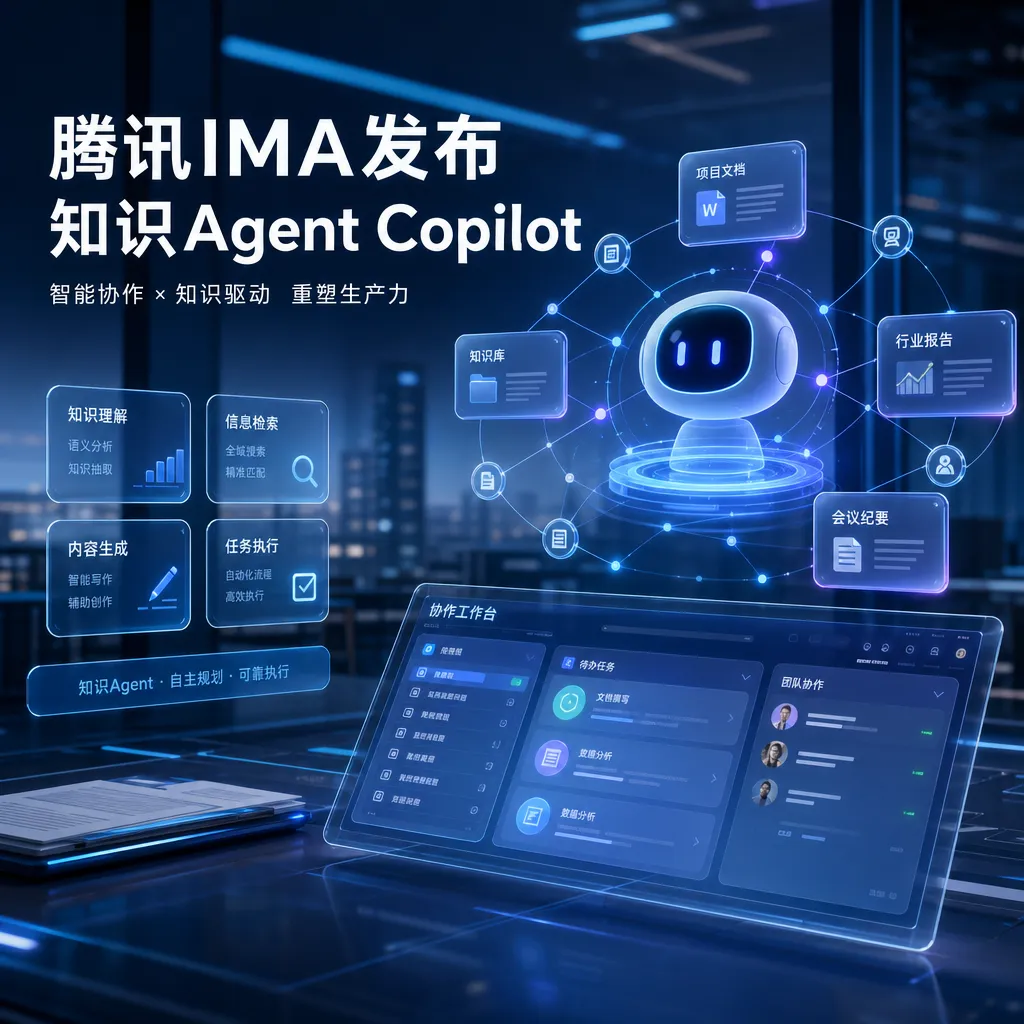
On April 29, Tencent IMA officially launched the Knowledge Agent — Copilot, featuring a built-in memory system that supports continuous cross-scenario invocation. Users can create their own dedicated intelligent agents, significantly reducing repetitive input. This marks an important leap for the AI workspace from an efficiency tool to a personalized knowledge companion.
Tencent IMA Launches Knowledge-Based Agent Copilot: Built-In Memory System Enables Cross-Scenario Continuous Interaction
On April 29, Tencent IMA officially released a new Knowledge Agent—Copilot. This agent is equipped with four major memory modules that can remember user background, habits, and ongoing tasks, enabling continuous calls across scenarios. This marks a critical step for AI workbenches from "passive response" toward "active understanding."
I. Event Overview: IMA Welcomes Its Most Significant Product Upgrade
Today (April 29, 2026), Tencent’s AI workbench product ima.copilot (hereafter IMA) officially launched its Knowledge Agent—Copilot. Unlike the previous version, which focused on "search, read, and write" efficiency integration, the newly released Copilot expands its core capabilities into the "memory and understanding" domain. It allows users to create personalized agents that can truly "know you," "remember you," and "follow up" with you.
The announcement immediately drew widespread attention. Media outlets such as 36Kr and Sina Finance quickly reported on it. This release is not only a major iteration for the IMA product line but also provides a new product paradigm for the AI workbench industry.
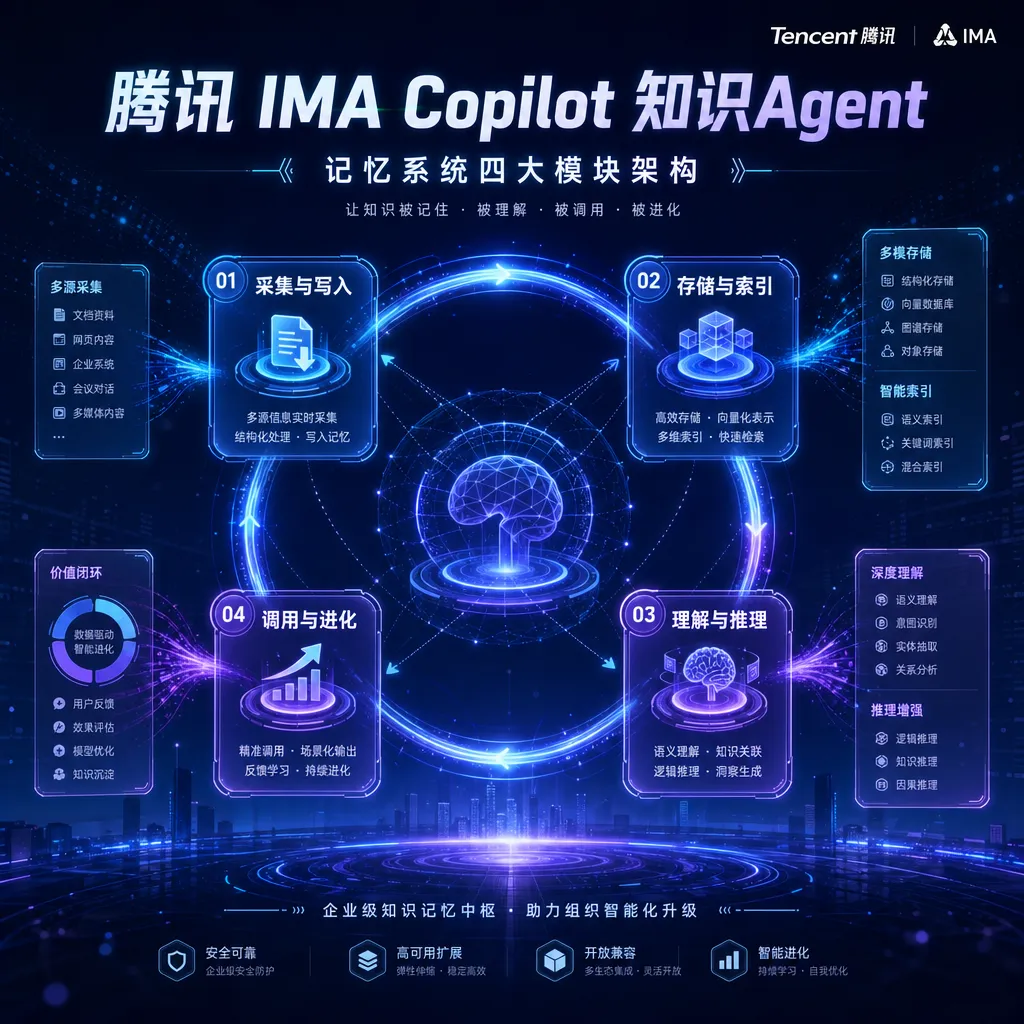
II. Core Highlights: Four Memory Modules Build a "Stateful" AI Assistant
2.1 Memory System: The Soul of Copilot
The biggest pain point of traditional AI chat tools lies in—“every conversation starts from zero.” Users must repeatedly input their background information, preferences, and task context, leading to fragmented experiences and inefficiency.
The Copilot released by IMA comes with a complete Memory System, consisting of four major modules that continuously accumulate and intelligently retrieve user information:
| Module Name | Function Description | Typical Use Scenarios | |---|---|---| | Copilot Settings | Defines the agent’s role, capability boundaries, and behavioral style | Create role-based agents such as “Research Assistant,” “Fitness Coach,” or “Project Manager” | | User Profile | Records basic user background information such as profession, industry, and language preferences | Automatically retained after first interaction—no need to repeat inputs | | Long-Term Memory | Continuously tracks key user tasks, project progress, and to-do items | Connect unfinished discussions across days or contexts | | Experience & Skills | Extracts preferred response styles and habits from past interactions | Adapts to preferred output formats (e.g., prefers tables or bullet points) |
These four modules work in synergy, making Copilot a truly stateful AI assistant. Users no longer need to reteach the AI who they are or what they’re doing, enabling continuous service across scenarios and sessions.
2.2 Personalized Agent Creation: Everyone Can Be an Agent Builder
Beyond the built-in memory system, Copilot also supports personalized agent creation. Users can build agents with specific roles and knowledge backgrounds according to their needs.
For example:
- Academic researchers can create a "Literature Review Assistant" agent, set it to specialize in a specific research field, and import a custom paper knowledge base. The agent can then provide precise recommendations and summaries based on the user’s ongoing research.
- Content creators can build a "Topic Planning Agent" that understands target audiences and content tone, proposing suggestions aligned with personal preferences learned through long-term memory.
- Project managers can create a "Project Tracker Agent" that imports project documents and timelines, remembers previous discussion points and pending items, and resumes from where the last meeting ended.
This "everyone can create their own agent" approach dramatically lowers the barrier to entry, allowing non-technical users to enjoy the benefits of personalized AI services.
III. Technical Evolution: From Efficiency Tool to Knowledge Companion
3.1 IMA’s Product Evolution Path
Looking back, IMA’s product development shows a clear trajectory from "tool" to "companion":
Stage 1 (October 2024): Launch of the AI Workbench
On October 23, 2024, Tencent launched ima.copilot, positioned as an "all-in-one AI tool for search, read, and write efficiency." Core features included:
- Smart Search: Real-time retrieval across the web and Tencent’s ecosystem (over 5 million WeChat Official Accounts)
- Document Comprehension: Upload and summarize PDF, Word, PPT, and other formats
- AI Writing: Built-in note editor supporting inline search and AI-assisted rewriting
- Personal Knowledge Base: Import local documents, webpages, and articles to build a “second brain”
The product gained quick traction; Mac and Windows versions launched within 23 days, along with a WeChat Mini Program.
Stage 2 (Ongoing): Dual Model Engine and Ecosystem Expansion
IMA later adopted a dual-model architecture powered by Tencent’s Hunyuan Model and DeepSeek-R1 Model, allowing users to choose based on task type:
- Hunyuan excels in general conversation and content generation
- DeepSeek-R1 specializes in deep reasoning and complex analysis
The platform expanded across Mac, Windows, WeChat Mini Program, and Android App to ensure coverage across major devices.
Stage 3 (April 29, 2026): Launch of the Knowledge Agent Copilot
Today’s Copilot marks the third major leap in IMA’s product line. From “efficiency tool” to “knowledge platform” to “knowledge agent,” IMA’s mission has evolved—from passive tool usage to becoming an active intelligent companion.
3.2 The Technical Significance of the Memory System
From a technical perspective, the memory system addresses several key AI application bottlenecks:
1. Overcoming Context Window Limits
Even as model context windows grow, information per session remains limited. The memory system uses structured storage and intelligent retrieval to persist user information indefinitely, free from context-length constraints.
2. Scaling Personalized Services
Through automatic accumulation in user profile and experience modules, each user gains a unique digital avatar. The AI can then offer highly personalized services—without the user having to configure settings manually.
3. Ensuring Task Continuity
The long-term memory module preserves continuity across sessions and scenarios. This is crucial for long-cycle activities like project management, academic research, and content creation—users can resume anytime, and the AI understands the current stage and context.
IV. Deep-Dive Application Scenarios: What Can Copilot Do?
4.1 Academic and Research Use
For scholars and students, Copilot’s memory system acts as a truly "field-aware" research assistant:
- Literature Management: After papers are imported, Copilot remembers the research area and read history, recommending pertinent new publications
- Writing Assistance: Adapts tone and style according to academic writing preferences stored in the user profile
- Progress Tracking: Tracks research milestones via long-term memory, resuming exactly where work was left off
4.2 Content Creation
Content professionals—marketers, copywriters, journalists—can achieve major productivity gains:
- Idea Generation: Recommends more aligned topics based on past content themes and audience feedback
- Style Consistency: Learns individual tone through the experience module, ensuring brand coherence in AI outputs
- Resource Accumulation: Continuously enriches the knowledge base with curated materials, ready for reference during creation
4.3 Project Management and Team Collaboration
In enterprise settings, Copilot’s long-term memory and task tracking offer distinct value:
- Meeting Minute Management: Automatically logs key decisions and tasks, summarizing pending items before the next meeting
- Knowledge Retention: Teams can build shared knowledge bases to capture institutional knowledge
- Cross-Department Collaboration: Different agents can maintain distinct memories, reducing communication costs
4.4 Personal Life Management
Copilot can also enhance personal life organization:
- Fitness Planning: Remembers physical data, exercise preferences, and history to optimize training plans
- Travel Planning: Generates custom itineraries based on stored travel preferences and saved notes
- Learning Paths: Tracks learning progress and blind spots to recommend targeted resources
V. Industry Context: Competitive Landscape in the AI Agent Sector
5.1 "Memory" Becomes the New Competitive Edge
Since 2026, competition in AI agents has shifted from "intelligence" to "understanding the user." More products recognize that memory is the key to transforming AI from tool to companion.
Trends include:
- OpenAI’s ChatGPT introduced a memory feature for personalized user interactions
- Google Gemini continues strengthening personalization
- Chinese developers are also experimenting with memory-enabled architectures
Compared to simple “chat memory,” IMA’s Copilot memory system offers superior structure and controllability—the four-module design clarifies what is being remembered and how it’s used.
5.2 IMA’s Differentiated Advantages
Among AI workbench products, IMA Copilot's unique strengths lie in:
- Dual Power of Knowledge Base + Memory System: Structured external knowledge plus continuous internal accumulation create a powerful personalized knowledge service
- Deep Tencent Ecosystem Integration: Seamless access to WeChat Official Accounts and chat files ensures an advantage in Chinese-language information retrieval
- Flexible Dual-Model Architecture: Hunyuan + DeepSeek engines allow task-adaptive model switching
- Cross-Platform Consistency: Unified experience across Mac, Windows, Mini Program, and Android
VI. User Perspective: How Will Copilot Change Daily Workflows?
To highlight how Copilot’s memory system shifts the experience, consider this common scenario:
Scenario: A Product Manager Conducting Competitor Research
Traditional AI Tool (No Memory):
- Opens the AI chat window
- Inputs, "I’m a product manager doing competitor analysis for a social app, focusing on user growth and retention..."
- Uploads reports for analysis
- The next day, reenters all background information
- Manually copies previous discussion results
- Repeats the process endlessly
With IMA Copilot:
- Creates a "Competitor Research Assistant" agent once
- Defines its role: specialize in social app competitive analysis
- User profile records: product manager, social industry, focus on growth and retention
- Uploads competitor reports to the knowledge base
- The next day, the agent greets: “Last time we analyzed Product A’s growth strategy—shall we continue with Product B’s retention data?”
- The experience module learns the preference for tabular comparisons and data-first analysis
- Outputs a final report fully aligned with user style and needs
This illustrates the transformative value of the memory system—shifting AI from a one-off Q&A tool into a long-term, ever-learning partner.
VII. Outlook and Reflection
7.1 Privacy and Security in the Memory System
While the memory system boosts convenience, it also raises privacy considerations. User background, work habits, and project details are highly sensitive. Balancing personalization and data protection is a key challenge IMA must address.
Expected privacy measures include:
- Transparent storage locations and encryption of memory data
- User control for viewing, editing, and deleting memories
- Policies on whether data contributes to model training
- Isolation mechanisms for shared or team-memory scenarios
7.2 From “Second Brain” to “Digital Twin”
IMA’s evolution from knowledge base to memory system envisions a broader future—transforming AI from an assistive tool into a “digital twin.”
Once AI amasses sufficient user memory and knowledge, it can not only assist but sometimes act on behalf of the user. This is particularly relevant in enterprise contexts—future AI agents might autonomously reply to emails, schedule meetings, or draft reports, freeing humans for higher-level creative and strategic tasks.
7.3 The Endgame of the AI Workbench Race
The release of Tencent IMA Copilot signals a new phase in China’s AI workbench competition. From “chat window” to “efficiency tool” to today’s “knowledge agent,” the product form continues to evolve rapidly.
Upcoming competitive dimensions will include:
- Memory Depth: Who understands and remembers users best?
- Ecosystem Breadth: Who integrates more data sources and scenarios?
- Collaboration Capability: Who enables multi-user and multi-agent teamwork?
- Security and Trust: Who earns long-term user confidence through privacy protection?
VIII. Summary
The launch of Tencent IMA’s Knowledge Agent Copilot represents a major upgrade in AI workbench innovation. Its key feature—the built-in memory system—empowers AI to understand, remember, and accompany users through four pillars: Copilot Settings, User Profile, Long-Term Memory, and Experience Skills.
For users, this means:
- ✅ No more reintroductions: AI remembers your context and preferences
- ✅ Seamless continuity: Work spans days and devices smoothly
- ✅ Increasing personalization: The more you use it, the better it adapts
- ✅ Custom Agents: Create role-specific assistants for different needs
For the industry, this marks a shift from “general-purpose chatbots” to “personalized intelligent agents.” On this new frontier, the future belongs to the AI that remembers you best.
Tencent IMA’s move arrives at the perfect time.
Official Website: ima.qq.com
References
(Note: Only sources accessible within mainland China are listed)
This article draws upon public reports from 36Kr, Sina Finance, Zhidx, and PMCAFF, with additional information from Tencent IMA’s official product page. Specific URLs are omitted; readers may search full versions using the media names above.


