
Ant Digital Tech releases the DataX platform, with the MCP protocol reshaping the data ecosystem.

At the 9th Digital China Summit, Ant Digital Technologies officially released the DataX Intelligent Agent Data Ecosystem Platform. By integrating the Model Context Protocol (MCP) and the professional intelligent agent DTClaw, it has built a three-layer data intelligence architecture that significantly lowers the barrier to data access and accelerates the release of data value.
Ant Digital Technologies Launches DataX Intelligent Data Ecosystem Platform, Integrates MCP Protocol to Reshape the Data Ecosystem Landscape
From April 28 to 29, the 9th Digital China Summit was held in Fuzhou. During the summit, Ant Digital Technologies officially released the DataX Intelligent Data Ecosystem Platform, marking a new stage in its "Data+AI" strategy.
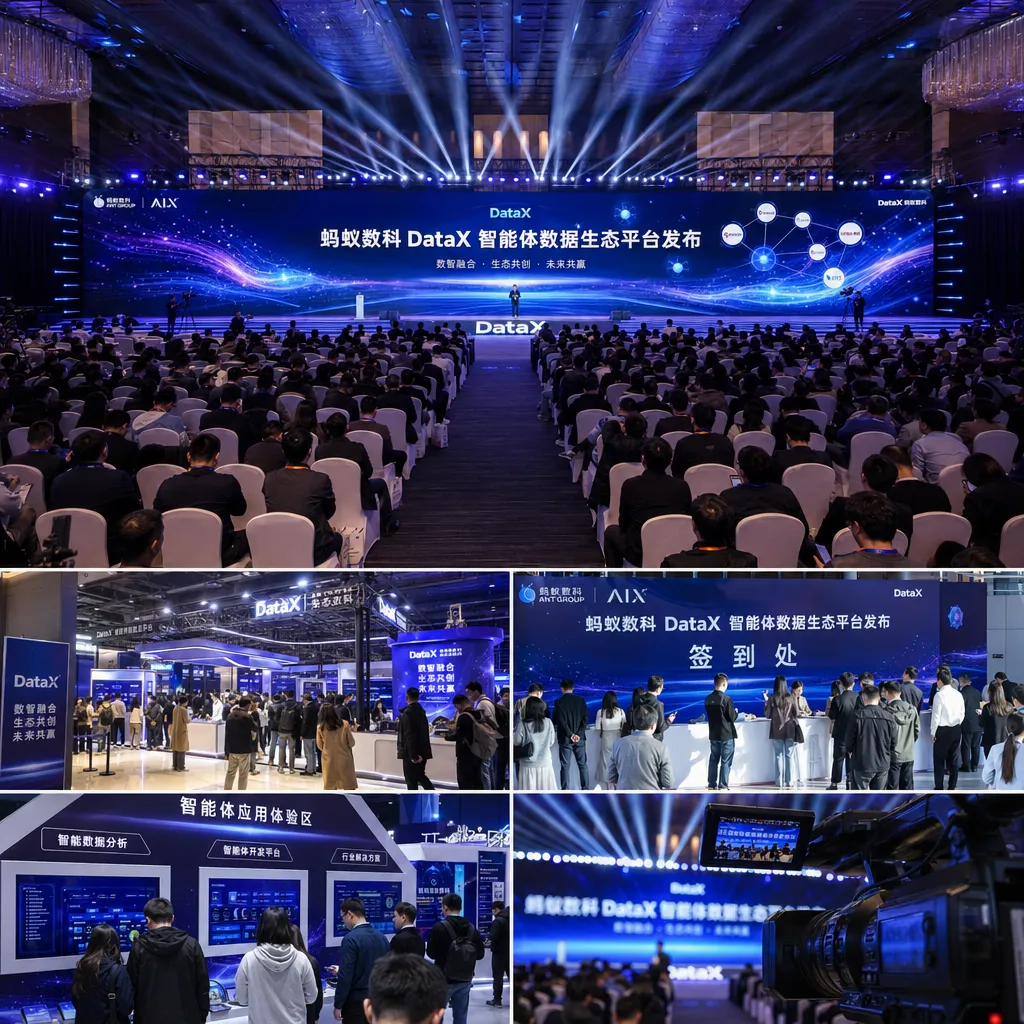
I. Background: Data Elements Move from "Circulable" to "Trusted Intelligent Circulation"
In recent years, the data elements market has developed rapidly under policy support and technological evolution. Since the release of the “Twenty Data Articles” in 2022 and the establishment of data exchanges across various regions, systems for data ownership, circulation, and compliance governance have gradually improved. However, a core contradiction remains: Although the infrastructure for data circulation is increasingly complete, the “last mile” of transforming data into business value is still a long one.
In practice, enterprises face several challenges when using data:
- High data access costs: Data formats vary widely, and interface standards are inconsistent. Enterprises must invest significant manpower for adaptation and cleaning.
- Long data processing chains: Turning raw data into usable data products requires collection, cleaning, modeling, and validation, often taking months.
- High threshold for data applications: SMEs without professional data teams often find data out of reach despite its potential.
- Data security and compliance pressure: Valuable data tends to be sensitive, and cross-domain use faces strict privacy protection requirements.
As large models mature rapidly since 2025, simple data circulation alone can no longer unlock data’s full value. Only through deep integration with AI’s analytical, reasoning, and decision-making capabilities can data truly be transformed into tangible applications. With this backdrop, Ant Digital Technologies officially launched the DataX Intelligent Data Ecosystem Platform at the 9th Digital China Summit.
II. Deep Dive into DataX Platform: Three-Layer Architecture Driving Data Intelligence
2.1 Platform Positioning and Core Philosophy
DataX is not merely a data management tool—it is an Intelligent Data Ecosystem Platform designed for the entire lifecycle of data elements. Ant Digital Technologies defined DataX’s core positioning as building a “Industry Digital Employee + Data Application Factory + Data Capability Marketplace” three-layer architecture, connecting the full chain from “idle assets” to “intelligent applications” through technology.
The three-layer roles are as follows:
| Layer | Name | Core Functions | Target Users | |------|------|----------------|---------------| | Top | Industry Digital Employee | Encapsulates industry practices into directly callable intelligent agents supporting natural language interaction | Business personnel, decision-makers | | Middle | Data Application Factory | Provides full-process automation for data processing, modeling, and validation | Data engineers, developers | | Bottom | Data Capability Marketplace | Aggregates standard components such as privacy computing and data operations, supporting on-demand invocation | Platform ecosystem partners |
The philosophy behind this design: Enable every user to efficiently use data within their own capabilities. Business personnel can interact with the “digital employee” via natural language to gain insights without technical knowledge; data engineers can perform detailed operations at the factory layer; ecosystem partners can publish their capabilities to the marketplace, forming a virtuous data cycle.
2.2 Key Technology I: Model Context Protocol (MCP) Integration
One of the most technically significant highlights is DataX’s full integration of the Model Context Protocol (MCP) at the technical infrastructure level.
MCP is an emerging open standard in AI that defines a unified interface specification for interaction between AI models and external data sources or tools. In simple terms, MCP is like USB for computers—it provides a standardized “port” that allows AI models to call and understand data and tools in a consistent way.
In the DataX platform, MCP integration delivers key benefits:
- Standardization of data services: Traditional data services—delivered via APIs or file transfers—are complex and costly to maintain. DataX converts these heterogeneous data services into MCP-compliant interfaces, enabling AI models to read and interpret contextual data directly.
- Accelerated AI connectivity: Developers no longer need custom connectors for each data source—MCP protocol enables rapid data access and invocation, shrinking integration time from “weeks” to “hours.”
- Cross-platform interoperability: As an open standard, MCP allows DataX’s data capabilities to be seamlessly invoked by any AI app supporting MCP, breaking down data silos.
This choice reflects Ant Digital’s view of AI’s future: As intelligent agents (Agents) become the mainstream paradigm of AI applications, data services must shift from passive invocation to active AI adaptation. Integrating MCP is a crucial step in that shift.
2.3 Key Technology II: DTClaw Professional Intelligent Agent
Beyond MCP, DataX’s second key capability comes from its built-in professional intelligent agent—DTClaw (DataClaw).
The design philosophy of DTClaw: Encapsulate complex data processing logic and industry best practices into directly callable Skills and Agents, enabling “out-of-the-box” data usage.
Traditionally, a complete data analysis task involves:
- Defining data requirements and business scenarios
- Finding and accessing relevant data sources
- Cleaning and preprocessing data
- Selecting suitable analytical models or algorithms
- Running analysis and validating results
- Presenting results in business-friendly formats
This process is time-consuming and error-prone, requiring collaboration between engineers, analysts, and business experts. DTClaw aims to automate all standardizable steps.
Specifically, DTClaw offers:
- Skills Library: DataX aggregates Skills covering privacy computing, data processing, data operations, and data applications—each a modular unit callable by agents.
- Intelligent orchestration: By describing needs in natural language, DTClaw automatically selects appropriate components from the Skills Library and assembles complete workflows.
- Industry practice encapsulation: DTClaw integrates standardized Agents based on financial, government, transportation, and energy industry experiences—companies can rapidly apply expertise without starting from scratch.
2.4 Knowledge Graph and Natural Language Interaction
DataX’s third major capability is its data-based knowledge graph repository.
This repository isn’t just a directory or documentation index—it structures data assets, relationships, domain knowledge, and operational experience as a knowledge graph. Based on this, users can perform two types of natural language operations:
- Intelligent data application orchestration: Describe needs in plain language (e.g., “Analyze user retention trends over the past three months considering regional distribution”), and DataX automatically matches data sources, selects analytical methods, and builds a complete workflow.
- Efficient data knowledge retrieval: Query asset details via natural language (e.g., “Which datasets include user consumption behavior?” “What’s the update frequency and coverage of this dataset?”), and DataX retrieves precise answers from the graph.
This capability significantly accelerates intelligent agent development in data-driven business scenarios—reducing labeling and configuration workload and shortening the delivery cycle.
III. Industry Ecosystem Perspective: Strategic Significance of DataX
3.1 The Key Piece in the "Data+AI" Strategy
This summit marked Ant Group’s first full presentation of its “Data+AI” stack strategy, with DataX as the key component.
Within Ant’s broader business map, DataX connects synergistically with:
- OceanBase Database: As the underlying data storage and management infrastructure, OceanBase provides reliable, high-performance support. It serves over 4,000 clients across government, finance, transport, and energy, processing billions of transactions daily.
- Ant Cryptocomputing (Privacy Computing): Privacy computing Skills in DataX are built atop Ant’s “Trusted Intelligent Fabric” architecture, enabling encrypted fusion and decision-making. Cryptographic computation overhead is now only 1.21× that of plaintext operations.
- Ant Digital Agentar Intelligent Agent Development Platform: Agentar’s full-stack agent development complements DataX’s data ecosystem, together forming the full link from data to intelligent agent.
3.2 Impact on the Data Elements Market
DataX’s launch provides a model for the data elements market. Its value lies in offering a standardized pathway from data resources to data products to intelligent applications, supporting ongoing reforms in market-oriented data allocation.
Notably, DataX implements the "DataClaw+X" model for rapid packaging and open integration of data intelligence applications, connecting high-quality government and industrial data nationwide. Thus, the platform is not limited to individual enterprises—it aims to build a cross-agency, cross-industry intelligent data ecosystem.
In the public sector, pilots already show promise. Cases showcased during the summit demonstrate intelligent government capabilities such as “Unified Network Governance,” “Instant Approval,” and “Policy Targeting” enabled by DataX-style intelligence.
3.3 Industry Opportunities in the MCP Protocol Ecosystem
Looking broadly, Ant Digital’s full adoption of MCP in DataX injects new momentum into the domestic MCP ecosystem.
Since MCP’s introduction, many global AI toolchains and data platforms have embraced the standard. As a leader in data technology, Ant Digital’s adoption is highly influential—more data service providers and AI app developers are expected to join the MCP ecosystem, accelerating standardization of AI-data interoperability in China.
IV. Technology Trends and Industry Outlook
4.1 Evolution of Data Platforms in the Intelligent Agent Era
DataX represents the evolution from traditional data warehouse/lake paradigms to agent-native data platforms.
In the old paradigm, data platforms focused on storage, compute, and query—users manually wrote SQL or ETL workflows. The agent-native paradigm demands that platforms:
- Be discoverable and callable by AI agents — addressed by MCP
- Encapsulate data processing capabilities as composable atomic units — embodied by the Skills Library
- Support natural language–based orchestration and retrieval — powered by the Knowledge Graph
- Enable secure cross-domain data fusion via privacy computing — ensuring compliance
DataX provides solutions across all four dimensions, representing cutting-edge data platform design.
4.2 Three Emerging Data+AI Trends
Based on summit insights and industry developments, three clear trends emerge:
Trend 1: “Agentization” of Data Services
Where data services were once delivered via APIs or reports, they will increasingly take form as intelligent agents. Users will access insights through natural conversation—illustrated by DataX’s “Industry Digital Employee.”
Trend 2: Automation and Autonomy in Data Processing
Data processing cycles dropping from months to hours—as seen in DataX and Qiantang Credit’s six-hour auto-modeling demo—show accelerating automation. AI-driven autonomous data processing will become routine, with human experts supervising.
Trend 3: Privacy Computing Becomes the Standard for Data Fusion
With stricter data protection laws and rising awareness, privacy computing shifts from optional to standard. Ant Cryptocomputing’s efficiency milestone (1.21× plaintext computation) suggests readiness for large-scale commercialization.
4.3 Recommendations for Enterprises
For enterprises pursuing digital transformation and data strategies, the DataX launch and related Data+AI trends warrant attention:
- Follow the MCP ecosystem: Assess feasibility and value of standardizing corporate data services under MCP.
- Consider agent-based data platforms: For SMEs with limited data teams but strong data demands, platforms like DataX may offer a shortcut to data intelligence.
- Strengthen privacy computing capabilities: Early investment in this area will offer advantages in future data collaboration.
- Foster AI-native data talent: Traditional engineers and analysts should learn to use agent-based tools for data handling and analysis.
V. Conclusion
At the 9th Digital China Summit, Ant Digital Technologies’ launch of the DataX Intelligent Data Ecosystem Platform marked a major milestone in its “Data+AI” strategy. Through MCP protocol integration, DTClaw professional intelligent agent, and the Knowledge Graph architecture, DataX aims to solve the challenge of transforming data from simply “circulable” to “intelligently applicable.”
From an industry perspective, the three-layer structure—“Industry Digital Employee + Data Application Factory + Data Capability Marketplace”—and adoption of open MCP standards offer a compelling roadmap for data-element market development. As intelligent agents become the mainstream AI paradigm, enabling data services to actively adapt to AI and making data truly ‘out-of-the-box’ will define the next competitive frontier in data platforms.
We will continue tracking the real-world implementation of DataX and the domestic growth of the MCP ecosystem, delivering in-depth follow-up analysis and technical insights to our readers.
References
- Ant Digital Technologies debuts at the 2026 Digital China Summit, launching the DataX Intelligent Data Ecosystem Platform - IT Home — IT Home’s detailed report covering technical highlights and features of the DataX platform.


