
Xiaomi distributes 100 trillion tokens, developers can’t stop collecting them
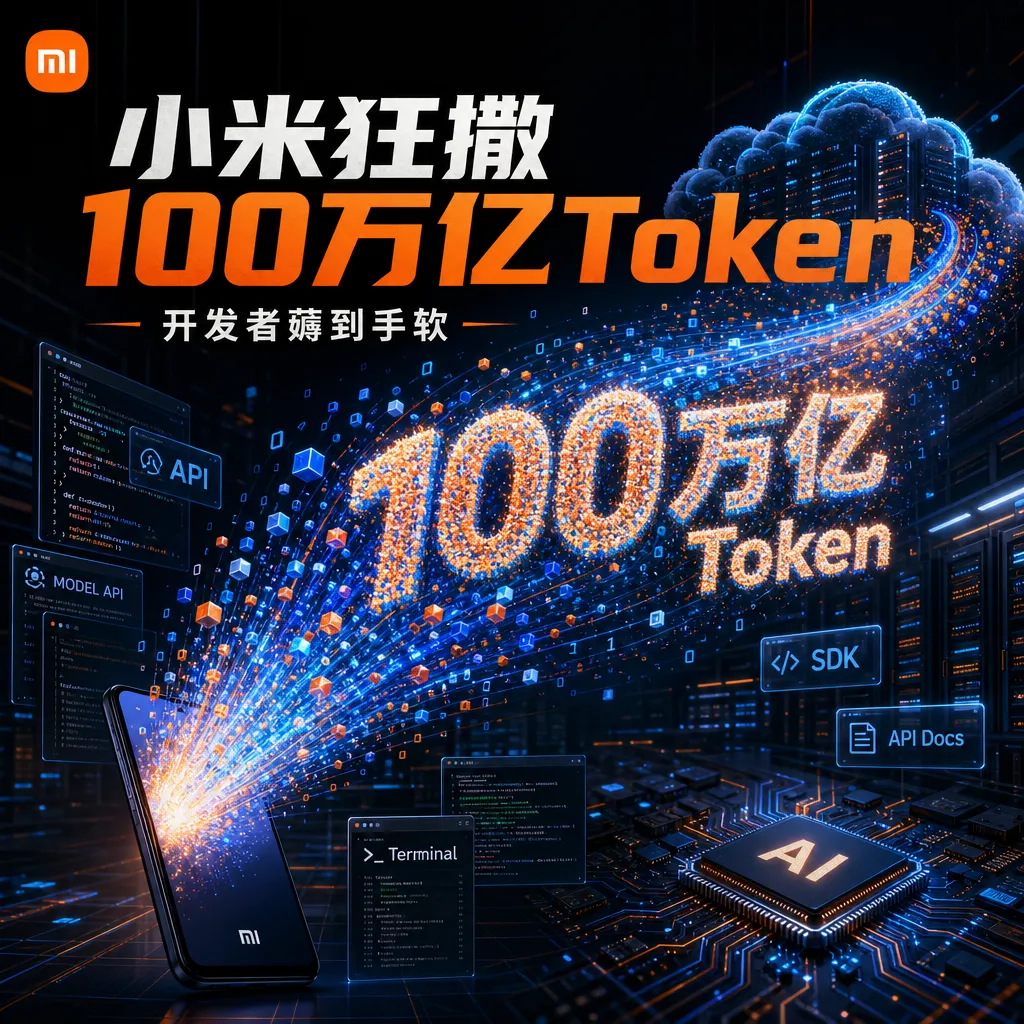
Xiaomi has open-sourced the MiMo-V2.5 model and simultaneously launched the Orbit quadrillion-token incentive program. Over a 30-day period, global developers can receive free computing power, with the Max package offering up to 1.6 billion Credits in benefits. The developer community has already sparked a surge of applications.
Xiaomi Massively Distributes 100 Trillion Tokens, Developers Reap Big Rewards
Yesterday (April 28), Xiaomi did something that made the entire developer community boil over with excitement: while open-sourcing the full range of MiMo-V2.5 models, it simultaneously launched the MiMo Orbit "Trillion-Token Creator Incentive Program", announcing that it would distribute a total of 100 trillion tokens in computing power rights to developers worldwide for free within 30 days.
No teaser, no countdown poster—applications opened directly. As soon as the news broke, developer communities like linux.do and V2EX exploded with activity. Users quickly posted screenshots of approval, with some receiving acceptance emails within just a minute.
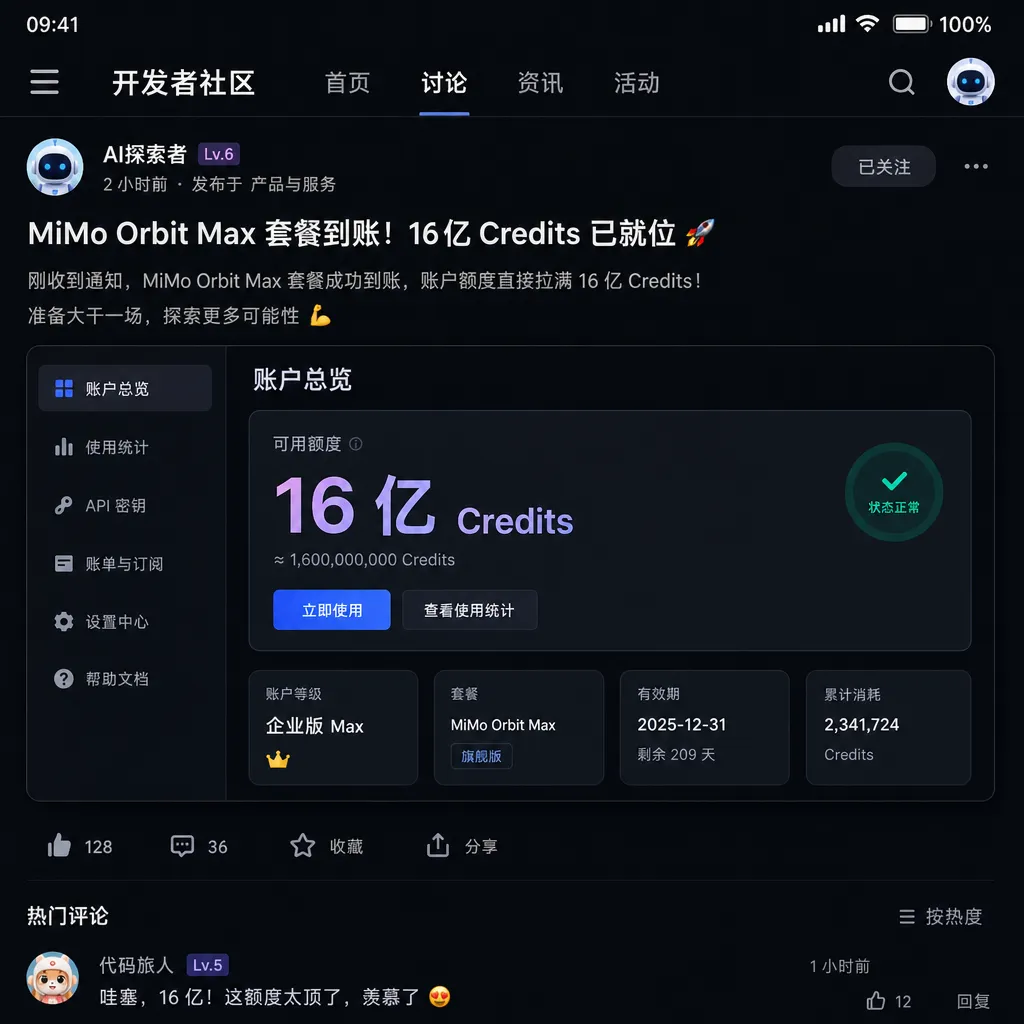
This is not a typical "a few dollars new-user bonus" campaign. 1.6 billion credits, a Max monthly plan worth 659 RMB, direct integration with Claude Code and Cursor—Xiaomi’s sincerity this time is worth a closer look.
What Exactly Is Being Given Away
Let’s do the math.
The Orbit Program uses an application review system. Based on the project information and account status you submit, Xiaomi assigns different levels of rewards. According to community feedback, there are roughly three tiers:
| Tier | Credits Quota | Approx. Value | Review Requirement | |------|---------------|---------------|--------------------| | Basic | ~200 million | — | Email registration + simple form | | Pro | ~700 million | — | Some project description | | Max | 1.6 billion (1.6 G) | 659 RMB | Detailed project + supporting materials |
The Max plan doesn’t just offer a higher quota. It also includes:
- 0.8x billing coefficient during off-peak hours (roughly 20% discount)
- TTS voice model free for a limited time
- Access to the entire MiMo-V2.5 model family, including flagship reasoning, multimodal, and voice models
In other words, if you get the Max tier, for the next month you can use 1.6 billion credits to run inference, agents, and multimodal tasks—completely free.
Why Developers Are So Excited
What does 1.6 billion credits really mean?
A rough estimate: take the MiMo-V2.5 flagship reasoning model, which may consume several thousand to tens of thousands of credits per conversation (depending on context length and reasoning depth). 1.6 billion credits are enough for a heavy developer to run daily coding assistance, agent debugging, and stress tests for an entire month—with some to spare.
Compare that to the market:
- OpenAI’s free API quota has long shrunk to near insignificance
- Anthropic’s Claude API has no large-scale free plan
- Google Gemini’s free tier has strict rate limits
- Domestic platforms like DeepSeek and Kimi occasionally offer bonuses, but nowhere near this scale
Xiaomi has effectively said: as long as you have a real project, you get enough for a month’s full use. That’s virtually unprecedented among domestic AI developer platforms.
Even more critical is how easy it is to use. MiMo’s Token Plan is a subscription package—you can directly configure MiMo’s API endpoint in tools like Claude Code, Cursor, Cline, and OpenClaw, using MiMo-V2.5 as the underlying model. This means you don’t have to change your development workflow—just swap the API address and key.
For developers coding daily in Cursor or running agents in Cline, this is essentially a free “unlimited model call” month.
Application Process and Approval Tips
Application link: https://100t.xiaomimimo.com/
Event period: April 28, 2026, 00:00 — May 28, 00:00 (29 days countdown)
The process itself is straightforward: register a MiMo account → fill out the form → wait for review → get results via email. But there are plenty of tricks inside.
Review Mechanism: Manual + Account Weight
Based on community reports, the review is not fully automated. Xiaomi assesses multiple factors:
- Which AI tools you use — selecting Cursor, Claude Code, Cline, OpenClaw, etc. earns points
- Which underlying models you use — indicates real API usage
- Level of detail in your project description — the more detailed, the higher the tier
- Strength of supporting materials — GitHub repos, run logs, or receipts from other platforms
- Account weight — reportedly, Xiaomi account trust level matters; users invited via official SMS have far higher approval rates
Real-World Tips for Getting Max Tier
From developers who’ve been approved for Max, application items #4 (project description) and #5 (proof) are key. Verified strategies include:
Emphasize long-chain reasoning and agent-collaboration scenarios. MiMo-V2.5 focuses on reasoning ability, so Xiaomi wants to see real demand for it. For example:
- “I’m building a multi-agent collaborative code review system; each task chain consumes 50K+ tokens and runs 200+ times a day.”
- “My project requires multi-step mathematical reasoning and code generation, with session contexts exceeding 32K tokens each.”
Quantify your token consumption potential. Don’t just say “I need lots of tokens.” Give numbers—daily call volume, tokens per request, projected monthly total. Reviewers can then easily see why you deserve Max.
Strong supporting proof. This can’t be overstated:
- GitHub repository — even a demo repo beats empty talk
- Run log screenshots — capture the reasoning (“Thought”) and execution trace from Aider, Cline, or another agent tool
- Billing screenshots — Kimi, MiniMax, OpenAI usage proofs help show you’re a real, active developer
One developer shared: he applied just out of curiosity and casually attached Kimi and MiniMax subscription screenshots—and got Max immediately. “I was just hoping to get any approval, but they gave me Max straight away.”
Some Cautions
- Multiple email types supported—QQ, 163, Gmail all work
- Same phone number can only register limited accounts per day; more than two can trigger anomalies
- Review time varies—from minutes to hours
- Credits expire after one month; unused credits are forfeited
How Good Is MiMo-V2.5 Itself
Free tokens mean nothing if the model is bad. So, what’s MiMo-V2.5 really like?
Xiaomi open-sourced MiMo-V2.5 under the MIT license, allowing commercial inference and retraining—no extra authorization needed. That’s relatively bold in China, where many “open” models restrict commercial use.
The models span three main directions:
- Flagship reasoning models — long-chain reasoning, code generation, math solving
- Multimodal models — image-text understanding
- Voice models — TTS (text-to-speech)
Early community feedback suggests MiMo-V2.5 performs “solidly” in code generation and reasoning tasks. Developers testing it in real coding scenarios particularly praised its multi-step agent reasoning—placing it among the top domestic open-source models.
Benchmark details aside, one takeaway is clear: Xiaomi must be confident in its model quality; otherwise launching such a huge incentive plan would quickly backfire if the models disappointed.
What Xiaomi’s Bigger Strategy Is
Step back, and the Orbit plan’s logic is simple: trade computing power for ecosystem growth.
Competition among China’s large-model players has shifted from “whose model is stronger” to “whose ecosystem is deeper.” A good model isn’t enough; you need developers actively using it, building apps around it, becoming dependent on it.
Xiaomi’s four-step play:
- Open-sourcing to lower knowledge barriers — MIT license, free to use and modify
- Trillion-token giveaway to remove trial costs — use it free for a month
- Toolchain compatibility to reduce migration costs — plug directly into Claude Code, Cursor, etc.
- Agent ecosystem partnerships to bind frameworks — already collaborating with OpenCode, Hermes Agent, KiloCode
After these steps, Xiaomi hopes that by the time users’ free month ends, they’ll already be accustomed to working with MiMo. The switching cost is established, leading naturally to paid conversion.
The playbook isn’t new—AWS grew the same way with its free tier—but Xiaomi is the first in China’s AI API market to do it at a 100 trillion-token scale.
Comparison with Other Incentive Plans
| Platform | Incentive Type | Scale | Threshold | Usage Limits | |-----------|----------------|--------|------------|---------------| | Xiaomi MiMo Orbit | Subscription package / bonus | 100 trillion tokens (total pool) | Application review | 30 days validity | | DeepSeek | Signup bonus | Small | Register only | Usage credit | | Alibaba Tongyi | Free API quota | Rate-limited | Register only | Partial model access | | Baidu Wenxin | Developer grant | Event-based | Application | Depends on campaign |
Xiaomi’s advantages: higher per-user cap (1.6 billion credits) and flexible usage (works with Cursor, etc.). Downsides: review means not everyone gets Max, and 30-day expiry means you must use it promptly.
For heavy AI developers, the plan’s cost-effectiveness is excellent. For casual users, the Basic tier’s 200 million credits are still enough to explore.
Risks to Note
Now the flip side.
Credits expire after one month. Unused amounts vanish. Without a clear usage plan, even Max just looks nice on paper.
Ecosystem maturity still developing. MiMo-V2.5 just launched, so community tooling, fine-tuning options, and best practices are early-stage. Compared with mature models like Llama or Qwen, MiMo’s ecosystem still needs time.
Platform stability untested at scale. With developer surges, API latency, concurrency, and uptime remain uncertain. Things are fine early on but could clog up later.
Don’t abuse multi-account tricks. Some are already discussing loopholes, but Xiaomi clearly has anti-fraud checks (multiple accounts per phone trigger flags). Apply honestly with real projects—it’s not worth risking your account.
Final Thoughts
The scale of Xiaomi’s Orbit plan is truly rare in China’s history of open AI platforms: a 100 trillion-token pool, up to 1.6 billion credits per user, MIT license, direct compatibility with mainstream dev tools—each attractive alone, together nearly irresistible.
If you’re a developer who codes with AI every day, spending 10 minutes on an application for a month of free compute is a no-brainer.
Countdown: 29 days left. First come, first served.
Application link: https://100t.xiaomimimo.com/
As a side note, the MiMo-V2.5 series is also gradually available on API aggregators like OpenAI Hub. If you prefer a unified API interface across vendors, keep an eye there too.
References
- Xiaomi MiMo Trillion-Token Plan Approval: How I Got 1.6 B Credits for Free — linux.do developer community, detailed process and tips
- MiMo Credits Arrived—Turned Me from Skeptic to Fan — linux.do community, Max tier feedback
- Xiaomi MiMo Quotas May Depend on Account Type — linux.do community, comparative analysis
- Xiaomi MiMo Trillion-Token Plan, 16 B Tokens, Must Try — linux.do community discussion
- Thanks Xiaomi—My Application Approved! — linux.do community confirmation posts


