
Alibaba Cloud Team Edition Token Plan Launch: Multi‑Model Subscriptions Enter the Era of Co‑Management

Alibaba Cloud today launched the Team Edition Token Plan, which uses Credits for unified measurement and integration of more than ten mainstream models. It offers multi-seat management and enterprise-grade security features, directly addressing the challenges of scaling enterprise AI subscription services.
Alibaba Cloud Team Edition Token Plan Launched: Multi-Model Subscription Enters the Co-Management Era
Alibaba Cloud officially launched the Team Edition Token Plan today (May 11). This follows the Coding Plan for individual developers introduced in February, marking another milestone for the Alibaba Cloud Bailian platform in enterprise-level AI subscription services.
What’s the core change this time? In short: turning multi-model usage from “pay per model” to “unified subscription,” combined with team-level seat management and cost control. It comes with over a dozen multimodal models such as Qwen3.6, Kimi-K2.6, GLM-5.1, Wan2.7, and DeepSeek. Users subscribe monthly to different plan tiers to obtain a certain amount of Credits, which are automatically deducted when any model is called.
Why Build a Team Edition?
Pay-per-use works fine for individual developers using the Coding Plan, but the enterprise context is completely different.
Previously, when an enterprise wanted to provide AI capabilities to its team, they had two options: give each member their own account and recharge individually, or share one account with its API key circulating everywhere. The former meant high administrative costs and lack of transparency; the latter carried security risks and made accountability impossible. Even worse, different models belonged to different vendors—each requiring independent integration, billing, and quota management. IT departments were buried in tedious administrative work.
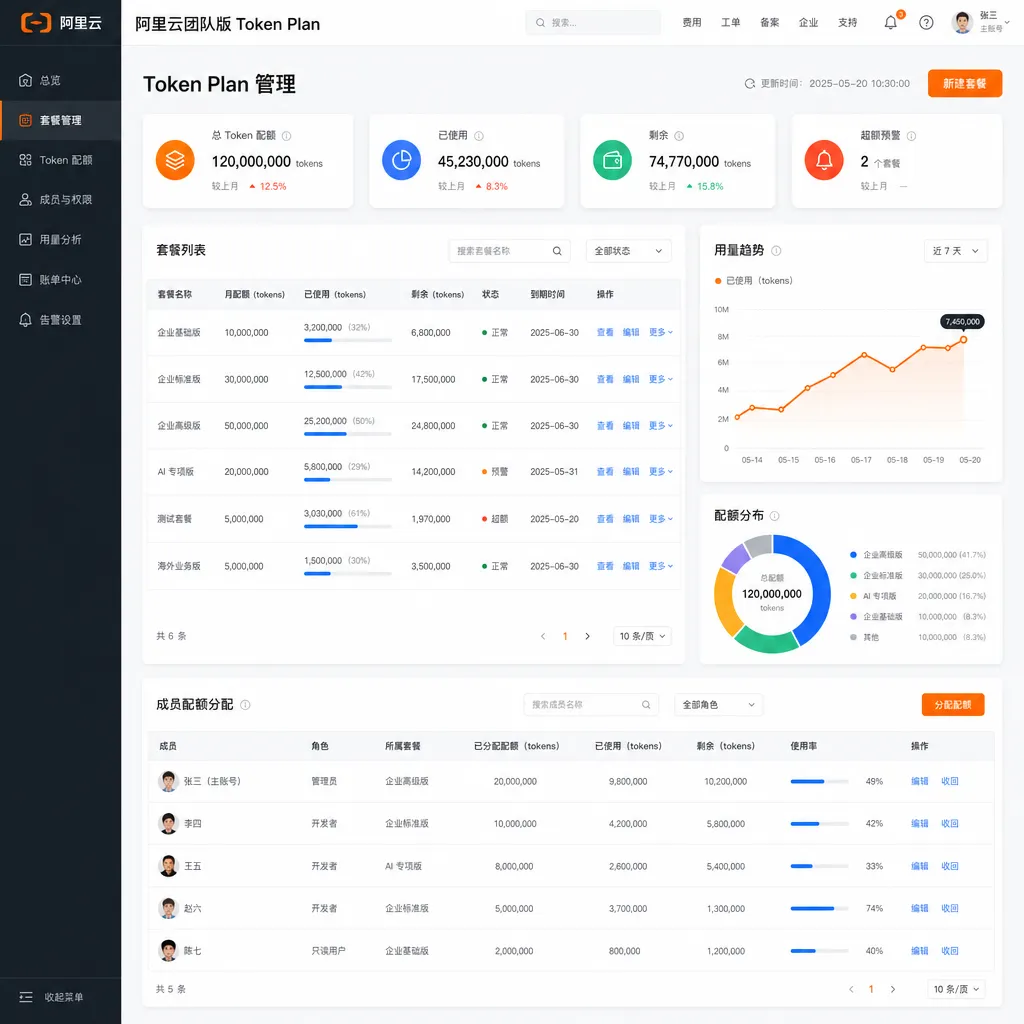
The Team Edition Token Plan aims to solve all of these problems at once: the admin manages all seats in a centralized console, each member has their own account and usage stats, and all model usage draws from the same Credits pool. The result: manageable costs, clear permissions, and strict data isolation.
This design mirrors services like GitHub Copilot Business and Cursor Team, but Alibaba Cloud’s edge lies in offering more model options, greater pricing flexibility, and seamless integration with domestic models like Qwen, GLM, and Kimi—no need to connect to overseas APIs.
Unified Credits Measurement: The Core of Multi-Model Subscription
The core mechanism of the Team Edition Token Plan is unified Credits measurement.
Simply put, the costs of different models and task types (text generation, image generation, multimodal understanding) are all converted into a single virtual unit called Credits. After subscribing to a plan, users receive a fixed quota of Credits, which are deducted based on actual consumption when calling any model—until they run out.
This design solves two key issues:
- Cost transparency: Enterprises no longer need to monitor each model’s token price—just check the Credits balance to know how much usage remains.
- Flexible model switching: The same task can be run with Qwen first and then retried with Kimi or GLM if needed—without worrying about one model’s quota running out.
Of course, different models consume Credits at different rates. According to Alibaba Cloud’s conversion rules, text-generation models (like Qwen, GLM) are relatively cheap, multimodal models (like Qwen-VL, Kimi-K2.6) consume more, and image-generation models (like Wan2.7) use the most. This pricing logic aligns with real compute costs across vendors.
Three Plan Tiers: Standard, Advanced, Premium
The Team Edition Token Plan offers three subscription tiers:
- Standard: For small teams experimenting with limited seats and Credits—ideal for light use cases like internal documentation or simple code completion.
- Advanced: Designed for mid-sized teams, offering higher Credit quotas and more seats, suitable for regular development or content creation.
- Premium: Enterprise-level configuration with abundant Credits, flexible seat management, and higher priority—geared for large-scale or high-concurrency use.
Alibaba Cloud has not disclosed specific pricing, but based on the Coding Plan (first month from ¥7.9 for new users), the Team Edition will likely follow a “low entry + scalable upgrade” model.
Notably, the Team Edition allows on-demand seat adjustment, meaning enterprises can dynamically scale up or down based on actual usage—no need to pre-purchase excess capacity. This is more flexible than GitHub Copilot Business’s fixed-seats model and more cost-efficient for smaller enterprises.
Enterprise-Level Capabilities: Multi-Tenant Isolation + Data Privacy Protection
Another selling point of the Team Edition Token Plan is enterprise-grade security and performance assurance.
First is multi-tenant isolation. Each team’s data, usage, and quota are fully separated, ensuring no interference even during peak hours when multiple teams are using models simultaneously. Alibaba Cloud emphasizes "stable performance under high load," suggesting optimized resource scheduling to prevent one team from monopolizing compute resources.
Next is data privacy protection. Alibaba Cloud promises that user data (inputs/outputs) will not be used for model training or shared across tenants. This is crucial for enterprise clients handling sensitive data such as customer information, financial reports, or code repositories.
However, Alibaba Cloud has not yet clarified whether it supports private deployment or VPC internal access. For sectors with strict data-security requirements (like finance or healthcare), custom solutions might still be needed.
Compatible with Mainstream Agent Tools: One-Click Integration
The Team Edition Token Plan is already compatible with popular Agent tools such as Qoder, JVS Crew, Qwen Code, OpenClaw, Hermes Agent, Claude Code, and Cursor.
This means developers can simply input Alibaba Cloud’s API key within those tools to access all models under the Token Plan—no code changes required. This compatibility is key for developer experience: if every model switch required new code and API re-adaptation, few would bother using such a service.
The supported tool list clearly positions Alibaba Cloud against Cursor and Claude Code, while also covering domestic tools like Qwen Code and Qoder—a pragmatic approach catering to both developers using overseas tools and enterprises concerned with compliance and data residency.
Use Cases: Code Generation, Content Creation, Multimodal Tasks
Alibaba Cloud presents several typical use cases:
- Code generation: Use Qwen3.6 or DeepSeek in tools like Cursor or Qwen Code for code completion, bug fixing, and unit test generation.
- E-commerce image generation: Use Wan2.7 to bulk-generate main and scene product images, boosting content efficiency.
- Podcast content creation: Use Kimi-K2.6 or GLM-5.1 to generate podcast scripts and outlines, then combine with speech-synthesis tools to produce finished audio.
These cover development, operations, and creative roles—matching common enterprise AI needs. That said, these scenarios aren’t new—many tools already do the same. The Team Edition Token Plan’s true value lies not in what it can do, but how it’s managed: unified subscription, unified billing, unified management—reducing integration and maintenance overhead.
Comparing with Coding Plan: The Personal vs. Team Divide
The Coding Plan launched in February targeted individual developers with pay-per-use pricing, emphasizing “low entry (¥7.9 first month)” and “multi-model switching.” The Team Edition Token Plan is aimed at enterprises, and the core differences are:
| Dimension | Coding Plan | Token Plan (Team Edition) | |------------|--------------|----------------------------| | Target users | Individual developers | Enterprise teams | | Billing | Pay-per-use | Monthly subscription (Credits pool) | | Seat management | Single user | Multi-seat assignment | | Cost control | Managed individually | Managed centrally by admin | | Data isolation | Not required | Multi-tenant isolation | | Use case | Personal projects, learning | Team collaboration, enterprise deployment |
In short, Coding Plan is for “personal use,” while the Team Edition Token Plan is “for teams.” For freelancers or small teams (fewer than three people), Coding Plan is better value; for IT managers equipping dozens or hundreds with AI capabilities, Team Edition is the right tool.
Market Competition: Rivals Cursor Team & GitHub Copilot Business
The Team Edition Token Plan competes directly with Cursor Team and GitHub Copilot Business.
- Cursor Team: Seat-based subscription at $20 per user/month, using GPT‑4 and Claude, focused on AI coding experience. Strengths: mature product, excellent developer reputation. Weaknesses: high price, limited models.
- GitHub Copilot Business: $19 per user/month, deeply integrated with VS Code and GitHub. Strengths: seamless toolchain, robust enterprise support. Weaknesses: limited to OpenAI models, lacking flexibility.
Alibaba Cloud’s advantages:
- Wider model selection: Qwen, Kimi, GLM, DeepSeek, Wan, and more—covering text, code, image, and multimodal tasks.
- Flexible pricing: Three tiers plus dynamic seat scaling—ideal for small and midsize enterprises to start small and expand.
- Domestic connectivity: No network latency or compliance issues—better suited for Chinese businesses.
Weaknesses:
- Product maturity: Cursor and Copilot are more polished after years of refinement. Alibaba’s tool ecosystem (Qwen Code, Qoder) is still catching up.
- Ecosystem integration: GitHub and VS Code’s ecosystems are difficult to rival; Alibaba Cloud needs time to build developer trust and adoption.
Developer Feedback
From community discussions, developers’ attitudes toward the Team Edition Token Plan are pragmatic:
- Pros: Unified multi-model subscription is convenient, especially for teams switching models frequently. Credits-based billing is simpler than managing individual token quotas.
- Concerns: Unclear pricing, Credits-to-usage ratios, and performance under load—all need real-world testing. Also, can Alibaba Cloud’s API stability and latency match OpenAI or Anthropic?
- Complaints: Why force subscription-based API access instead of open APIs? For enterprises with established API management systems, this may add migration friction.
Overall, the Team Edition Token Plan is a “useful but not revolutionary” product. It addresses enterprise AI subscription operations rather than pioneering new tech or experience. For enterprises currently managing multiple vendor quotas manually, this service can indeed reduce workload—but for large companies with mature AI infrastructure, its appeal may be limited.
Final Thoughts
Alibaba Cloud’s Team Edition Token Plan essentially promotes the “SaaS-ification of AI capabilities”—bundling multi-model access, cost control, and team management into one subscription to lower enterprise adoption barriers.
The success of this approach depends on three key factors:
- Competitive pricing: If it’s half the cost of Cursor Team or Copilot Business, SMEs will try; if only 10–20% cheaper, interest may wane.
- Model performance stability: Can Qwen, Kimi, and GLM truly match GPT‑4 and Claude in quality? If not, developers may still prefer overseas models.
- Toolchain integration quality: Supporting Cursor and Qwen Code is just step one—achieving “seamless switching” and “zero-configuration access” will determine long-term adoption.
From today’s launch, Alibaba Cloud seems to have a solid start: clear product positioning, rational design, well-defined audience. Now, it’s all about execution.
For Chinese developers and enterprises, having one more choice is always good. Especially with overseas APIs becoming less reliable and compliance demands tightening, a “domestic, multi-model integrated” alternative reduces many worries.
Whether this service becomes mainstream depends on Alibaba Cloud’s ability to drive prices down and user experience up. After all, developers vote with their feet—the only true test of a product is in use.
References
- Alibaba Cloud launches Team Edition Token Plan with multi-seat management – IT Home — official release
- 2026 Edition|Complete Guide to Alibaba Cloud Bailian Token Plan – Zhihu — detailed feature analysis
- 2026 Deep Dive into Alibaba Cloud Bailian Token Plan – Zhihu — Credits measurement explanation
- Full Team Edition Token Plan Manual – Zhihu — pricing and API integration guide


