
MiniMax launches the "10x Team" program: Unlimited tokens for industry experts

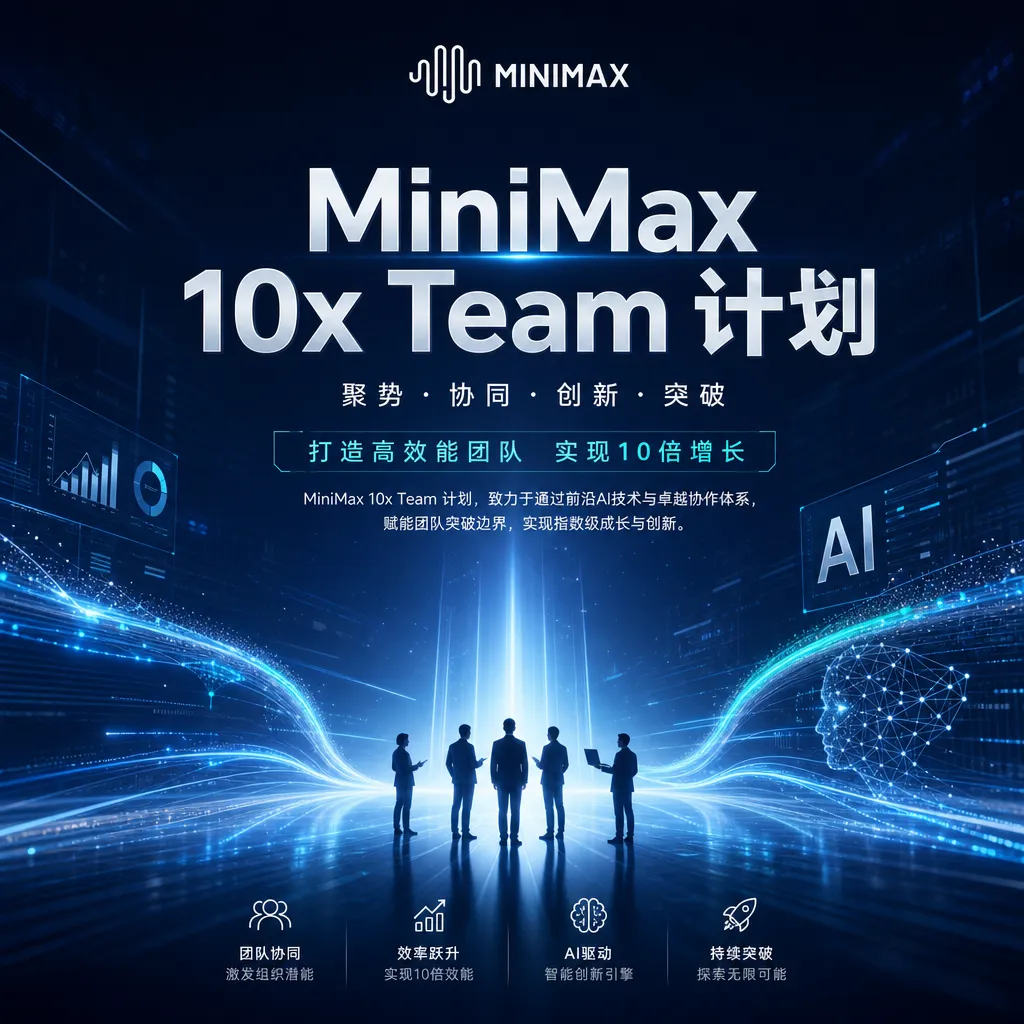
MiniMax today launched the "10x Team" collaboration program, offering industry experts unlimited Tokens and full multimodal capabilities. Participants can engage deeply in model iteration through full-time or fellowship modes, and the evaluation system will be open-sourced.
MiniMax Launches “10x Team” Program: Unlimited Tokens for Industry Experts
MiniMax announced today (May 11) the launch of its “10x Team” collaboration program, with its core selling point being unlimited tokens for industry experts. This is not a typical API opening or developer program; rather, it packages model capabilities, R&D environments, and evaluation systems together, bringing top industry talent directly into the process of model iteration.
Why Now
Over the past year, the divide between “usable” and “good to use” in large models has become increasingly clear. Programming and content creation have already achieved intelligent upgrades, but vertical fields like industrial software, chip design, and finance are still in the exploration stage. MiniMax believes that no matter how many parameters general models stack, it’s more efficient for industry experts to participate directly in training and evaluation.
This logic isn’t new. OpenAI’s GPT-4 medical version enlisted many doctors for annotation, and Anthropic’s Constitutional AI invited experts to define value boundaries. But MiniMax’s approach is more radical—not just data labeling or requirement collection, but deep expert involvement in problem definition, evaluation system design, and workflow setup.
According to official sources, MiniMax has already conducted substantial collaborations in recent months with experts from fields including industrial software, game engines, chip design, finance, and accounting, validating the technical value of this model. The results of these collaborations will be integrated into future model iterations, meaning that the next version you use could incorporate the accumulated expertise of a chip design engineer or a CFO.
Thresholds and Resource Support
The “10x Team” is not an open program for all developers—the entry criteria are clear:
- Industry Experience: Must be a professional in a vertical domain with real business experience
- Cognitive Alignment: Must endorse the logic of AI empowering industry advancement, not just come to experiment
- Independent Capability: Must be able to participate in problem definition, evaluation system setup, and workflow design independently—not merely waiting for assigned tasks
In terms of resources, MiniMax provides top-tier conditions among Chinese large-model companies:
- Full Multimodal Model Capabilities: Not just API calls, but full access to underlying capabilities
- R&D Environment: Includes the complete toolchain for training, fine-tuning, and evaluation
- Unlimited Tokens: The most direct attraction—for professional scenarios requiring large-scale testing and iteration, token costs have always been an invisible barrier
There are two collaboration modes:
- Full-Time Employment: Standard hiring, suitable for experts who want to deeply cultivate their AI careers
- Fellowship Short-Term Collaboration: At least four months, on-site work, with stock incentives. This model borrows from academia’s visiting scholar system, offering industry experts a low-cost opportunity for trial and error
Fellowship offices cover Shanghai, Beijing, Hong Kong, San Francisco, and London—clearly a move to compete in the international talent market. MiniMax is seeking not only domestic experts but also top-tier global talent.
Incentive Mechanism: Not Just Money
Salary and stock incentives are standard, but MiniMax adds two elements usually found only in academia:
- Joint Authorship: Collaboration outcomes can be co-authored—valuable professional assets for experts with academic backgrounds
- Shared Academic Outcomes: Supports institutional joint research; evaluation content will be open sourced
These two points are critical. Many companies invite experts but internalize the outcomes—experts get paid but gain no industry or academic recognition. By open-sourcing evaluation systems, MiniMax turns collaborative results into public goods, allowing expert contributions to be recognized across the industry.
This design resembles Hugging Face’s open-source ecosystem—datasets, models, and benchmarks you contribute circulate in the community with your name attached. For experts seeking both commercial impact and scholarly recognition, it’s a well-balanced approach.
Industry Significance: From “Buying Compute” to “Buying Expertise”
At this stage of competition among large models, the marginal effects of compute, data, and algorithms are diminishing. OpenAI spends billions training GPT-5 yet may only achieve a 10–20% improvement. But inviting industry experts directly into model optimization could double performance in vertical domains.
Essentially, MiniMax’s plan is a reverse form of “knowledge distillation”—not compressing large-model knowledge into smaller models, but injecting expert knowledge into large models. This is more efficient than traditional supervised learning because experts not only label data but define what constitutes “good” and “correct.”
From a business perspective, it's also a defensive strategy. Chinese AI firms are competing on general capabilities, but real commercial value lies in vertical applications. By locking in top experts across industries with the “10x Team,” MiniMax is securing early positions in specialized tracks.
Comparison with other companies:
- Baidu: Focuses on industrial deployment but mainly outputs to-B solutions, with limited expert involvement
- Alibaba: Tongyi Qianwen takes the open-source route, emphasizing community contribution yet lacking deep collaboration mechanisms
- ByteDance: Doubao just announced a paid subscription model, still exploring to-C monetization, with little vertical deployment
MiniMax’s approach of bringing experts directly into joint development is more aggressive—but also riskier. How to ensure expert knowledge effectively converts to model capability? How to balance priority among differing domain needs? These will be challenges ahead.
The Real Cost of Unlimited Tokens
“Unlimited tokens” sounds generous, but the actual cost is manageable.
First, the program targets a select group of experts—not large-scale access. Suppose MiniMax recruits 100 fellowship researchers, each using 10 million tokens per month (a very high usage rate)—that’s a total of 1 billion tokens. At today’s inference costs, such usage is easily sustainable for a well-funded AI company.
Second, experts mainly use tokens for evaluation and optimization, not high-concurrency production environments—meaning consumption is predictable and controllable.
Most importantly, the model improvements experts bring are far more valuable than the token cost. If a chip design expert helps MiniMax raise code generation accuracy in EDA tools from 60% to 85%, the commercial value could be tens of millions—or even billions.
Thus, “unlimited tokens” is more of a marketing phrase—the real value lies in lowering participation barriers. Experts don’t need to worry about budgets or quotas; they can test freely.
The Open-Source Evaluation System Gamble
MiniMax pledges to open-source its evaluation content—an interesting move.
Open-sourcing evaluation systems has two main benefits:
- Establishing Industry Standards: If MiniMax’s benchmarks are widely adopted, it gains discourse power in vertical fields. Like MMLU or HumanEval—whoever defines the evaluation standards shapes the narrative.
- Attracting More Experts: Open-source recognition makes outcomes academically valid, a major incentive for reputation-conscious experts.
But the risks are also clear: Competitors could use your evaluation system to optimize their own models. MiniMax’s possible strategy is “rapid iteration”—open-sourcing the evaluation framework but keeping optimization methods and data proprietary. This way, MiniMax sets the standards while maintaining a technical edge.
It’s similar to OpenAI’s early move with the open-source Gym environment—anyone could use it, but the best-performing models still came from OpenAI.
Impact on Developers
The “10x Team” plan doesn't directly affect ordinary developers—you won’t suddenly get unlimited tokens. But indirect effects could be significant:
- Improved Model Capabilities: If the plan succeeds, MiniMax’s performance in vertical domains will markedly improve in coming months, benefiting developers building industry-specific applications.
- Transparent Evaluation Standards: Open benchmarks help developers more accurately gauge model performance in specific use cases, reducing trial and error costs.
- Ecosystem Reorganization: If MiniMax gains clear advantages in certain vertical fields, developers’ model selection strategies could shift.
For professionals deeply involved in large-model research, this is worth watching—especially those with deep industry experience but lacking an AI transformation path. The Fellowship provides a low-risk way to experiment.
In Conclusion
The core logic behind MiniMax’s plan is that the next breakthrough in large models lies not in compute or parameter scale, but in deep integration of domain expertise. This judgment may be right—but execution will be tough.
Industry experts and AI researchers differ in mindset, rhythm, and evaluation standards. How to enable efficient collaboration, make tacit knowledge explicit, and balance resource investment across fields—these are the challenges MiniMax faces next.
Still, the direction is meaningful. Rather than continuing the arms race in general capability, it’s wiser to lay the groundwork in vertical domains and build a moat with expert knowledge. Whether it succeeds will become clear in a few months when the first batch of Fellowship results is released.
If you’re using MiniMax’s API for vertical applications, keep an eye on upcoming model updates—your next version might just contain the distilled knowledge of a leading industry expert.
References
- MiniMax Launches “10x Team” Collaboration Program, Offering Unlimited Tokens - ITHome
Official announcement with full details and resource descriptions


