
Tencent Hunyuan Hy3 has topped the OpenRouter rankings for three consecutive weeks.
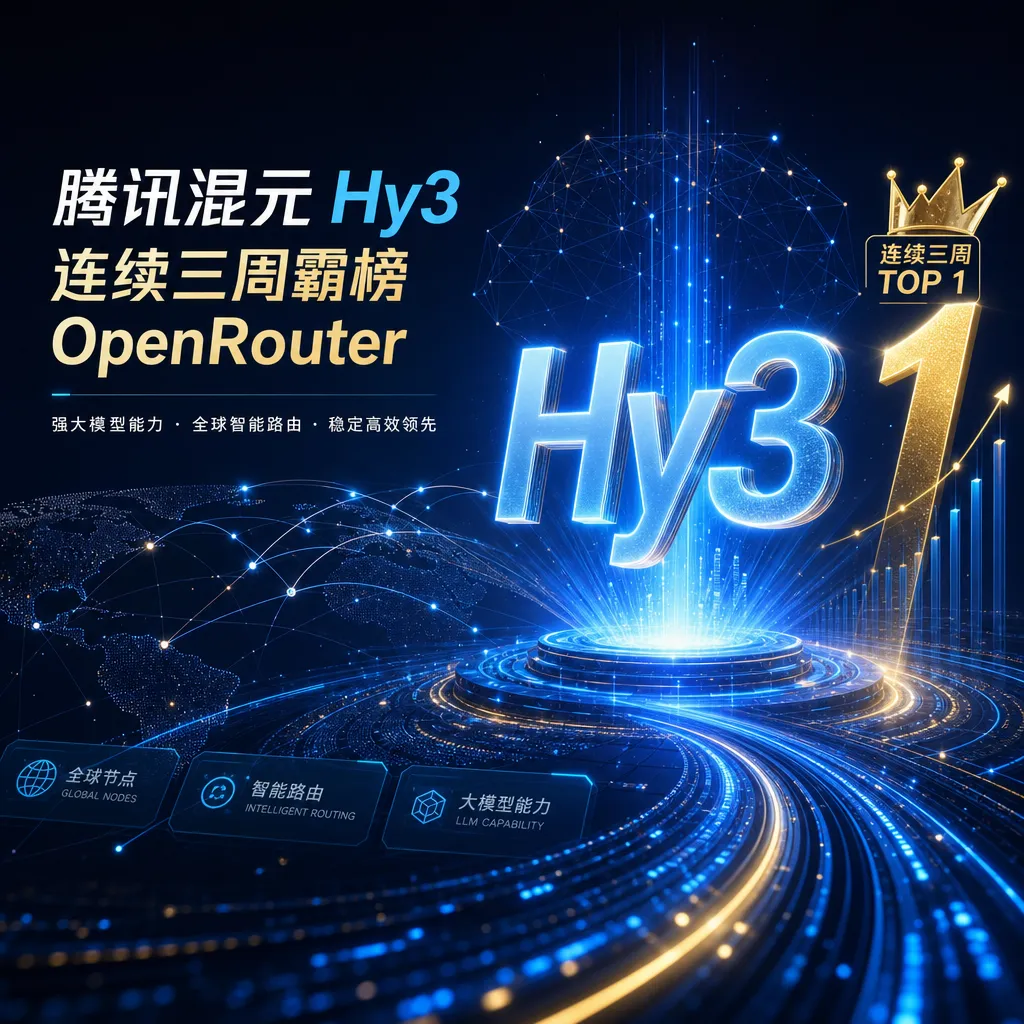
Tencent Hunyuan completed a technical rebuild in less than three months. After the free access period for the new model **Hy3 preview** ended, it still maintained the top position on the OpenRouter leaderboard, ranking first overall for three consecutive weeks from April 27 to May 11, with token usage reaching 10 times that of the previous generation.
Tencent Hunyuan Hy3 Dominates OpenRouter for Three Consecutive Weeks, Delivers High Cost-Performance After Three-Month Rebuild
Tencent Hunyuan Hy3 preview has gained a firm foothold on OpenRouter.
According to Tencent’s Q1 2026 financial report, this model—rebuilt less than three months ago—topped OpenRouter’s overall weekly chart for three consecutive weeks from April 27 to May 11. More importantly, even after its free-access period ended, Hy3 preview remained the leader in both daily Token usage and weekly Token volume—indicating developers are willing to pay for it.
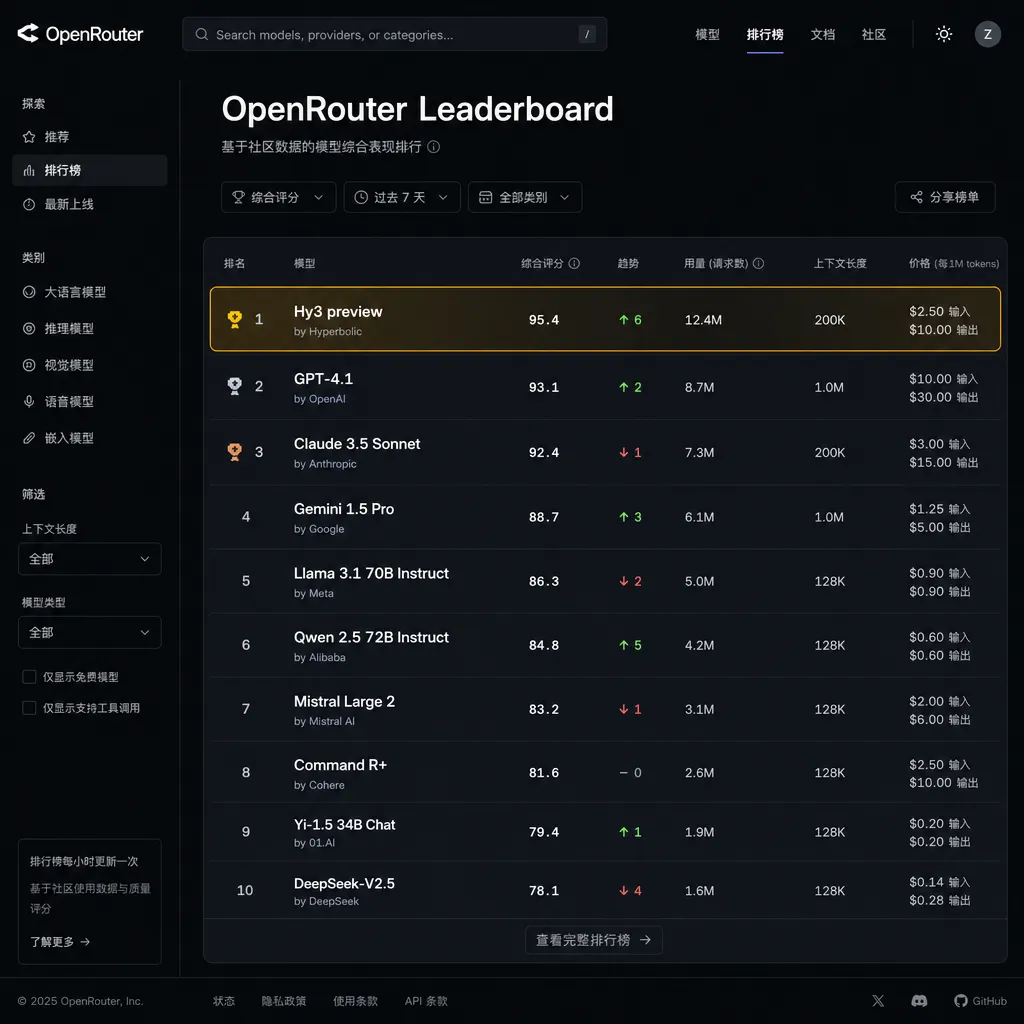
OpenRouter is the world’s largest API distribution market for large models, integrating over 300 models—essentially acting as the “global routing hub” for AI calls. On this platform where developers vote with their feet, Hy3 preview’s performance directly reflects its market recognition for cost-effectiveness.
Three-Month Rebuild Targeting Cost Pain Points
Tencent’s speed and determination in rebuilding Hunyuan are remarkable. From a technical architecture perspective, Hy3 preview employs a hybrid “fast-slow thinking” Mixture-of-Experts (MoE) design, with 295 billion total parameters, 21 billion active parameters, and support for 256K-long context. Despite its moderate size, it delivers significantly improved inference efficiency—allowing developers to get 40% more work at the same cost compared to the previous generation.
The design philosophy is clear: instead of chasing absolute parameter scale, Tencent focuses on optimization at a mid-size level, pushing cost-performance to the limit. This mirrors DeepSeek’s strategy last year—achieving near top-tier capability with far lower compute and training costs.
Data shows this strategy worked. OpenRouter statistics indicate Hy3 preview reached 3.66 trillion weekly Token calls, ranking first both in total volume and market share. It also ranked first in tool-use scenarios and second in programming. Within two weeks of launch, its Token calls were 10 times that of Hy2, with code and agent-related usage up by over 16.5 times.
Behind these numbers are real developer choices. As AI adoption enters the 2.0 era, model cost is critical for countless indie developers and “one-person companies.” Hy3 preview was engineered from the start to solve this pain point—focusing on mid-scale model optimization to achieve efficient AI applications at lower cost.
Intensive Agent Rollout: Tencent’s Bigger Play
Model capability enhancement is only the first step—Tencent’s real goal lies in building an Agent ecosystem.
According to its financial report, Tencent has launched dozens of general and vertical Agents this year—a rapid pace that suggests Agents have become the core of Tencent’s AI strategy. Hy3 preview’s improvements in context handling, Agent, and coding capabilities are designed to lay the foundation for that ecosystem.
Agent scenarios differ from pure conversational ones: they demand stronger tool-use capabilities, longer context comprehension, and more stable multi-turn interactions. Hy3 preview’s rank as No.1 in tool-use and its 256K context support show it was tailored precisely for these needs.
From a product rollout perspective, Hy3 preview has already been integrated into Tencent Yuanbao, QQ Browser, and WeChat Reading, while also ranking high in usage among international applications. This “internal-external dual circulation” approach allows Tencent to quickly iterate through its own products while gathering feedback and use cases from external developers via open APIs.
The Cost-Performance Battle Among Chinese Models Has Just Begun
The success of Hy3 preview represents a breakthrough in the cost-performance dimension.
Today’s large model market is fiercely competitive among top players in parameter scale and capability—but for many developers, what they need isn’t the most powerful model, but one that’s “good enough and affordable.” Hy3 preview’s 40% increase in inference efficiency means that for the same budget, developers can make more calls—or save significant costs at the same scale.
This strategy has been validated on OpenRouter. Most users there are indie developers or small teams, who are price-sensitive but also demand quality. That Hy3 preview stayed at the top even after its free period ended shows it achieved the right balance between cost and capability.
From a broader perspective, the competition among Chinese models on cost-performance is just starting. Last year, DeepSeek astonished the world with ultra-low training costs; this year, Tencent Hunyuan demonstrates another path—boosting inference efficiency by 40%. Next, players like Alibaba’s Tongyi, Baidu’s Wenxin, and ByteDance’s Doubao are also expected to intensify efforts in this area.
The essence of the cost-performance battle is technological diversification. Not every application needs a trillion-parameter behemoth; efficient mid-scale models have vast potential. Hy3 preview’s success provides a valuable new reference point for Chinese models.
The Product Logic Behind Three Weeks at the Top
Why has Hy3 preview led the OpenRouter charts for three consecutive weeks?
First, due to a thorough architectural rebuild. Completing a full reconstruction in under three months shows Tencent had a clear goal—no patchwork improvements, but a fresh start. The hybrid MoE architecture, 21 billion active parameters, and 256K context all revolve around one core objective: high inference efficiency.
Second, focus on scenarios. Hy3 preview’s 16.5x growth in coding and agent-related use cases wasn’t random. Tencent knows exactly what developers need most—models that can code, call tools, and process long texts. Ranking first in tool-use and second in programming perfectly matches the current battleground of AI applications.
Third, ecosystem approach. Tencent isn’t treating Hy3 preview as a standalone model—it’s positioning it as a foundation for its Agent ecosystem. Dozens of Agent releases not only validate the model’s capabilities but also serve as examples for developers. This “model + ecosystem” strategy adds long-term value far beyond mere model capability competition.
Lastly, pricing strategy. Remaining No.1 after the free period means the pricing is within developers’ comfort zone. Tencent isn’t dumping at ultra-low prices to grab share—it’s reducing effective usage costs through efficiency. This approach is healthier and more sustainable.
What This Means for Developers
Hy3 preview gives developers a new high-value choice.
For indie developers and small teams, a 40% efficiency boost means their existing budgets can support more experiments and iterations. In AI development, model call costs are often the largest expense. Hy3 preview’s cost-performance advantage enables more exploration of complex application scenarios.
For Agent-related workflows, its tool-use capability and long-context support are tangible benefits. A 256K context allows for longer conversation history and more complex task flows, while leading tool-use performance ensures stability in multi-tool coordination.
In code generation, ranking second—combined with a 16.5x increase—reflects marked improvement in code comprehension and generation. That’s welcome news for developers relying on AI-assisted programming.
Regarding API availability, Hy3 preview is stably accessible on OpenRouter, and domestic developers can also call it via aggregated platforms like OpenAI Hub. OpenAI Hub supports Hy3 preview, enabling single-key multi-model access—convenient for developers who juggle multiple models simultaneously.
Differentiated Competition Among Chinese Models
Hy3 preview’s success introduces a new variable into the competitive dynamics of Chinese AI models.
Over the past year, domestic models have mainly competed on two fronts: capability (aiming to surpass GPT-4 on benchmarks) and price (using discounts to gain market share). Hy3 preview adds a third: inference efficiency.
Improving inference efficiency is fundamentally an innovation in technical pathways—it’s not about stacking parameters or compute, but optimizing at the levels of architecture, training, and inference. This path is more challenging, but once breakthroughs occur, the advantage endures longer.
Market feedback proves developers value efficiency more than expected. Hy3 preview’s sustained leadership post-free period shows that developers are willing to pay for higher efficiency. That’s a recognition of technical value—not just a price war.
Looking ahead, competition among Chinese models will grow more diversified. Capability, price, and efficiency will each have strong players: Alibaba’s Tongyi excels in multimodal tasks, Baidu’s Wenxin in search enhancement, ByteDance’s Doubao in engineering optimization, while Tencent Hunyuan has made its mark with inference efficiency.
This differentiation is good for the entire industry—it means Chinese models are moving beyond homogenous competition to explore optimal solutions across dimensions. Developers can thus choose models best suited to their specific scenarios.
Final Remarks
Tencent Hunyuan Hy3 preview’s three-week dominance on OpenRouter is no accident. It reflects Tencent’s clear strategic position in AI: avoiding the pursuit of sheer parameter scale, focusing instead on maximizing efficiency and cost-performance; treating models not as isolated products but as foundational pillars for its Agent ecosystem.
From rebuild to market validation, Tencent delivered a high-value answer sheet in less than three months. A 40% improvement in inference efficiency, 10x growth in Token calls, and three weeks atop the leaderboard—all driven by developer choice.
For Chinese models, Hy3 preview offers a new reference point: beyond capability and price, inference efficiency is an equally critical competitive strength. And for developers, it provides one more high-value option—enabling complex AI applications at lower cost.
The cost-performance battle has only just begun, but the direction is clear: success won’t depend on who builds the biggest model, but on who builds the most efficient one.
References
- Tencent Hunyuan Hy3 preview hits 10× Token calls in two weeks, tops dual OpenRouter charts – Official Tencent News report with detailed call data and technical parameters
- Tencent Hunyuan’s first appearance after reconstruction! New model tops OpenRouter – Sina Finance coverage of Hy3 preview’s first chart-topping performance
- KrStar Evening News|Tencent president Liu Chiping: No large-scale layoffs planned – 36Kr’s summary of Tencent Q1 earnings, including AI business progress


