
SenseTime Open-Source U1: Ditch the VAE, directly output pixels

SenseTime open-sources SenseNova U1, which completely abandons the VAE based on the NEO-Unify architecture, achieving unified pixel-level native understanding and generation. With 8B parameters, it matches commercial closed-source models and pioneers continuous image-text creation, fully open-sourced under the Apache 2.0 license.
SenseTime Open Source U1: Ditch the VAE, Direct Pixel Output
SenseTime has just released the technical report for SenseNova U1, and it’s quite a big deal. The model was already open-sourced on April 28 under the Apache 2.0 license, and both versions (8B-MoT and A3B-MoT) are available for commercial use. After its release, it shot straight to the Hugging Face Trending list — pretty rare heat compared with the recent wave of open-source multimodal model launches.
Alongside the model release, SenseTime announced the SenseNova Token Plan: 1,500 free calls every 5 hours in the first month, with 60% lower token consumption than competitors. They also launched the SenseNova 6.7 Flash-Lite multimodal agent model and the SenseNova-Skills office toolkit.
Architecture Innovation: No VAE, Direct Pixels
Traditionally, text-to-image models convert pixel RGB values into vectors and process them in latent space (the VAE layer). This has been standard practice for years. U1’s NEO-Unify architecture throws that away — switching to direct pixel input/output, enabling the model to understand images natively rather than through abstract latent representations.
This isn’t just for show. The traditional architecture works like “multi-person relay translation”: a vision encoder interprets the image, converts it to text, a language model infers intent, translates that back into design instructions, and finally generates the image. Each relay loses information and must be offset with more parameters. NEO-Unify acts as “a single versatile brain — direct understanding, direct expression,” reducing translation layers and boosting information density and efficiency.
Data backs the claim: the 2B-parameter NEO-Unify model achieves 31.56 PSNR and 0.85 SSIM on the MS COCO 2017 image reconstruction benchmark, within 1 point of the industry-standard Flux VAE (32.65 PSNR, 0.91 SSIM). Crucially, Flux VAE is a purpose-built generation module, while U1 accomplishes this under a unified architecture. Compared with similar unified models like BAGEL, NEO-Unify yields better results using fewer training tokens — clear data efficiency superiority.
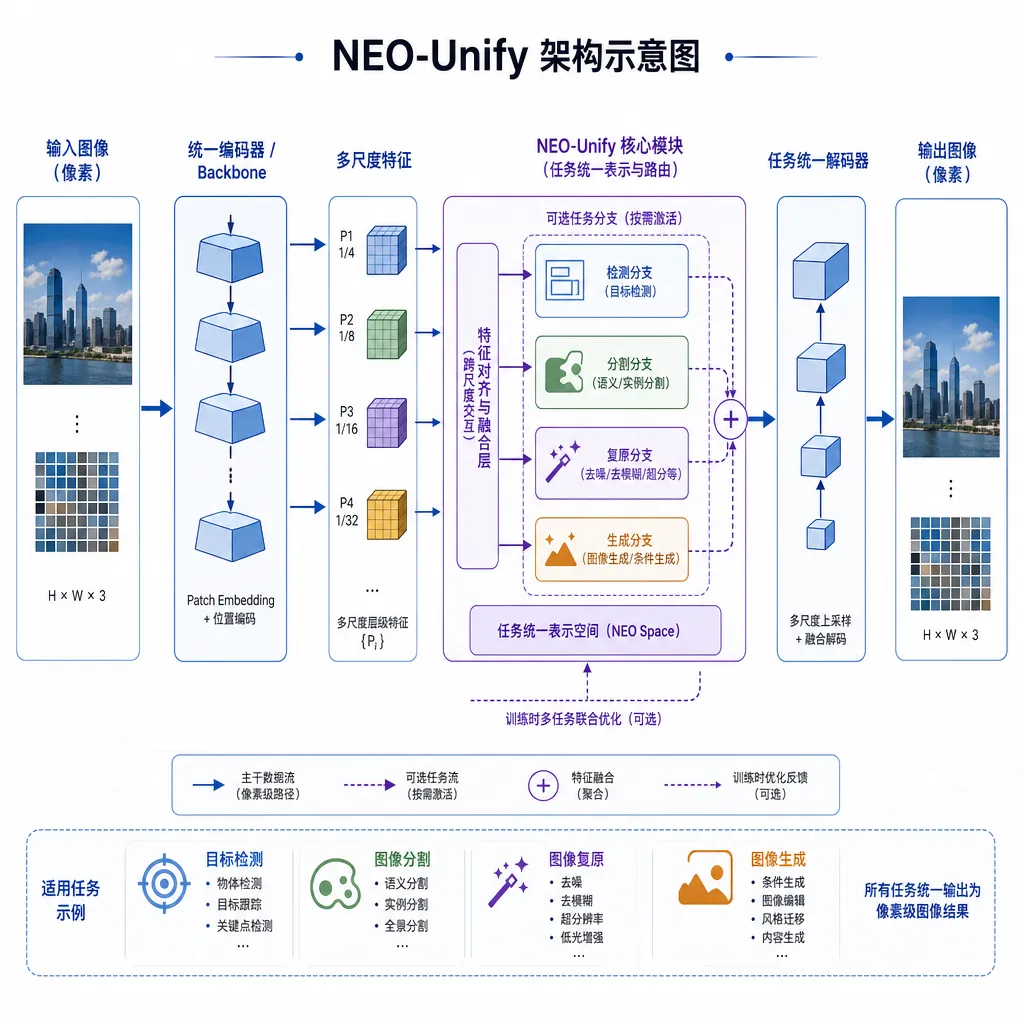
Technically, NEO-Unify uses two convolutional layers for 32× image compression encoding, with an MLP head that predicts pixels directly. It introduces Dynamic Noise Scaling (DNS) to maintain consistent SNR from 512px to 2048px resolution. The native MoT (Mixture-of-Transformers) architecture shares self-attention layers between understanding and generation streams but uses decoupled FFN and Norm layers with dynamic routing based on token type.
Its training method diverges from traditional diffusion models, combining autoregressive and flow-matching loss optimization through a six-stage pipeline — from warm-up and instruction fine-tuning to eight-step distillation.
Training Data: Separate Feeds for Understanding and Generation
Data composition is fine-tuned. The pretraining mix for understanding tasks: 32% image-text pairs, 37% pure text, 17% detailed descriptions, and 14% infographics. Mid-stage training uses the SenseNova V6.5 dataset, filtered by sampling balance, prompt enhancement, and automated model scoring.
All generation data flows through the VLM re-labeling pipeline. Every image (natural, design, portrait, synthetic) is deduplicated and re-labeled to ensure pixel-text semantic alignment. Data distribution: 44% lifestyle, 29% infographics, 8% reasoning.
Reasoning samples include full chain-of-thought (CoT) reasoning before pixel rendering, allowing the model to grasp scene logic. This design greatly improves complex infographic generation — better control of layout and text.
Performance: 8B Matches Closed Commercial Models
In multimodal understanding, A3B-MoT achieves 80.55 on MMMU, 72.83 on MMMU-Pro, and 91.90 on OCRBench. Its dense-text image and general visual understanding perform well, with no degradation from unified generation.
In generation, GenEval scores 0.91–0.92 overall; composition, counting, color, position, and attribute binding are all stable. OneIG reaches top scores in English/Chinese textual alignment at 0.969/0.977, and LongText-Bench English/Chinese at 0.979/0.962 — highlighting strong long-text rendering capability.
Across joint image-text generation (OneIG EN/CN, LongText EN/CN, CVTG) and infographic benchmarks (BizGenEval Easy/Hard, IGenBench), U1 leads in overall performance within comparable latency, surpassing open-source models like Nano-Banana and Gemma-4 — setting a new SOTA standard for open models.
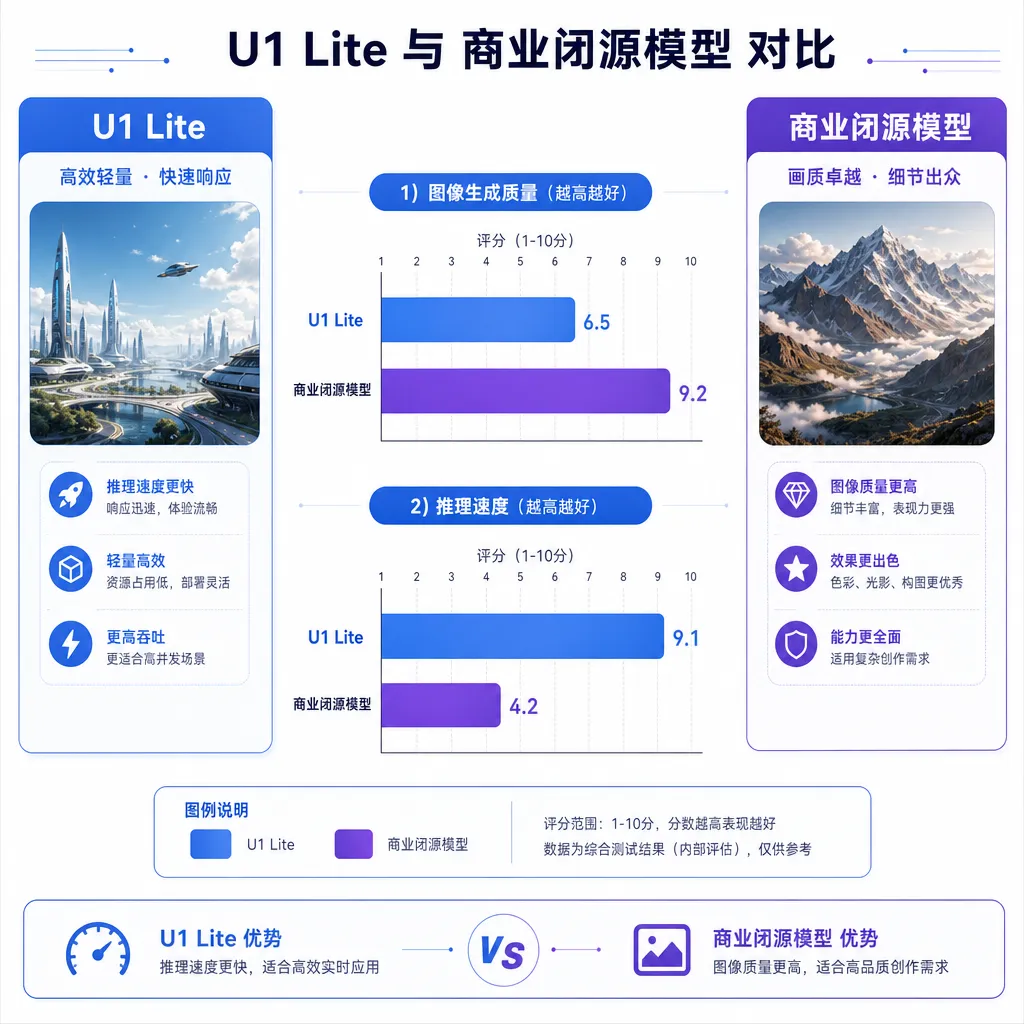
In horizontal comparison with closed commercial systems, U1 Lite’s general image generation quality matches Qwen-Image 2.0 Pro and Seedream 4.5. Historically poor areas for open models like infographics now reach commercial-grade quality. Inference response time remains distinctly faster.
Industry’s First Continuous Image-Text Creation
With NEO-Unify, U1 pioneers continuous image-text creative output. A single model call can produce high-quality multi-step results, dramatically boosting efficiency over traditional workflows.
Its native image-text understanding/generation retains underlying fusion signals in context, unlike prior methods requiring chained multi-model setups. Style consistency between images is significantly higher, enabling coherent reasoning in a unified representation space.
Examples:
Task 1: How to make a medium-rare steak.
U1 thinks and plans out step-by-step actions, providing matching illustrative images for each step. The visuals remain highly consistent across steps.
Task 2: Drawing an Iron Man logo.
Starting from a sketch, U1 continuously refines the creation, producing a highly finished final image. Each step precisely preserves previous structure and detail, enabled by the shared unified context space.
This ability is practical for infographic generation, tutorial creation, and sequential storytelling — previously requiring multiple models; now a single run does the job with consistent style.
6.7 Flash-Lite: The Agent That Understands Documents
Released simultaneously, SenseNova 6.7 Flash-Lite is a new-generation multimodal agent model. If U1 is the versatile creator, Flash-Lite is the project manager handling coordination and oversight.
Traditional agent models use “text + vision” concatenation, where vision acts as an auxiliary, resulting in high information loss and token cost. Flash-Lite employs a native multimodal architecture — removing the vision-to-text conversion layer entirely — directly understanding webpages, documents, and charts for unified “see–think–act” execution.
Its biggest advantage: drastically reduced cost. In tasks like information retrieval, token consumption drops 60% versus text-only agents, with millisecond-level response, ideal for high-frequency production environments. It ranks among the leaders in authoritative benchmarks.
Capabilities include:
- Deep analysis of 900,000 lines of sales data — automatically detecting anomalies and suggesting business optimizations
- Independent authoring of 8-chapter industry research reports — integrating market data and generating visual charts
- Creating hospital-friendly PPT guides for elderly visitors — consistent style, clear information
It natively supports frameworks like OpenClaw and Hermes Agent. Combined with the open-source SenseNova-Skills office toolkit, users can enable full automation with one click. Skills cover infographic creation, PPT generation, data analysis, and in-depth research — deployable with one-click or for flexible integration.
Token Plan: 1,500 Free Calls Every 5 Hours
SenseTime’s SenseNova Token Plan allows developers to log in and claim 1,500 free calls every 5 hours — zero-cost access to Flash-Lite and U1 Fast. Paid tiers (Lite, Pro) will follow.
Token usage is 60% lower than competitors; together with the free quota, the trial cost is minimal. The Apache 2.0 license further removes entry barriers for developers.
This approach is counter to the current trend of AI model monetization — low-cost tokens keep users engaged, open licensing lowers technical barriers, and combined with a complete toolchain (SenseNova-Skills), it forms a full-cycle system from architecture innovation to cost advantage.
How to Interpret This Release
U1 proves one thing: the text blurring and texture loss caused by VAEs are not “necessary trade-offs.” With the right architecture, native pixel generation can outperform latent-space methods. Its 8B model matches commercial closed models and beats peer unified models in data efficiency — strong evidence of NEO-Unify’s advantages.
Continuous image-text creation isn’t a gimmick — it’s functional. What once needed multiple model calls now works in one, with consistent style. In scenarios like infographic design, tutorial generation, and story creation, this directly enhances productivity.
Flash-Lite’s 60% token reduction is also noteworthy. Removing the vision-to-text middle layer enables direct comprehension of complex inputs, cutting costs in search and data-processing tasks. Combined with 1,500 free calls every 5 hours, experimentation becomes almost risk-free for developers.
The open-source strategy is bold: Apache 2.0 licensed, fully commercial-ready models, paired with a complete toolkit and free plan — a genuinely generous offering amid today’s surge of multimodal releases.
Of course, U1 is still part of the Lite lineup; SenseTime says it’s continuing to scale up this technical route, aiming for larger models. Whether a larger parameter version can reach world-class levels at lower compute cost remains to be seen.
But at least for now, SenseTime offers a serious answer — a complete system from architectural innovation (NEO-Unify) to tools (SenseNova-Skills) to cost advantage (Token Plan), turning “native unified multimodality” from concept into deliverable product.
For developers, both U1 and Flash-Lite are worth testing: U1 for high-quality visual-text creation, Flash-Lite for complex document and data workflows. Apache 2.0 license + free quota + low token usage — this combination is compelling in today’s market.
If you’re using OpenAI Hub to access other models, it’s worth watching whether SenseTime gets integrated into it. A unified API format minimizes switching costs — and one more choice is always good.
References
- SenseTime SenseNova U1 GitHub Repository – model weights, technical documentation, and usage examples
- SenseTime SenseNova-Skills GitHub Repository – open-source office skills toolkit
- Linux.do Community Discussion – developer feedback and practical testing of the U1 technical report


