
Qwen 3.6/3.7 Preview Released: The Qwen Series Evolves Once Again
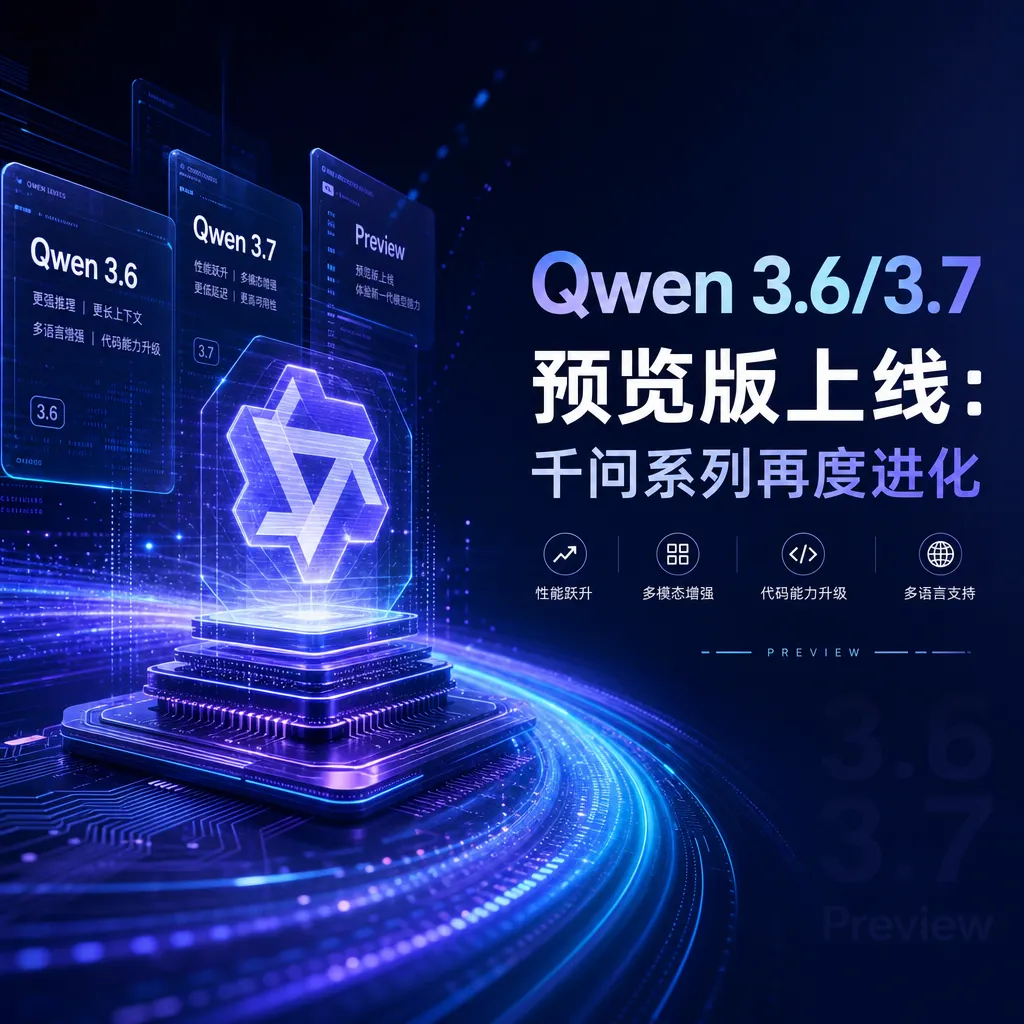
Alibaba’s Tongyi Qwen has launched **Qwen 3.6 Plus Preview** and **Qwen 3.6 Max Preview**, featuring a hybrid architecture with comprehensive upgrades in programming, reasoning, and multimodal capabilities. Meanwhile, discussions about **Qwen 3.7** have appeared in the community.
Qwen 3.6/3.7 Preview Released: The Qwen Series Evolves Again
In May 2026, Alibaba’s Tongyi Qwen series received a dense wave of updates, launching two preview versions—Qwen 3.6 Plus Preview and Qwen 3.6 Max Preview—while the community began discussing the upcoming Qwen 3.7. This round of updates spans the whole product lineup from lightweight to flagship models, focusing on strengthening Agentic Coding, deep reasoning, and multimodal recognition capabilities.
The jump in version numbering reflects Alibaba’s fast iteration rhythm: the Qwen 3.5 series has just stabilized, yet the 3.6 series quickly follows in preview form—and the community is already talking about 3.7. Such frequent iteration is rare among domestic large-model developers and highlights Alibaba’s strong engineering capabilities in model architecture and training processes.
Qwen 3.6 Plus: Efficiency Breakthrough with a Hybrid Architecture
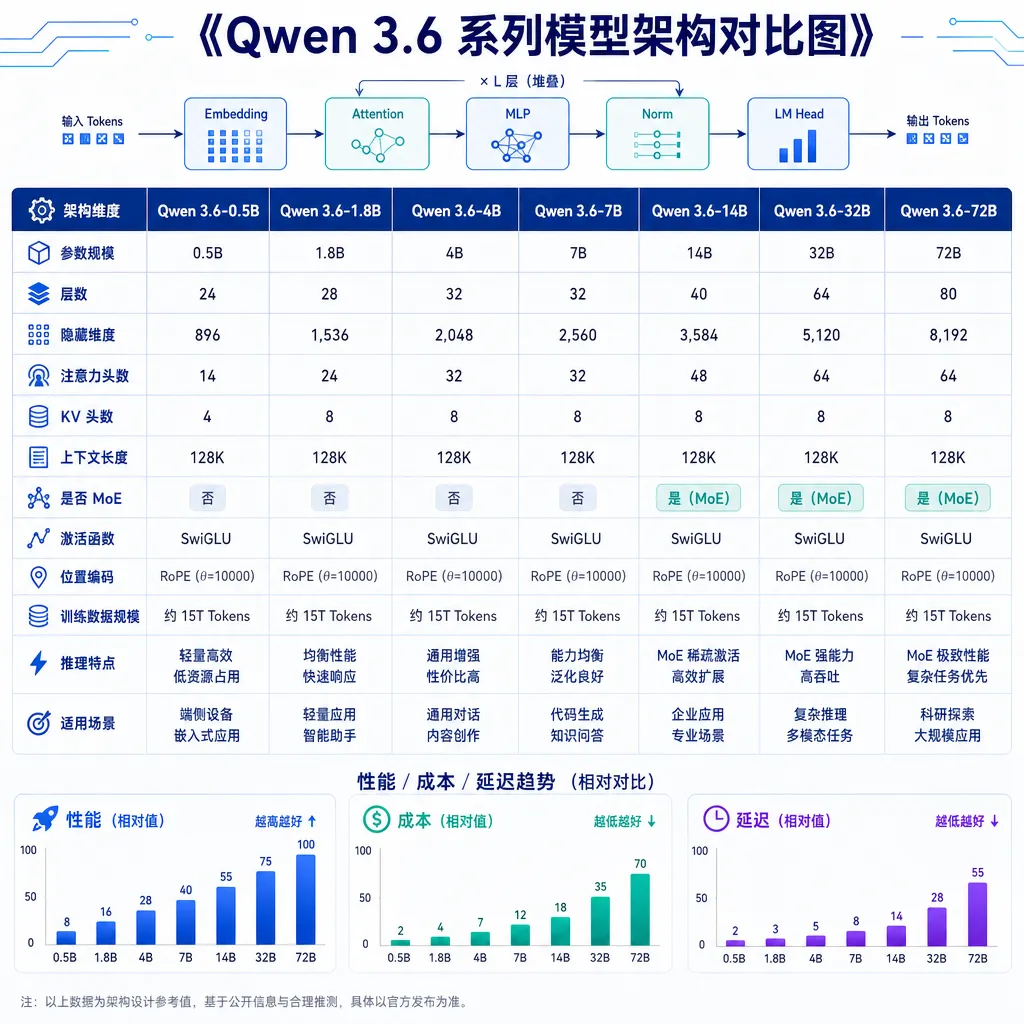
Qwen 3.6 Plus Preview is the core product of this update. The official description emphasizes its “advanced hybrid architecture”, claiming dual breakthroughs in efficiency and scalability. Although specific architectural details are not disclosed, based on performance, this hybrid design likely combines the strengths of dense models and sparse Mixture-of-Experts (MoE) frameworks.
Upgraded Vibe Coding Experience
“Vibe Coding” essentially means enabling the model to capture developers’ intent and context, rather than mechanically generating code snippets. Qwen 3.6 Plus demonstrates improvements on multiple fronts:
- Contextual Coherence: Maintains understanding of project structure across multiple rounds of conversation without losing earlier context
- Consistent Coding Style: Generates code aligned with existing naming, commenting, and structural conventions
- Accurate Bug Fixing: Identifies specific logic errors instead of rewriting entire code segments when issues are raised
These enhancements significantly benefit real-world development workflows. Previously, developers spent time tweaking AI-generated code to fit project norms; now, the model better understands contextual requirements, reducing friction and manual overhead.
Engineering Improvements in Inference Stability
The official notes describe Qwen 3.6 Plus inference as “more flexible and more stable.” Here, stability means consistent and predictable output—not just preventing crashes. In production, stability often outweighs peak performance: a model that occasionally dazzles but frequently makes simple mistakes is less valuable than one that reliably produces moderate-quality results.
Technically, improved inference stability may stem from:
- Adaptive Temperature Adjustments: Dynamically tuning sampling strategies by task type
- Enhanced Post-Training: Using RLHF or DPO to reduce randomness
- Constraint Mechanisms at Decoding: Applying rule-based restrictions during generation to avoid obvious errors
Practical Multimodal Recognition
Multimodal capabilities show “marked improvement” in Qwen 3.6 Plus. This includes not only higher recognition accuracy but improved usability of those results.
Accuracy is fundamental, but usability matters more. For instance, in document understanding, the model should not only identify numbers in a table but also grasp their relations; in image analysis, it must comprehend spatial and semantic relations between objects.
Qwen 3.6 Plus advances in handling complex scenes—for example, when analyzing a financial report screenshot containing multiple charts, it can recognize logical relationships among charts instead of just describing each one.
Qwen 3.6 Max: Expanding the Boundaries of Flagship Performance
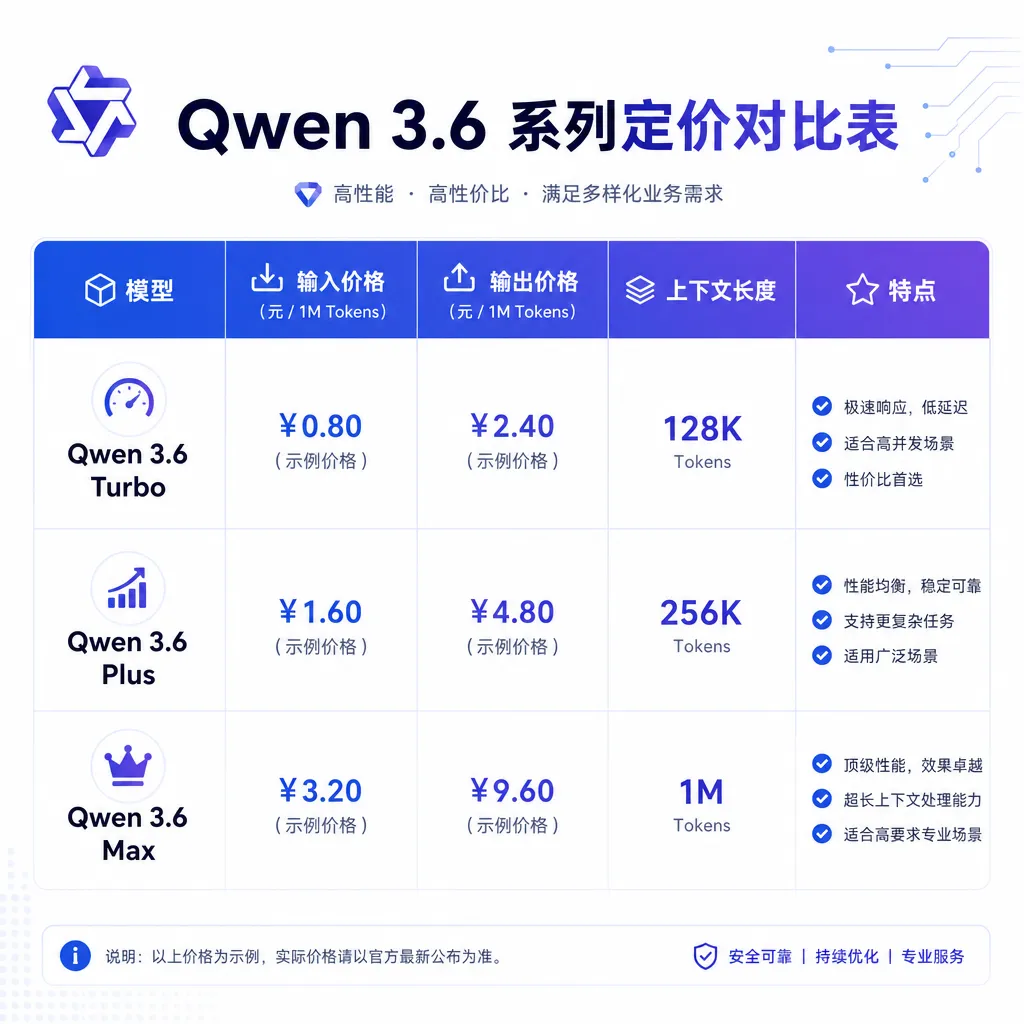
Qwen 3.6 Max Preview represents the flagship model, supporting up to 128K tokens of context window. From its pricing (¥9/1M input tokens, ¥54/1M output tokens), it clearly targets performance-critical use cases.
Integration of Thinking and Non-Thinking Modes
Qwen 3.6 Max supports both “thinking” and “non-thinking” modes—a noteworthy design. The thinking mode parallels OpenAI’s o1 series, internally performing multi-step reasoning before producing answers; non-thinking mode is the conventional direct-response mode.
Combining the two allows automatic selection of inference strategy based on task complexity. Simple queries use non-thinking mode for speed, while complex logic switches into thinking mode for deeper reasoning. This adaptive mechanism helps developers avoid manual mode switching for each task.
Cost Optimization through Context Caching
Qwen 3.6 Max supports context caching with discounted pricing—dramatically reducing costs for long-text use cases.
Context caching stores reusable context (e.g., system prompts or background info) so future calls only send updated portions. Applications repeatedly processing similar tasks can cut costs by over 50%.
Alibaba offering discounts for cached requests indicates encouragement for adoption—since caching lowers both user cost and Alibaba’s GPU inference cost.
Qwen 3.6 Flash: Lightweight Yet Fully Upgraded
Qwen 3.6 Flash is the lightweight edition, but this update is far from “light.” Three major areas are emphasized:
Downscaling of Agentic Coding Abilities
Originally reserved for flagship models, Agentic Coding now extends to the Flash version. Even cost-sensitive applications can leverage intelligent agent-style coding.
The technical challenge lies in maintaining lightweight structure without sacrificing complex reasoning. Alibaba likely used knowledge distillation or model pruning to transplant flagship abilities into lighter models.
Precision in Spatial Localization and Logical Reasoning
Spatial localization is key for multimodal scenarios—including autonomous driving, robotics, and AR/VR—where understanding spatial relations is critical.
Qwen 3.6 Flash’s improvements make it suitable for high-real-time applications. For instance, in smart-home interactions, understanding “turn off the left light” precisely requires recognition of which light is “on the left.”
Logical reasoning improvements enhance multi-condition comprehension—useful for customer service, where questions often contain layered constraints that must be logically parsed.
Half-Price Batch Invocation Strategy
Qwen 3.6 Flash offers half-price batch calls. Batch invocation groups multiple requests for collective processing, ideal for non-real-time tasks like large-scale data analysis or offline operations.
This pricing logic is clear: batch processing lets Alibaba optimize GPU scheduling during idle times, saving costs while offering users discounts—a win-win scenario.
Qwen 3.7: The Mysterious Version in Community Discussions
On the Linux.do community, users mention a Qwen 3.7 version, though no official confirmation exists. Such unannounced testing isn’t uncommon—companies often release small-scale previews before public rollout.
Following versioning patterns, if 3.7 truly exists, it’s likely an incremental upgrade over 3.6, not a major overhaul. Possible improvements may include:
- Enhanced domain-specific capabilities for industries like finance, healthcare, or law
- Further inference efficiency optimizations via compression or quantization
- Strengthened safety and compliance with added content and privacy safeguards
Until official confirmation, these remain speculative. Developers seeking early access should follow updates on Qwen Studio (chat.qwen.ai).
The Qwen Product Matrix: From All-Purpose to Specialized
The Qwen 3.6 updates illustrate Alibaba’s comprehensive product matrix design:
Flagship: Qwen 3.6 Max
For performance-demanding scenarios—complex scientific computation, large-scale analysis, high-precision generation. Highest capabilities, higher cost.
Balanced: Qwen 3.6 Plus
Optimized between performance and cost; suitable for most production environments. Upgraded Vibe Coding and multimodal capabilities cover both code generation and document understanding.
Lightweight: Qwen 3.6 Flash
Designed for cost-sensitive or real-time-use cases. Despite being lightweight, its Agentic Coding inheritance enables functionality comparable to heavier models.
Specialized: Qwen 3.5 Omni, Qwen Image, Qwen TTS, etc.
Models specialized for modalities or tasks—Omni for all modalities, Image for generation/editing, TTS for high-quality speech synthesis.
This matrix strategy is clear: use flagship to showcase technology, balanced models for mainstream adoption, lightweight versions to lower entry barriers, and specialized models for niche needs.
Engineering Reflections Behind Qwen’s Technical Evolution
While the Qwen 3.6 updates look like feature boosts, they underscore Alibaba’s engineering maturity in large-model development.
Trade-offs in Hybrid Architectures
Though hybrid architecture isn’t new, finding the sweet spot between dense and MoE requires extensive experimentation. Using it in the Plus version suggests Alibaba sees optimal gains in efficiency-cost balance.
Post-Training Refinement
From enhanced Vibe Coding and inference stability, it’s clear Alibaba invested heavily in post-training—not just RLHF but instruction tuning, preference alignment, and safety reinforcement, each demanding custom datasets and fine-tuned strategies.
Systematic Inference Optimization
Features like context caching and batch invocation show a systematic inference optimization approach—reducing cost while improving experience via faster responses, lower latency, and stable outputs.
Comparison with Competitors: Qwen’s Differentiation Path
Domestically, Qwen faces competition from DeepSeek, Zhipu, Baichuan, and others. The 3.6 update demonstrates Alibaba’s distinct strategy:
Full-Stack Capabilities vs Focused Specialization
DeepSeek excels in reasoning; Zhipu leads in multimodal processing; Baichuan focuses on domain-specific verticals. Qwen aims for competitiveness across all fronts—building full-stack capabilities.
Advantage: meets broad market needs. Drawback: may be less dominant in single areas. Yet enterprise clients often prefer full-stack solutions to simplify tech stacks.
Balance Between Open and Closed Source
The Qwen series includes both open-source (e.g., Qwen 2.5) and closed-source (Qwen 3.6 and above) versions—serving community engagement and commercial monetization respectively.
Open-source builds ecosystem and brand, closed-source drives revenue. Controlled capability gaps ensure coexistence without self-cannibalization.
Flexible Pricing
The Qwen 3.6 lineup offers flexible pricing—premium Max and cost-effective Flash—with discounts via caching and batching, reducing real-world usage costs.
This pricing encourages migration—developers switching from other models gain similar performance at lower prices, easing adoption.
Practical Adaptability Across Use Cases
Reviewing the upgrades, Qwen 3.6 showcases notable suitability for typical application categories:
Code Generation and Development Assistance
Enhanced Vibe Coding makes Qwen more practical for coding support. In iterative projects, maintaining contextual understanding reduces developer effort.
Still, AI-assisted coding is early-stage: generated code needs human review—especially in security or performance-critical areas. Qwen’s role is reduction, not replacement, of human workload.
Document Understanding and Knowledge Extraction
Improved multimodal comprehension makes Qwen reliable for document-heavy tasks—extracting info and understanding logic in tables, charts, or formulas.
Applications include legal text mining, corporate compliance checks, or research analytics—boosting efficiency in knowledge-intensive sectors.
Smart Customer Support and Conversational Systems
Better inference stability helps Qwen produce consistent responses—crucial for customer service, where answer reliability matters.
Qwen 3.6 Plus suits production use, although customer service typically integrates models with knowledge bases or rule engines to cover all requirements.
Outlook: What’s Next for Qwen
Given Qwen 3.6’s aggressive iteration, Alibaba’s commitment to the LLM field remains robust. Future directions may include:
Longer Context Windows
Currently at 128K, Qwen 3.6 Max may soon support 256K or more—for entire books or large codebases. But longer context raises cost/efficiency trade-offs, requiring balanced design.
Stronger Reasoning Skills
Thinking mode is only the beginning—multi-step, counterfactual, and causal reasoning still pose challenges. Expect enhancements like external tool integrations, logic verification modules, or refined chain-of-thought strategies.
Better Multimodal Fusion
Beyond text-vision, future versions could integrate audio, video, or 3D understanding, targeting AR/VR, robotics, and autonomous driving.
Qwen 3.5 Omni already supports full-modality interaction, but audio/video accuracy and temporal modeling still have room for growth.
Lower Barriers to Use
Despite full API and SDK support, non-technical users still struggle. Future iterations may include visual prompt editors or low-code app builders.
Alibaba Cloud’s Bailian Platform is experimenting in this direction, moving toward universal usability.
Conclusion
The Qwen 3.6 update marks continuous evolution for Alibaba’s Tongyi Qwen series. From hybrid architecture to Vibe Coding, inference stability to multimodal fusion—each enhancement serves one goal: making LLMs more practical, reliable, and accessible.
For developers, these updates broaden options: whether targeting extreme performance, cost-efficiency, or lightweight scenarios, Qwen provides tailored solutions. The downward integration of Agentic Coding and improved context caching makes AI-assisted development more economical.
As for the rumored Qwen 3.7, we’ll wait and see. In today’s rapid iteration landscape, the next breakthrough may arrive sooner than expected.
References
- Qwen Might Have Released 3.7 - Linux.do – Community discussion on Qwen 3.7
- Alibaba Tongyi Qwen’s New Model Qwen 3.6 Plus Preview Released - CSDN Blog – Technical introduction to Qwen 3.6 Plus
- Qwen Large Model - Alibaba Cloud – Official product page for the Qwen series


