
Gemini 3.5 Flash Exposed: 900 TPS inference speed ushers large-parameter models into a new era of speed

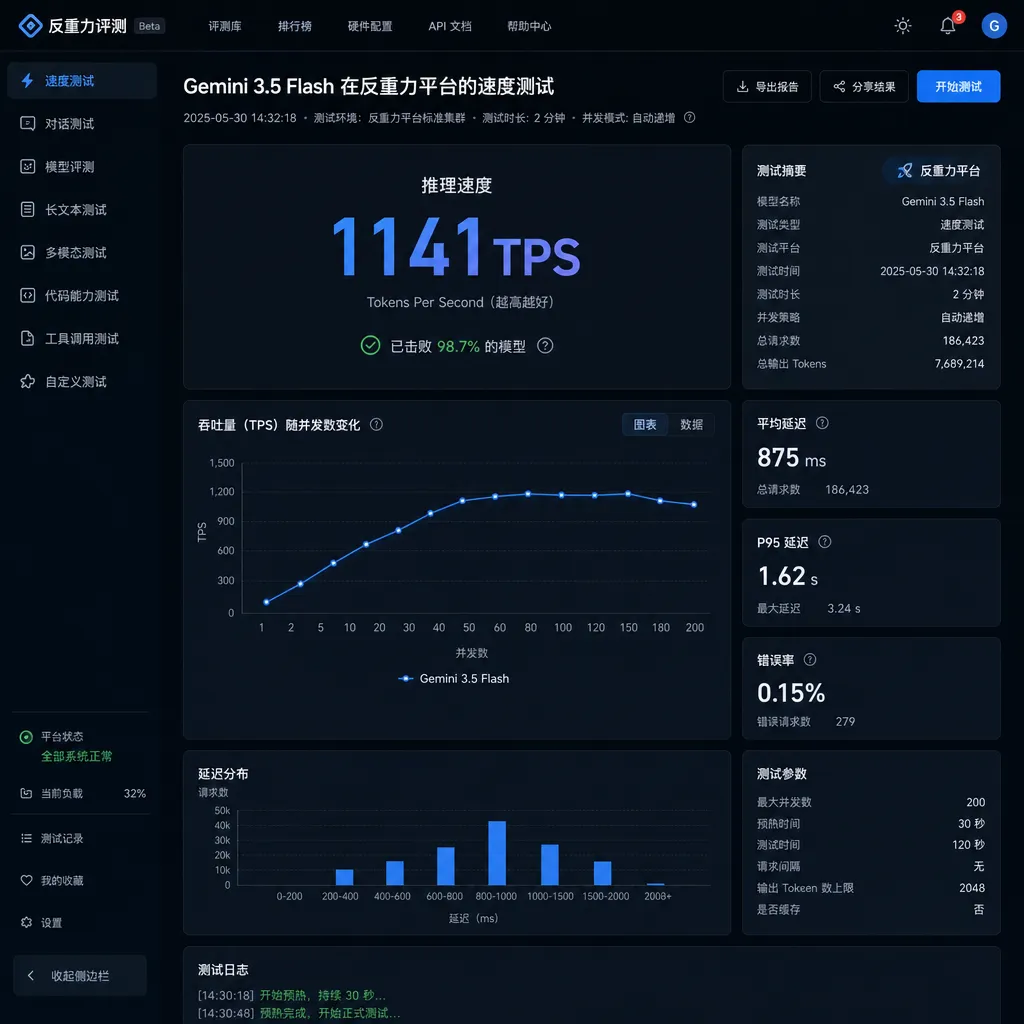
Google Gemini 3.5 Flash achieved a peak inference speed of 1141 TPS in the anti-gravity platform grayscale test, with stable performance between 600–900 TPS in regular scenarios—representing a 3–9× improvement over the previous generation—while maintaining a capability level comparable to Gemini 3 Flash.
Gemini 3.5 Flash Exposed: 900 TPS Inference Speed Marks a New Era for Large-Parameter Models
Google hasn’t officially announced it yet, but Gemini 3.5 Flash is already running on the Antigravity platform.
According to multiple developers’ tests on the Linux.do community, the new model achieves an inference speed of 600–900 TPS (tokens per second), reaching up to 1141 TPS during code generation. For comparison, the current Gemini 3 Flash on Google AI Studio only runs at about 100 TPS. That’s a 3–9× speed increase — without any drop in capability, which is what really matters.
The Secret Behind the Speed: Engineering Breakthroughs in Large-Parameter Models
Gemini 3.5 Flash reportedly has a parameter count comparable to Gemini 3 Pro, perhaps even more. Industry estimates place it in the hundreds of billions of parameters. Hitting 900 TPS at that scale means Google has made real progress in inference optimization.
Developer tests show that in real coding scenarios with 44k context length, Gemini 3.5 Flash stably outputs 1141 TPS. What does that mean? A full Vue front-end component — from requirement description to code generation — can be completed in just a few seconds.
More importantly, the time to first token is extremely low. In a test with 5k output, excluding thinking time, the model’s response is almost instant. This delivers a qualitative leap for real-time use cases such as code completion, instant translation, and interactive chat systems.
Speed Without Compromise: Accuracy Still on Point
Faster doesn’t mean weaker — that’s everyone’s concern.
Developers validated Gemini 3.5 Flash’s reasoning capability with some classic test problems:
- Candy Problem: Gemini 3 Flash needed over 70 seconds to get it right; Gemini 3.5 Flash solved it in under 20 seconds
- Color Blindness Problem & Car Wash Problem: both answered correctly
- SimpleBench: consistently scores 9/10 with near-perfect accuracy
In front-end tests, Gemini 3.5 Flash generated complete Minecraft sandbox game UIs and advanced weather card components, maintaining similar code quality to its predecessor. Performance in documentation writing and knowledge-base Q&A tasks also showed no noticeable drop.
This indicates that Google hasn’t traded off model capability for speed. The improvement likely stems from aggressive quantization, more efficient attention mechanisms (e.g., further optimization of FlashAttention), and hardware acceleration like TPU v6 or newer.

Antigravity Platform Gray Testing
Gemini 3.5 Flash is not yet officially live on Google AI Studio but has entered gray testing on the Antigravity platform. Users selecting the “3f” model may randomly be assigned the new version.
Antigravity, Google’s internally used AI coding platform, reached about 6% developer adoption just four months after launch. Though still behind Anthropic’s Claude Code and OpenAI’s Codex, as Google’s AI Agent experimental base, Antigravity serves as a testing ground for new models and features — collecting real usage data before public release.
The choice to gray-test Gemini 3.5 Flash on Antigravity shows Google’s intentions clearly: developer-oriented, focused on coding and Agent scenarios.
The Speed Anxiety of Large-Scale Models
Over the past year, the AI industry reached a consensus — while large models keep pushing capability limits, inference speed has become the bottleneck.
OpenAI’s GPT-5.5 and Anthropic’s Opus 4.7, top-tier models in the field, typically achieve 50–150 TPS. That’s still too slow for use cases requiring real-time responses — like code completion, interactive dialogue, or in-game NPCs.
The industry’s main solutions take two paths:
- Small model approach: distillation and pruning compress large models down to billions of parameters — faster, but weaker. Examples include "Lite" or "Mini" versions.
- Engineering optimization approach: keep large scale intact, but use optimized inference engines, hardware acceleration, and quantization for speed. Harder to do, but better — speed without quality loss.
Gemini 3.5 Flash clearly takes the second route. 900 TPS combined with hundreds of billions of parameters — this combination currently has no direct rival.
Step 3.5 Flash from StepStar also touts high inference speed (up to 350 TPS) via a sparse MoE architecture where each token activates only 11 billion parameters. Gemini 3.5 Flash runs on many more parameters and still hits 900 TPS, marking a completely different level of technical difficulty.
Competing with GPT-5.5 and Opus 4.7
Google’s timing is strategic. After Gemini 3 Pro launched, ChatGPT traffic dropped 6% within two weeks. OpenAI had to move up its GPT-5.2 release from late December to December 11. Six days later, Google rolled out Gemini 3 Flash — cutting ahead while GPT-5.2 was still stabilizing.
Now, Gemini 3.5 Flash enters gray testing, clearly timed to counter OpenAI’s upcoming GPT-5.5 and Anthropic’s Mythos.
In terms of sheer capability, Gemini 3.5 Flash may not yet match GPT-5.5 or Mythos. The UK’s AI Safety Institute (AISI) found that Mythos was the first to pass both high-intensity cybersecurity benchmarks; GPT-5.5 passed one. Gemini 3 Pro’s results aren’t public yet.
But speed is Gemini 3.5 Flash’s killer advantage. 900 TPS enables broader real-time interactions. For fast-response applications — customer service bots, code completion, live translation — speed may matter more than raw power.
Its pricing is also aggressive. Input cost is one-fourth that of the Pro version and doesn’t increase with context length. Pro pricing doubles beyond 200k context, while Flash stays constant — giving it a massive cost advantage for enterprise-scale tasks handling long documents.
Flash vs. Pro: Complementary, Not Replacement
Gemini 3.5 Flash doesn’t replace Gemini 3 Pro; they serve distinct roles.
The Pro version suits tasks requiring deep logic and long reasoning chains — mathematical proofs, complex code refactoring, strategic analytics. Its “deep thinking” mode excels in those scenarios.
The Flash version is the versatile performer — faster, cheaper, covering 80% of daily tasks. For most business use cases — customer service, document processing, code generation, data analysis — Flash offers higher cost efficiency.
In the SWE-bench Verified benchmark (AI coding assistant standard), Flash scored 78.0%, slightly higher than Pro’s 76.2%, signaling better code generation and multimodal parsing optimization — ideal for an AI Agent core engine.
It’s a clever strategy: Pro guards the top-end capability, Flash dominates speed and affordability. Together they cover different usage scenarios, letting users dynamically choose models based on task complexity rather than being locked to one.
A New Stage of AI Competition: From "Brute Force" to "Refined Skill"
The arrival of Gemini 3.5 Flash marks a new phase in AI competition.
Before, everyone was racing to amass parameters and benchmark scores — building bigger models. Now the focus has shifted to efficiency: achieving precision with less cost and greater speed.
That shift reflects changing market demand. Enterprise users no longer want just “usable” AI — they demand responsive, affordable, production-ready AI. Gemini 3.5 Flash’s 900 TPS speed and quarter-cost pricing directly meet that need.
Another evolution is the transition from “chatbots” to “AI Agents.” Flash’s role is clear — serving as the core engine for Agents, seamlessly switching tasks across terminals, browsers, and editors in real time.
Google’s Antigravity platform and upcoming Gemini Spark (always-on AI agent) are built for this era. Flash’s speed advantage makes it an ideal choice for these Agent systems.
OpenAI Hub Now Supports Gemini 3.5 Flash
For developers in China and other restricted regions, direct access to Google AI Studio can be difficult. OpenAI Hub now supports the Gemini 3.5 Flash model, callable through a unified API — no VPN required.
Invocation follows the same syntax as OpenAI’s API — simply switch the base_url and model parameters:
from openai import OpenAI

client = OpenAI(
    api_key="your-openai-hub-key",
    base_url="https://api.openai-hub.net/v1"
)

response = client.chat.completions.create(
    model="gemini-3.5-flash",
    messages=[
        {"role": "user", "content": "Create a weather card component using Vue 3"}
    ],
    stream=True
)

for chunk in response:
    if chunk.choices[0].delta.content:
        print(chunk.choices[0].delta.content, end="")
For high-concurrency, low-latency applications, Gemini 3.5 Flash’s 900 TPS speed noticeably improves user experience. And since its cost is just a quarter of the Pro version, enterprise-scale usage sees outstanding cost-performance benefits.
Final Thoughts
Gemini 3.5 Flash hasn’t officially launched yet, but it already showcases what’s possible in speed optimization for large models. 900 TPS paired with hundreds of billions of parameters — a combination unmatched on today’s market.
Google’s approach is clear: Pro holds the capability ceiling, Flash drives speed and cost-efficiency. Together, they cover the full range of applications. It’s a more practical strategy than simply stacking parameters and chasing benchmarks — and far more aligned with enterprise needs.
AI competition is shifting — from “muscle power” to “technical finesse.”
Those who can push speed and cost efficiency while maintaining capability will hold the edge.
Gemini 3.5 Flash offers a convincing answer to that challenge.
References
- 1141 TPS! A Simple Test Review of Google’s New gemini-3.5flash — Linux.do community developers measured Gemini 3.5 Flash’s inference speed and capability
- Simple Testing of gemini3 flash New Model — classic problems including candy, color blindness, and car wash validated
- Antigravity New 3 Flash Speed Around 600–800 tok/s — speed test data for 5k output scenarios


