
Wisemind WITA large model completed registration, Omni 1.0 to be released in the third quarter

The Zhiyuan WITA large model has become the nation's first registered embodied intelligent interaction model. In the third quarter, the end-to-end multimodal interactive large model **WITA Omni 1.0** will be launched, with interaction latency reduced to under 500 ms, approaching the rhythm of real human conversation.
Zhiyuan WITA Large Model Completed Registration, Omni 1.0 to Launch in Q3
The Shanghai Cyberspace Administration yesterday announced a new batch of registered generative AI services. The Zhiyuan WITA (Silicon Photonics Dynamic Speech) large model became the nation’s first compliant embodied intelligent interaction model to complete registration. This registration is more than a formality—it means Zhiyuan’s interactive intelligence technology stack is now ready for commercial deployment, enabling large-scale implementation in scenarios such as guided tours, retail, and service industries.
The “Deployment Mode” of Interactive Intelligence Has Arrived
The core application scenario of the WITA large model is humanoid robot interaction. Unlike traditional voice assistants, it tackles the more difficult challenge of “making robots talk like humans”—not only understanding semantics but also coordinating emotion, intonation, facial expression, and body movement.
Zhiyuan calls this capability the “interactive intelligence deployment mode.” At the April Partner Conference, Zhiyuan founder Deng Taihua proposed the “One Body, Three Intelligences” architecture of embodied intelligence: the “body” refers to the physical hardware, while the “three intelligences” are motion intelligence, interactive intelligence, and operational intelligence. Interactive intelligence provides emotional value and service productivity, enabling robots to evolve from merely “able to move” to truly “able to speak.”
The WITA large model has already been deployed at scale on Zhiyuan’s Lingxi X3 humanoid interaction terminal. In live demos, the robot naturally responds to user questions with coordinated tone, expression, and body movement—no longer the “mechanical voice” experience. The system is already being routinely used in scenarios such as mall guidance, hotel reception, and exhibition interpretation.
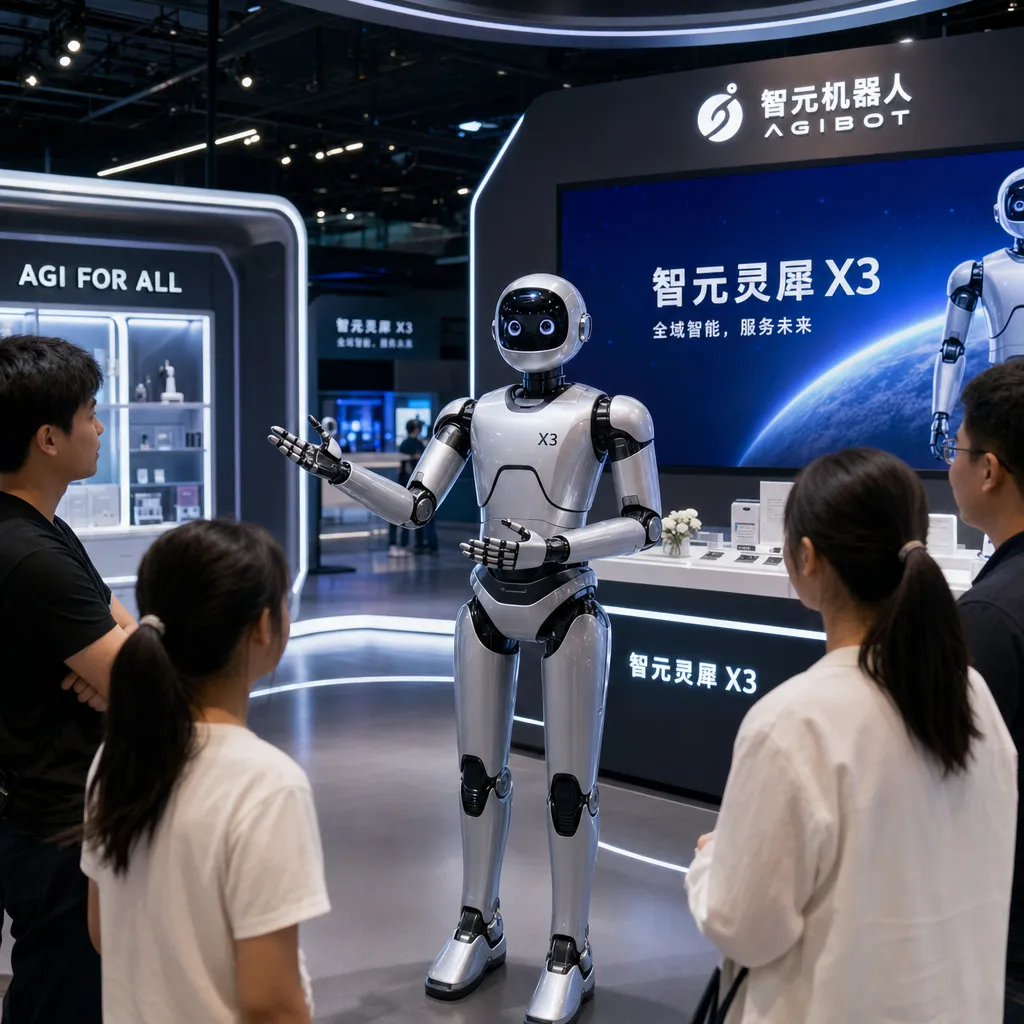
WITA Omni 1.0: End-to-End Multimodal Interaction
Zhiyuan plans to launch WITA Omni 1.0 in the third quarter of this year—the industry’s first robot-native end-to-end full-modality interaction large model.
Traditional embodied intelligence systems are modular patchworks: one model for speech recognition, another for semantic understanding, and separate modules for facial expression generation and motion planning. The problem with this is the “semantic gap” between modules—information loss and latency that cause slow, uncoordinated reactions where expressions and tone often don’t match.
WITA Omni 1.0 adopts an end-to-end architecture, using a single model to process the full chain from perception to expression. The inputs are multimodal sensor data (vision, audio, tactile), and the outputs are coordinated instructions for language, voice, expressions, and movement. Cross-modal information fusion is achieved internally through self-attention mechanisms, avoiding the shortcomings of modular splicing.
This brings several key improvements:
Interaction Latency Reduced to Under 500 ms
That’s close to the rhythm of natural human conversation. The average human response time in conversation is 200–600 ms—anything over 1 s feels “laggy.” Traditional robotic interaction systems have delays of 1–2 s, but WITA Omni 1.0 reduces that to under 500 ms, enabling continuous dialogue at normal speech speed.
Supports Interruptions, Corrections, and Mid-Sentence Interjections
This is a hallmark of natural conversation. Human dialogue isn’t strictly turn-based (“you finish, then I speak”)—people interrupt, supplement, and correct each other. WITA Omni 1.0 preserves emotional, contextual, tonal, and environmental information, enabling real-time response to interruptions and dynamic adjustment of expression strategies.
Multimodal Coordinated Expression
Language, speech, expression, and motion are fully integrated. When the robot says “I’m happy to see you,” its facial expression synchronizes with a smile, its body makes a welcoming gesture, and its tone brightens. This coordinated expression creates more natural, “personable” interactions.
Multimodal Interaction Data Flywheel
The model continuously learns through real-world deployment. Each interaction generates multimodal data (user speech, expressions, movements, and the robot’s response), which feeds back into training to make the model smarter over time. At the April conference, Zhiyuan announced its “Honeycomb Data Co-Creation Initiative,” targeting a multimodal interaction data capacity of tens of millions of hours annually.
Commercialization Path of Embodied Intelligence
Zhiyuan’s “358 Vision Plan” provides a clear roadmap: surpass RMB 10 billion in revenue by 2027 and RMB 100 billion by 2030. This is based on Zhiyuan’s judgment of embodied intelligence’s commercialization trajectory.
At the Hong Kong Embodied Intelligence Industry Summit, Zhiyuan co-founder Peng Zhihui presented the “XYZ Curve”:
- X Curve (2022–2025): Development and trial stage. Transition from prototype to mass production, turning robots from “exhibits” to “products,” achieving “mobility.” Zhiyuan achieved 5,000 units of mass production and RMB 1.05 billion revenue by 2025.
- Y Curve (2026–2030): Deployment growth phase. 2026 marks the “Year One of Deployment Mode,” when interactive and operational intelligence scale up. The deployment data flywheel drives productivity toward human-level performance. Zhiyuan plans to cross the RMB 10 billion revenue mark in this phase.
- Z Curve (2030 and beyond): Mass adoption stage. Embodied intelligence surpasses human productivity across manufacturing, logistics, and service sectors, ushering in the era of “intelligent emergence” and unlocking a trillion-yuan market.
The WITA model’s registration and Omni 1.0 launch signify Zhiyuan’s entry into the Y Curve stage—interactive intelligence is no longer a lab concept but a deployable, commercially iterative product.
From “Selling Robots” to “Delivering Outcomes”
At April’s Partner Conference, Zhiyuan released seven productivity solutions covering industrial manufacturing (3C precision, industrial transport), commercial services (store guides, restaurant retail), and specialized operations (security inspection, commercial cleaning). These solutions are already in routine use by leading enterprises such as Longqi, Fulim Seiko, and SAIC.
According to Peng Zhihui, the industry is shifting from “selling robots” to “delivering results.” Clients no longer want just a robot—they want an integrated solution: hardware, AI models, application software, deployment services, and ongoing optimization.
This shift demands a more capable tech stack. Zhiyuan’s strategy is “modular hardware, componentized software”—decoupling robot hardware, AI models, and industry application software into standard modules that can be flexibly combined per customer needs, similar to “turnkey engineering” in industrial automation.
Zhiyuan also launched the global robot leasing platform QingtianRent, offering RaaS (Robots-as-a-Service) to reduce deployment barriers. Enterprises no longer need to make large upfront purchases; instead, they can rent by demand and pay by usage time. This model has proven successful for the Cueto D2 quadruped robot—according to Zhiyuan Cueto’s CEO, mid-sized quadruped robots were sold out by Q1 2025, with 2026 revenue targets of RMB 500 million.
Full-Stack Openness of the Technology Architecture
At the April conference, Zhiyuan released its full-stack ecosystem development platform AIMA (AI Machine Architecture), built on a “1 + 3 + X” structure:
- Lingqu OS: the open-source operating system natively adapted for embodied intelligence
- Lingchuang Platform: an action-content creation platform where developers can describe movements in natural language and automatically generate control commands
- Lingxin Platform: an intelligent-agent customization platform supporting rapid construction of interactive agents for specific scenarios
- Genie Studio: a one-stop development platform integrating simulation testing, model training, and deployment management
Zhiyuan also launched the “Yuansheng” Ecosystem Development Program, investing over RMB 2 billion over five years to support scientific innovation, talent development, ecosystem partnerships, and developer community building.
This open strategy mirrors Tesla’s FSD and OpenAI’s GPT ecosystems—opening up core capabilities to attract developers and partners to build on the platform, forming data flywheels and network effects.
The Data Bottleneck of Embodied Intelligence
A core challenge for embodied intelligence is data. Training an effective embodied intelligence system requires massive high-quality robot operation data—expensive and difficult to obtain.
Zhiyuan’s solution is the “Honeycomb Data Co-Creation Initiative”—building the world’s first physical AI data network. Each Zhiyuan robot deployed in real-world scenarios becomes a data node continuously generating interaction, operation, and environmental data. After anonymization and labeling, this data feeds back into model training, benefiting all robots collectively.
This data flywheel mechanism is key to commercialization. Tesla’s FSD continuously improves its autonomous driving through data from millions of cars. Zhiyuan aims to replicate this pattern—scaling up deployment to accumulate data, using data to improve capability, and using capability to expand deployment, creating a positive feedback loop.
Zhiyuan expects to reach tens of millions of hours of annual interaction data capacity this year. At eight hours of operation per robot per day, that equates to the yearly data output of over 3,400 robots—already an industry-leading scale.
Competitive Landscape: From Tech-Driven to Demand-Driven
The competitive dynamic of embodied intelligence is shifting. Before 2025, competition was technology-driven—flashy robotic actions drew attention and funding. From 2026 onward, real-world demand will drive growth—labor shortages in manufacturing, rising service costs, and elderly-care needs are pushing embodied intelligence toward rapid adoption.
Zhiyuan’s strategy is “AI defines the body”—dedicating over three-quarters of its R&D resources to large-model AI, positioning itself as a foundational embodied intelligence model company. This parallels Tesla’s “software-defined car” and Apple’s “software-defined hardware” philosophies: hardware is the vessel, software is the core competitive edge.
The advantages of this strategy are high technical barriers, rapid iteration, and strong scalability. Once the AI model gains a lead, it can widen the gap through the data flywheel. The downside is heavy upfront investment and long return cycles, requiring sustained financial and strategic commitment.
In 2025, Zhiyuan achieved RMB 1.05 billion in revenue—up sharply from RMB 60 million in 2024—becoming China’s fastest robotics company to surpass RMB 1 billion in revenue. This validates the feasibility of the “AI defines the body” strategy.
Final Remarks
The registration of the WITA large model and the launch of Omni 1.0 mark a pivotal moment in moving embodied interactive intelligence from lab research to commercialization. Through its “One Body, Three Intelligences” architecture, XYZ Curve, and 358 Vision Plan, Zhiyuan presents a clear industrialization roadmap.
Commercialization of embodied intelligence won’t happen overnight. From “able to move” to “able to speak” to “able to perform,” each step requires breakthroughs in technology, data accumulation, and ecosystem building. But the direction is set, the path is clear—the rest is execution and iteration.
Zhiyuan targets revenue of over RMB 100 billion by 2030. That number may sound ambitious, but if embodied intelligence truly unlocks trillion-yuan productivity in manufacturing, logistics, and services, RMB 100 billion will only be the beginning.
References
- Nation’s First: Zhiyuan WITA (Silicon Photonics Dynamic Speech) Large Model Completes Registration – IT Home – Zhiyuan WITA model registration details and Omni 1.0 technical specifications


