
Tencent Cloud DataBuddy: Run the entire data process with one sentence
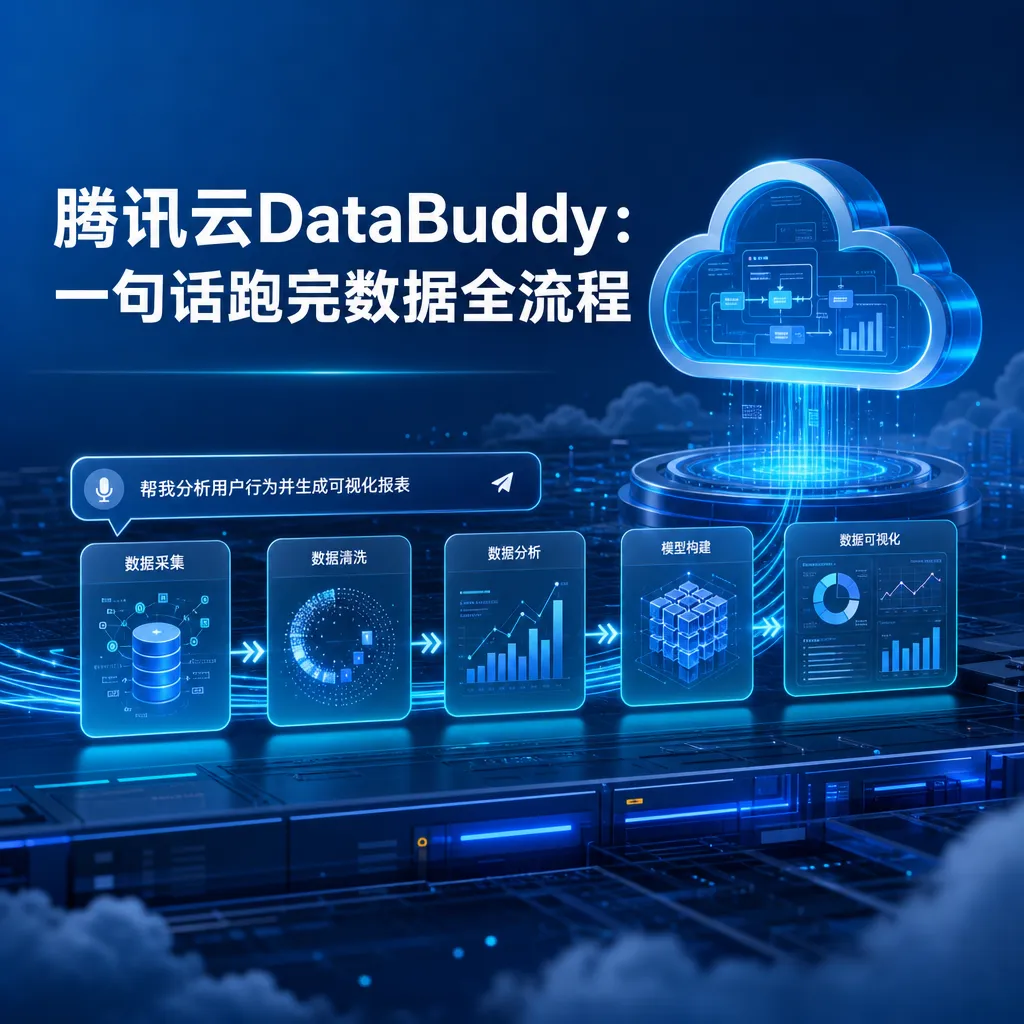
Tencent Cloud has released the big data Agent workspace **DataBuddy**, which enables complete end-to-end tasks—data integration, development, governance, and analysis—through natural language conversation. It reduces data latency from several hours to the second level, and internal practice has already cut response time by 90%.
Tencent Cloud DataBuddy: Complete the Entire Data Workflow in One Sentence
Tencent Cloud has officially launched the big data intelligent agent workbench DataBuddy, a native big data intelligent workbench built upon the underlying Agent capabilities shared with WorkBuddy. Through natural language conversations, users can complete the full chain of data ingestion, development, governance, and analysis tasks—no need to switch between multiple pages.
The core value of this product is straightforward: it compresses what used to take hours or even weeks to just seconds. Internal Tencent trials show that data query latency has been reduced by up to 90%.
The Real Problem It Solves: Slow Data Request Response
The “last mile” of enterprise data applications has long been a persistent challenge. Traditionally, the process looks like this: business users request data → the data department schedules the task → reports are developed → reports are delivered. This cycle can take from several hours to several weeks. Business teams face three main pain points:
- High barrier to data access: Requires knowledge of SQL and data models, making it inaccessible for many frontline users.
- Low analysis efficiency: Every new requirement goes through the full process, making ad‑hoc analysis slow to respond.
- Heavy reliance on tech teams: The data department becomes a bottleneck, and business decisions lag behind market changes.
Neither custom BI nor self‑service BI has fully solved the problem. The former lacks flexibility, and the latter has a steep learning curve—thus, the gap between business and technology persists.
DataBuddy’s approach is to use Agents to connect the entire process. You can simply say, “Analyze gross profit trends across major industry categories over the past six months,” and the system automatically generates SQL, renders charts, detects anomalies, and even exports a Word/PDF analysis report in one click. The decision‑making workflow shifts from seeing data to understanding data.
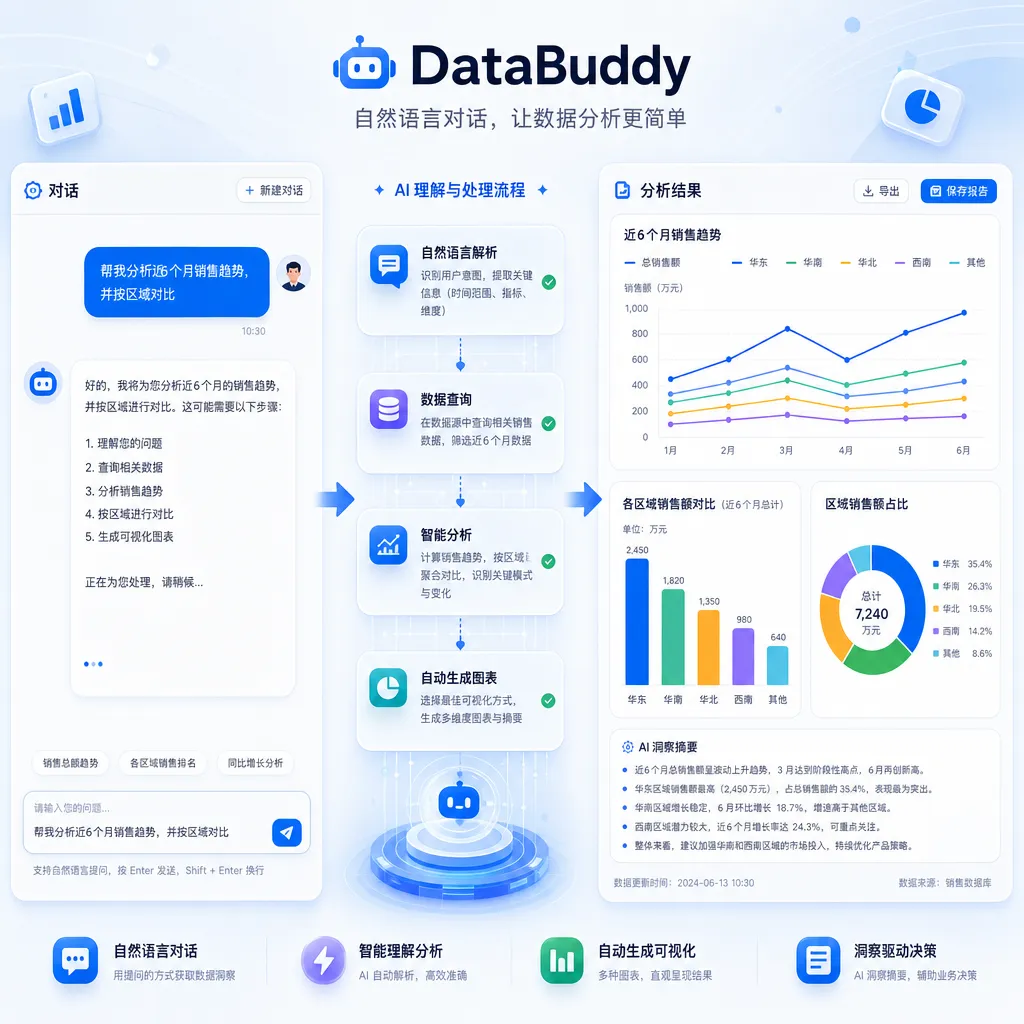
Technical Architecture: NL2DSL + DeepSeek‑R1 Deep Reasoning
DataBuddy’s core capability is Natural Language to Domain‑Specific Language (NL2DSL)—a hallmark of the Data Analysis 3.0 era. The system integrates data access, model analysis, and visualization, with key highlights including:
1. Semantic Understanding and Intent Clarification
With integration of the DeepSeek‑R1 large model, the Agent’s semantic comprehension and logical reasoning become more transparent. The model can display detailed reasoning chains, effectively clarifying vague user requests.
For instance, when a user asks “How are sales recently?” the system reasons:
- Does “recently” mean the past 7 days, 30 days, or this quarter?
- Does “sales” refer to revenue, units sold, or growth rate?
- Should the analysis be broken down by region, product, or channel?
The system actively asks for clarification instead of guessing arbitrarily.
2. Unified Semantic Layer + NL2SQL Optimization
By integrating Tencent Cloud WeData’s unified semantic layer, DataBuddy minimizes hallucinations in SQL generation and reduces token consumption by 30%. This layer serves as a “data dictionary,” explicitly defining each metric’s meaning, calculation logic, and data source—preventing the generation of incorrect queries.
3. Multi‑Platform Adaptation and Mobility
The system supports multiple endpoints (mobile, PC, embedded). Within Tencent, frontline employees and executives can query data anytime, anywhere on mobile devices—especially useful for real‑time decision‑making, e.g., a salesperson checking client data on site with a simple voice or text query.
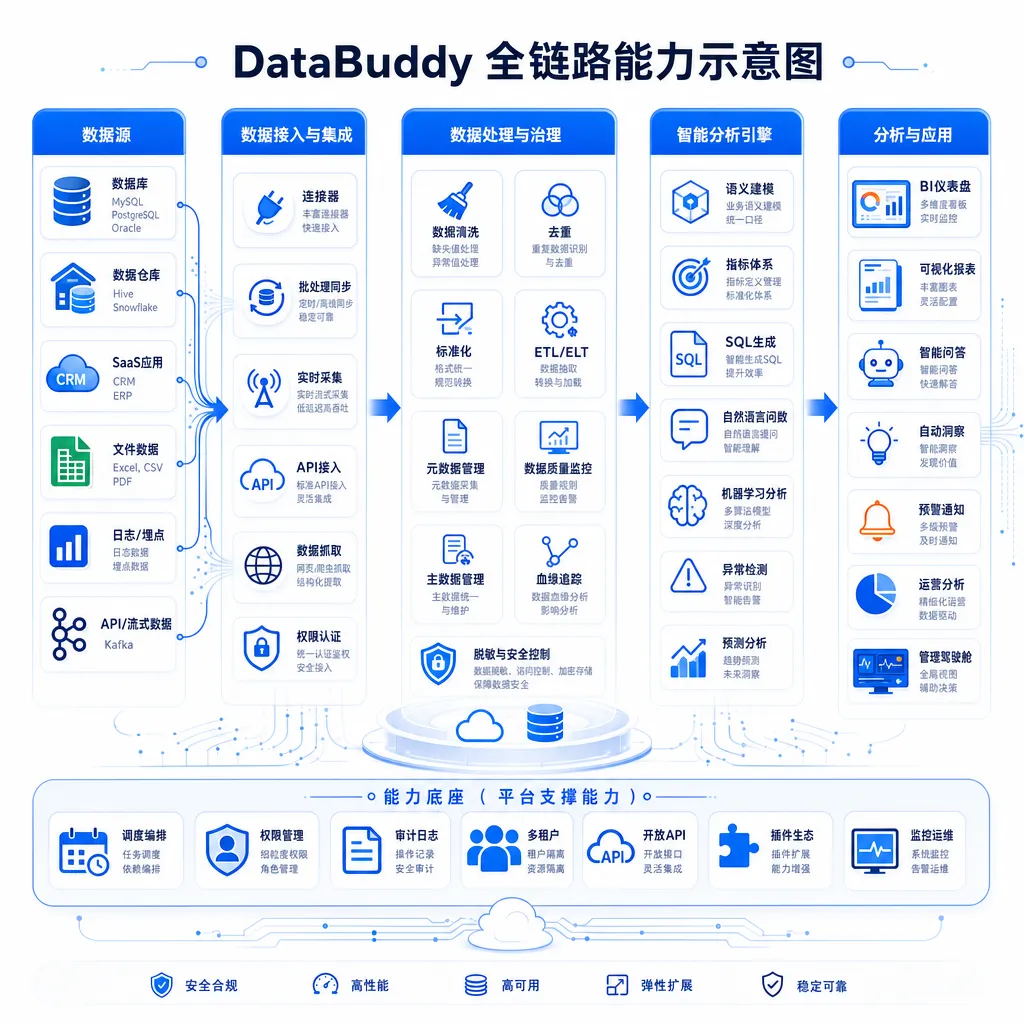
End‑to‑End Capabilities: From Ingestion → Development → Governance → Analysis
DataBuddy covers not only query and analysis but the entire big data lifecycle.
Data Ingestion
Describe data sources and ingestion rules in natural language, and the Agent configures connectors and sync policies automatically. For example: “Sync incremental MySQL order table data to the data lake at 2 AM daily.”
Data Development
Describe the data processing logic in natural language, and the Agent generates the ETL job. Example: “Join the order and user tables to calculate each user’s total spending.”
Data Governance
Automatically detects data quality issues, duplicates, and anomalies, then provides repair suggestions. If a field’s null rate spikes, the system issues alerts and diagnoses possible causes.
Data Analysis
The most direct use case: users ask questions, and the system automatically generates SQL, renders charts, performs attribution analysis, and produces reports—seamlessly.
Real‑World Impact: Significant Reduction in Data Team Workload
After Tencent’s internal rollout, the most notable result has been a major reduction in fundamental report development workloads for data teams. Routine reports that once needed manual coding can now be generated autonomously by business users via chat. Data teams can instead focus on advanced modeling and algorithm optimization.
Key results:
- 90% reduction in data access latency: from hours to seconds
- 30% reduction in token usage: due to semantic layer optimization
- Troubleshooting time reduced: from hours to 30 minutes (with Ops Agents)
These capabilities have already been extended to clients in finance, retail (e.g., Shengmu Dairy, Kao), and manufacturing sectors.
The Broader Product Matrix: Data + AI Integration
DataBuddy is not a standalone product—it’s part of Tencent Cloud’s integrated Data + AI ecosystem, unveiled at the Tencent Global Digital Ecosystem Conference in September 2025. The ecosystem spans infrastructure, data platforms, and data applications.
Foundational Architecture: The DIaaS Concept
Tencent Cloud introduced the DIaaS (Data Intelligence as a Service) concept, featuring a multimodal intelligent data lake TCLake integrated with a stream‑lake engine and enterprise‑grade search ES. It delivers millisecond‑level responses at billion‑scale vector scenarios—10× faster queries with up to 90% storage savings.
A core aspect of this architecture is multimodal data processing. Traditional platforms handle mainly structured data, but enterprises also rely heavily on unstructured content (documents, images, audio, video). TCLake supports hybrid text‑vector retrieval and introduces a one‑click AutoRAG solution to accelerate knowledge‑base construction.
Platform Layer: WeData Upgrade
Tencent Cloud’s WeData platform has evolved into an end‑to‑end Data + AI platform connecting ingestion, governance, modeling, training, and inference, unifying management across multimodal data, models, and metrics—bridging the gap from DataOps to AIOps.
Application Layer: Agent Matrix
Beyond analysis Agents like DataBuddy, Tencent Cloud has launched an intelligent Agent suite for operations, including:
- Self‑Optimizing Agent: reduces resource costs by 15%
- Autonomous Operations Agent: cuts issue resolution time from hours to 30 minutes
- Predictive Governance Agent: offers preventive alerts and automated responses
Tencent Cloud VP Huang Shifei stated that future data platforms will be increasingly Agent‑driven, forming a new generation of intelligent infrastructure. Tencent Cloud has already launched TCDataAgent on its intelligent agent development platform and plans to build a collaborative Agent ecosystem with partners across analytics and operations.
Industry Trend: The Democratization of Data Platforms
The release of DataBuddy reflects a broader shift toward the democratization of data platforms—lowering usage barriers through natural language interfaces so data intelligence becomes as accessible as utilities.
Driving this trend are declining compute costs and the proliferation of open‑source large models. As data becomes the key differentiator in enterprise intelligence, the limitations of traditional platforms—in multimodal processing, real‑time responsiveness, and knowledge‑base integration—are increasingly evident. Integrated Data + AI architectures are becoming essential.
Tencent Cloud’s “AI‑Ready” intelligent data platform leverages cloud‑native architecture, Data + AI integration, and Agent augmentation to provide enterprises with a future‑proof data foundation. This represents not mere feature stacking but a systemic re‑architecture from infrastructure to application layers.
Competitive Landscape: Everyone Is Building Agents
Data‑analysis Agents aren’t new, but few products truly enable full‑chain automation. Leading companies worldwide are now in the race:
- International: Snowflake Copilot, Databricks AI Assistant, Google Duet AI for BigQuery
- Domestic: Alibaba Cloud DataWorks AI Assistant, Huawei Cloud DataArts Studio Assistant
Tencent Cloud DataBuddy stands out in three ways:
- Full‑chain coverage: Ingestion → Development → Governance → Analysis
- Deep reasoning: powered by DeepSeek‑R1 with transparent, explainable logic
- Internal validation: deployed at scale within Tencent with verifiable results
Still, the key challenge for such products is not technical but the maturity of data governance. If an enterprise suffers from poor data quality, inconsistent metric definitions, or unclear permissions, even the smartest Agent can’t perform well. DataBuddy is thus best suited to organizations with an established data‑governance foundation rather than startups starting from scratch.
Future Direction: From Tool to Ecosystem
Tencent Cloud’s roadmap emphasizes building an open Agent ecosystem with partners. DataBuddy will not remain a closed‑off tool but evolve into an extensible platform.
Potential directions include:
- Industry‑specific Agents: tailored for finance, retail, manufacturing, etc.
- Scenario‑based Agents: marketing analytics, risk control, supply‑chain optimization, and more
- Developer ecosystem: enabling enterprises to build custom Agents atop DataBuddy
This approach parallels OpenAI GPTs and Anthropic Claude Projects, both shifting from single‑purpose tools to open ecosystems.
For developers, such products lower the barrier to data analysis but raise expectations for data engineers: rather than just writing SQL or building dashboards, they’ll design data architectures, optimize semantic layers, and train / tune Agents—a transition from execution‑level skills to architectural excellence.
References
- Tencent Cloud Releases Big Data Agent Workbench DataBuddy – 36Kr – Official product announcement
- Tencent Cloud Big Data TC Data Agent – Architecture and Practical Applications – Zhihu – Technical and implementation details


