
ByteDance Seedance 2.1 Launching Soon: 20% Improvement in Time Consistency
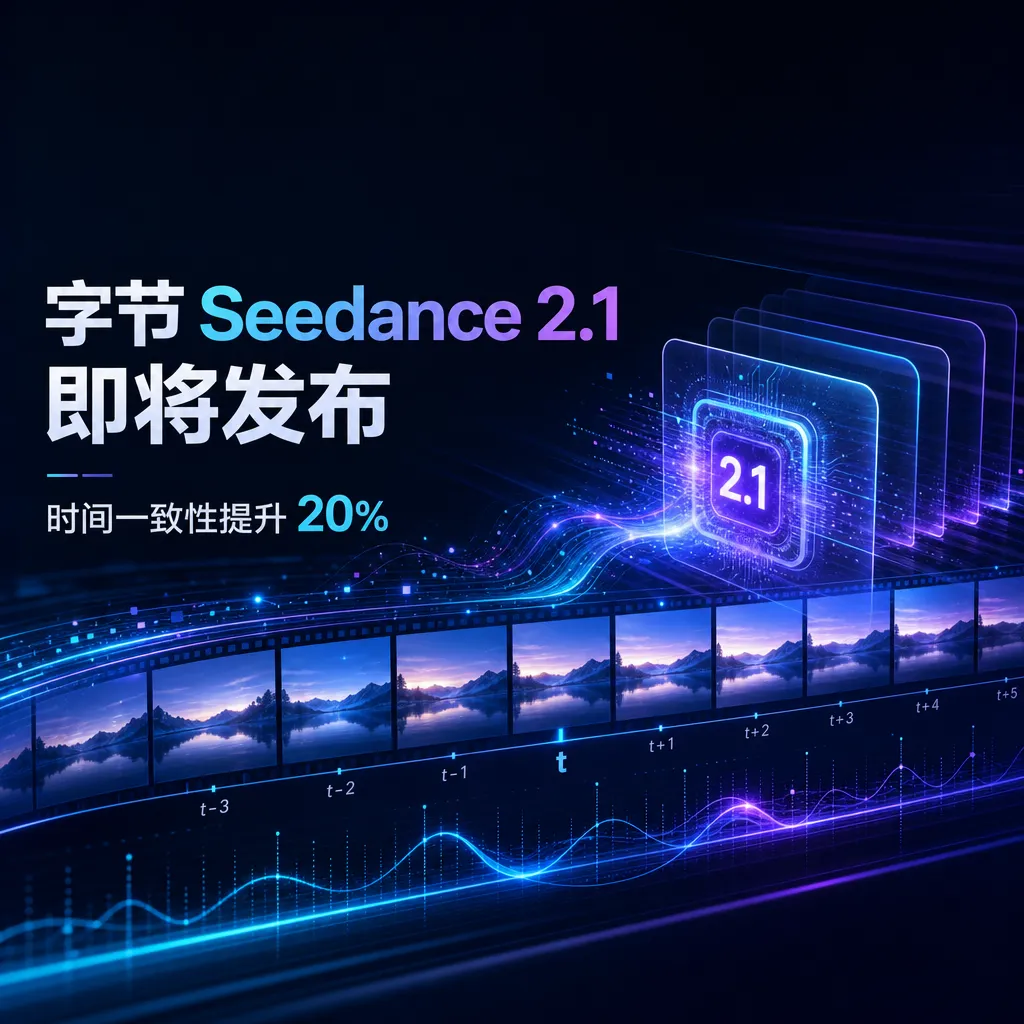
ByteDance is preparing to launch the Seedance 2.1 video generation model, with main improvements focused on temporal consistency and physical simulation. The Seedance series currently occupies over 80% of the computing power share in the AI video generation market.
ByteDance Seedance 2.1 to Launch Soon: 20% Improvement in Temporal Consistency
ByteDance is preparing to release Seedance 2.1, an updated version of its AI video generation model. According to insiders, version 2.1 improves generation quality by 20% compared to the current 2.0 release.
This 20% improvement mainly comes from advances in temporal consistency—the model’s ability to maintain visual coherence between frames—as well as improvements in physical scene simulation. ByteDance researchers also incorporated feedback from hundreds of thousands of Seedance 2.0 users during testing.
Temporal Consistency: The Core Challenge of Video Generation
Temporal consistency is a key metric for video generation models. Simply put, it measures whether objects, people, and lighting remain stable from frame to frame. Early video generation models often suffered from sudden character deformations, disappearing objects, and flickering backgrounds—the result of poor temporal consistency.
When Seedance 2.0 launched in February this year, it had already achieved impressive stability, able to render complex movements and interactions such as pair figure skating or martial arts duels with smooth, physically realistic motion. A further 20% improvement in version 2.1 means more stable generation over longer sequences, more complex multi-subject interactions, and more precise micro-expression control.
For creators, this directly impacts usability. If a 15-second video must be generated 10 times to get one without visible flaws, the tool is hardly production-ready. Improving temporal consistency essentially lowers the “footage rejection rate.”
Improvements in Physical Simulation
Another major enhancement is improved physical simulation. Seedance 2.0 could already reproduce gravity, inertia, and collisions quite well—showing realistic cloth movement, splashing water, and detailed light refraction. Version 2.1 is expected to improve multi-object physical interactions, soft-object deformation, and dynamic fluid effects.
These might sound like small details, but they are critical for professional creators. The texture and gloss on a product package, the flow of liquid into a cup, or the movement of a person’s hair can determine whether a frame looks “real.” For AI-generated videos to reach commercial quality, they must match live-action standards in these dimensions.

Market Share: Seedance Accounts for 80% of Compute Consumption
Measured by average daily compute consumption, Seedance has captured over 80% of the market, followed by Keling (~14%), Wanxiang 2.7 (~4%), while HappyHorse has dropped below 1%.
This figure says a lot. Compute usage directly reflects actual user engagement—it can’t be inflated like user registrations or DAUs. An 80% share effectively means Seedance holds a de facto monopoly in AI video generation.
That dominance wasn’t bought through subsidies or marketing—it’s driven by technical superiority. When Seedance 2.0 launched in February, it quickly went viral. Game Science founder Feng Ji even called it the “strongest video generation model on Earth.” Users voted with their feet, choosing the tool with the best generation quality and controllability.
Keling’s 14% share isn’t small either, suggesting Kuaishou still has competitive strength. But if Seedance 2.1’s quality improves as advertised, the gap could widen even further.
Application Scenarios: From Short Series to Advertising
Sources say the release of Seedance 2.1 is imminent and that ByteDance plans to integrate it into its content creation suite, including the popular video editor CapCut (known in China as Jianying).
The integration path is clear. With over 200 million monthly active users globally, CapCut is ByteDance’s cornerstone creative tool. Embedding Seedance 2.1 into CapCut effectively puts AI video generation directly into creators’ hands—no need to learn a new tool.
Seedance will first be applied in short drama and advertising production. The short drama industry is booming, but traditional production is hampered by high costs, long timelines, and limited capacity. AI video generation can dramatically cut production costs and time. An episode could be produced within hours rather than days, with costs dropping from hundreds of thousands to tens of thousands.
The same applies to advertising. A high-end commercial that once took half a month and cost over 1 million yuan could now be made in a few hours for tens of thousands. For small and medium-sized businesses, this greatly lowers the entry barrier to video marketing.
Full-length movies will take longer. While Seedance 2.0 already handles complex movements well, it still needs refinement in multi-subject consistency, text rendering accuracy, and advanced editing. Feature films demand far higher visual quality, narrative coherence, and detail control—current AI video tools aren’t there yet.
Competitive Landscape: Google Gemini Omni Joins the Race
At today’s 2026 Google I/O Developer Conference, Google unveiled the Gemini Omni model, adding a new contender to the AI video generation field. Gemini Omni claims to “generate any output from any input” and supports conversational video editing—users can change characters or backgrounds with a single instruction.
Google’s entry shakes up the field. The Gemini series has long excelled in multimodal understanding; if Omni extends this strength to video generation, it could offer differentiation in controllability and editing flexibility.
However, as of now, Gemini Omni is only at the launch stage. Its real-world performance and commercial scalability remain to be seen. Seedance’s advantage lies in having already built a full chain—from technology to product to business—backed by a massive user base, abundant feedback data, and rapid iteration. That first-mover advantage isn’t easily overtaken.
Industry Impact: The “ChatGPT Moment” for Film and Video Production
After Seedance 2.0’s launch, many film professionals described it as the industry’s “ChatGPT moment.” Animation workers noted that Seedance 2.0 can already handle many stages of animation production—and at high quality—predicting that “a reshuffle of the animation industry is imminent.”
Short drama producer Huang Minbin believes AI tools will have a disruptive impact on traditional video production, estimating that “over half of filming could soon be replaced by AI.”
This isn’t hyperbole. AI video generation is advancing faster than expected. A year ago, AI videos were barely animated slideshows; now they can deliver complex multi-person interactions, subtle facial expressions, and professional camera movement. At this pace, film-grade quality within two to three years isn’t out of reach.
That doesn’t mean traditional film professionals will lose their jobs. AI tools change how content is produced, not the creative essence itself. Roles requiring creativity and aesthetics—directors, screenwriters, art directors—will remain necessary. It’s the purely technical or execution-level positions—basic editing, VFX, animation production—that will feel the impact.
Positively, AI tools lower the barrier to creation, giving more people the means to realize ideas. A short film that once required a team, equipment, and funding can now be made by an individual using AI tools. This will lead to an explosion of content supply and new creative forms and business models.
Technical Details: Multimodal Reference and Video Editing
A key feature of Seedance 2.0 is its support for multimodal reference—it allows combining text, images, video, and audio as inputs. The model can precisely interpret multimodal content and use it as guidance for composition, cinematography, motion rhythm, sound design, and more.
This capability will likely be enhanced further in version 2.1. The challenge lies in balancing the relative weights of different modalities, handling conflicts between them, and ensuring consistent output. For example: if a user provides an image of daytime and a text prompt describing night, how does the model decide?
Seedance 2.0 also introduced video editing capabilities—allowing targeted edits of clips, characters, actions, or storylines. This was a major boost for creators. Previously, if one detail was unsatisfactory, they had to regenerate the entire video. Now, they can fine-tune specific parts, greatly improving efficiency.
The video extension feature is also intriguing. The model can continue a shot seamlessly, effectively “filming the next part.” Users can generate a 5-second clip, then ask the model to keep going. This incremental creation workflow aligns naturally with real-world production.
Audio Capabilities: Stereo Sound
Seedance 2.0 upgraded its audio system with stereo sound technology, enabling highly realistic, immersive audio generation. It supports multiple audio tracks—background music, ambient sounds, narration—precisely synced with visual rhythm.
Audio is often overlooked in AI video generation, despite being vital. Many tools focus only on visuals, producing poor or no sound. Since version 1.5, Seedance has emphasized “audio-visual synchronized generation,” and version 2.0 further strengthened its audio expressiveness.
With stereo sound, generated videos feel more immersive—for example, a person walking from left to right will have sound panning accordingly. Environmental sounds now have depth, direction, and layering instead of being flat background noise.
Audio improvements in 2.1 may be subtler than visual ones, but for professionals, they are equally crucial. In ads or short dramas, quality sound design directly affects viewer engagement.
Commercialization Path: From Free to Paid
Currently, Seedance 2.0 is available on platforms like Jimeng AI and Doubao under time-limited or quota-based free access. According to the official website, the enterprise annual plan costs $99/month, discounted to $49.9.
This strategy is typical: attract users with free or low-cost access, gather data and feedback, then transition to paid tiers. ByteDance is well-practiced in this approach—it worked for TikTok and Douyin.
Seedance’s monetization may take several forms:
- Subscription: For individual creators and SMEs, charging monthly or annually for a quota of video generation.
- Usage-based pricing: For enterprise clients, pricing by duration or volume of generated videos.
- API service: Offering APIs so developers can integrate Seedance into their own products.
- Tool suite integration: Bundling Seedance as a premium feature in tools like CapCut, monetized via membership.
Strategically, Seedance isn’t just a product—it’s infrastructure for ByteDance’s content ecosystem. By lowering creation barriers through AI video generation, ByteDance can attract more creators into its platforms and monetize via ads, e-commerce, and livestreaming. This is a long-term ecosystem play, not a rush for quick profits.
Technical Challenges: Issues Yet to Solve
Despite leading in many areas, ByteDance admits Seedance 2.0 is “still far from perfect” with several imperfections in its output.
Performance evaluations show main challenges in:
- Multi-subject consistency: Maintaining consistency among multiple characters or objects between frames is still difficult.
- Text fidelity: Generated videos with embedded text (signboards, subtitles) still lack sharpness and precision.
- Complex edits: For advanced editing needs like partial replacement or style transfer, response accuracy can improve.
These are not unique to Seedance—they’re common challenges in AI video generation. Fixing them requires larger models, richer training data, and finer alignment mechanisms.
Version 2.1 mainly targets temporal consistency and physical simulation, showing ByteDance’s focus on the core problems. Multi-subject consistency and text fidelity will likely improve in later releases.
Impact on Developers
For developers, Seedance 2.1 represents another leap in AI video generation capability. If you’re building tools in fields like content creation, marketing automation, education, or gaming, consider integrating video generation features.
ByteDance is likely to offer APIs so developers can embed Seedance functionality into their products, sparking new use cases such as:
- Automated marketing: Generate ad videos from product data.
- Personalized education: Create custom teaching videos based on learning progress.
- Game content generation: Generate in-game story clips from player interactions.
- Virtual anchors: Produce virtual character videos for streaming or short-form content.
However, AI video generation isn’t yet “plug-and-play.” Output quality depends heavily on prompt tuning. Performance, cost, and stability remain real factors. If your product demands high-quality or large-scale generation, you may need to wait for further maturity.
Summary
The imminent launch of Seedance 2.1 marks a new phase in AI video generation. A 20% boost in temporal consistency, improved physical simulation, and enhanced multimodal reference are pushing AI video creation from “usable” to “excellent.”
ByteDance has built a clear lead in this space—its 80% market share is no coincidence. But competition is only beginning. Google, OpenAI, and Meta are investing heavily. In the next year or two, AI video generation will be one of the main battlegrounds for large models.
For creators, this is the best of times. AI tools make creativity more accessible than ever. For industry professionals, it’s also a time of upheaval—technology will disrupt some roles but create new ones too. The key is to embrace change, master new tools, and adapt rather than resist.
References
- Report: ByteDance’s Seedance 2.1 Model to Launch Soon, Already Dominates 80% of AI Video Generation Compute Use – IT Home - Exclusive report from IT Home on the upcoming release of Seedance 2.1


