
Agnes has made the full‑modal API free: text, images, and video all included.
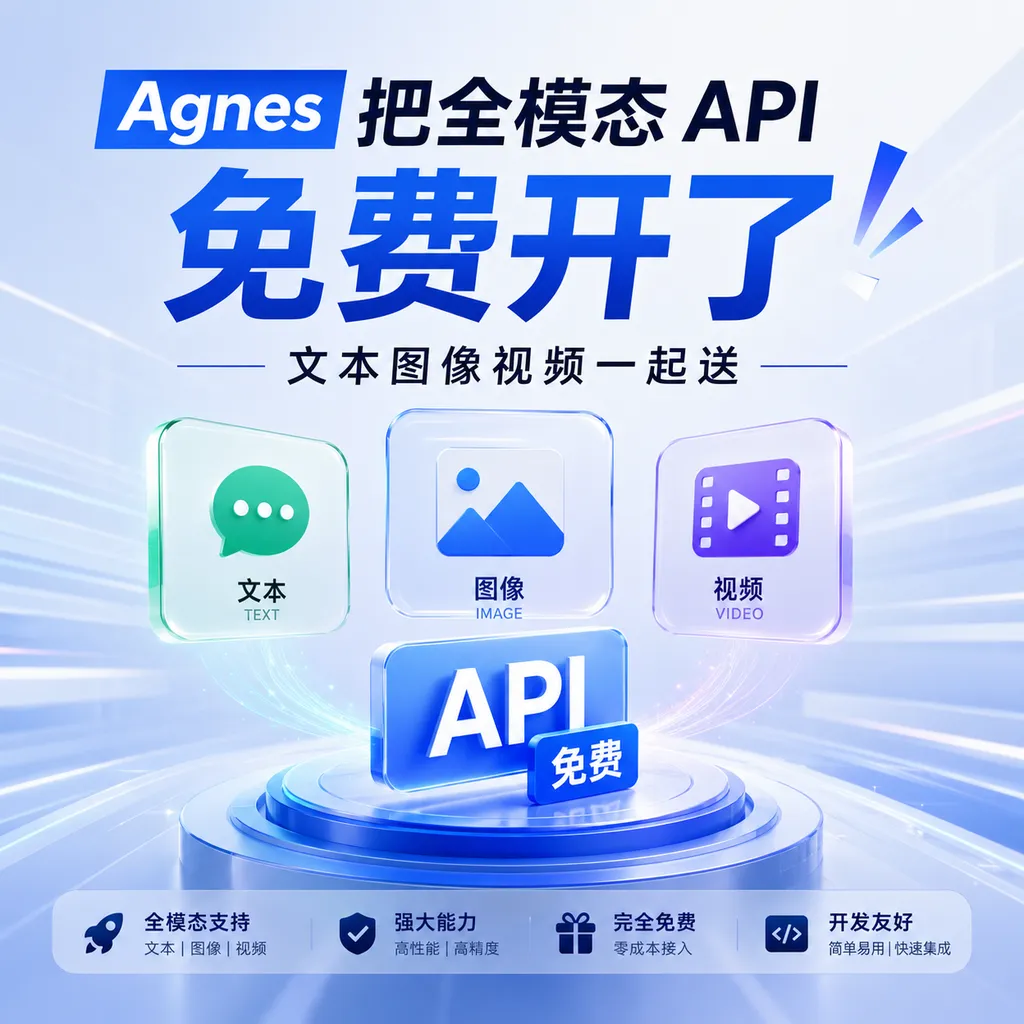
Agnes AI announced that its three model APIs for text, image, and video will be indefinitely free to use, claiming to be the world’s first fully multimodal free API. In an era where the cost of invoking agents is soaring, this is a profit‑sharing move worth serious consideration by developers.
Agnes Made Its Full-Modality API Free: Text, Image, and Video All Included
On June 1, Agnes AI announced that its three models—the text model Agnes-2.0-Flash, image model Agnes-Image-2.0-Flash, and video model Agnes-Video-2.0—would have their APIs opened indefinitely and free of charge for developers and creators worldwide.
The keyword here isn’t “free,” it’s “full-modality.” We’ve seen plenty of free APIs over the years, but most are point releases: free text generation or temporary image generation access. Agnes is the first to make text, image, and video models available simultaneously and indefinitely for free. According to the official statement, this is the “world’s first full-modality free API.”
It’s hard not to see this move as targeting the coming Agent application boom.
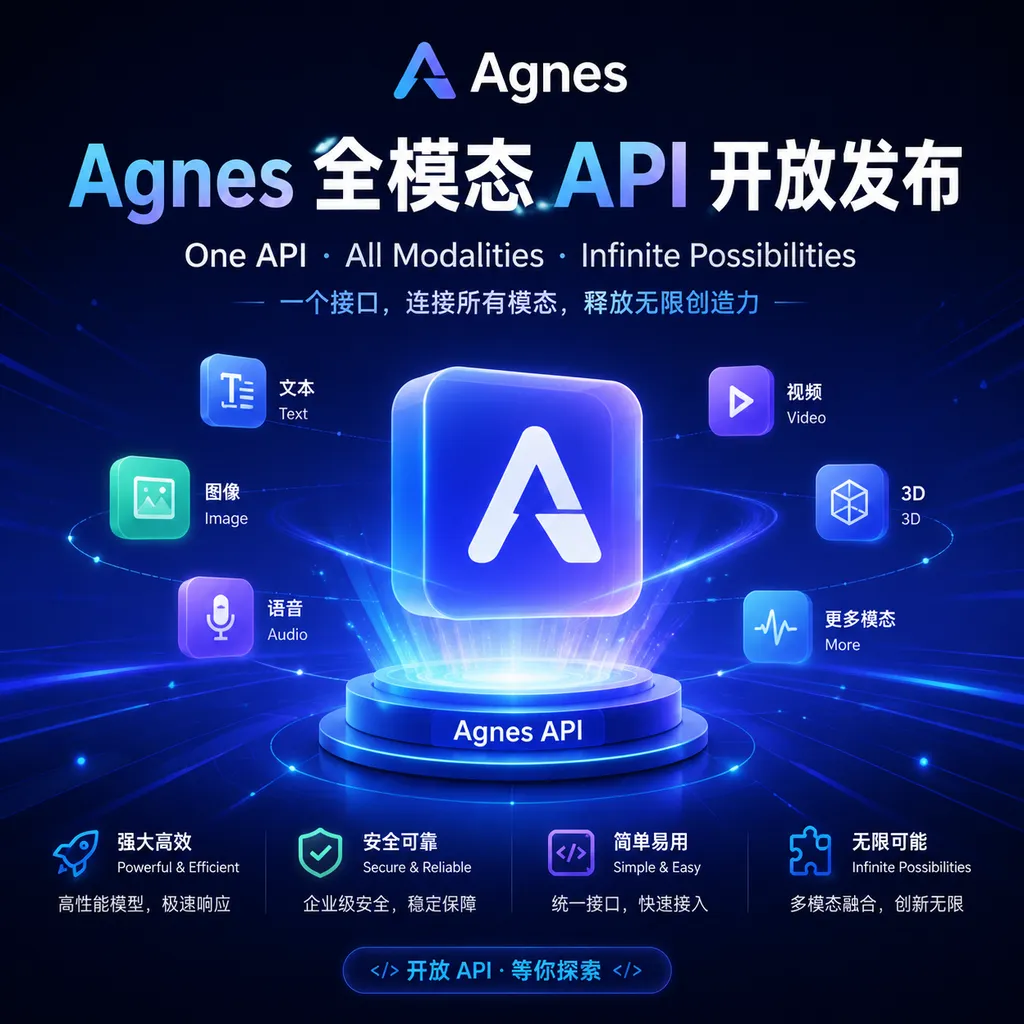
The Level of the Three Models
Let’s talk capabilities first, then strategy.
Agnes-2.0-Flash: Text Model for Engineering-Oriented Tasks
From several official prompt examples, Agnes-2.0-Flash isn’t designed as a “chat assistant” but rather focuses on structured outputs and complex engineering tasks.
Take this representative prompt:
Use Three.js + MediaPipe Hands to create a gesture-controlled 3D particle system in a single-file HTML. About 25,000 particles using custom ShaderMaterial. Vertex shader handles flicker (time + position sine oscillation + distance-based size decay). Fragment shader generates soft circular glow (exp(-d*4) radial glow + AdditiveBlending)…
A prompt like that mixes shader formulas, blending modes, and performance constraints—all requiring a truly executable single file, not just pseudocode. Agnes uses this as a demo to showcase that the “Flash” series isn’t only about speed but also the ability to deconstruct and deliver a complete project.
Another example: a Gaode Maps-style mobile app UI prompt with details like zoom controls, start/end input boxes, portrait layout, satellite basemap, road network, location icon, and scale bar—essentially a compound instruction mixing PRD, UI spec, and tech detail. This tests instruction decomposition + multi-objective alignment, not linguistic fluency.
Agnes disclosed that Agnes-2.0-Flash has appeared on the Claw-Eval leaderboard—no specific rank shared, but if they’re confident enough to benchmark it, it’s at least not bottom-tier.
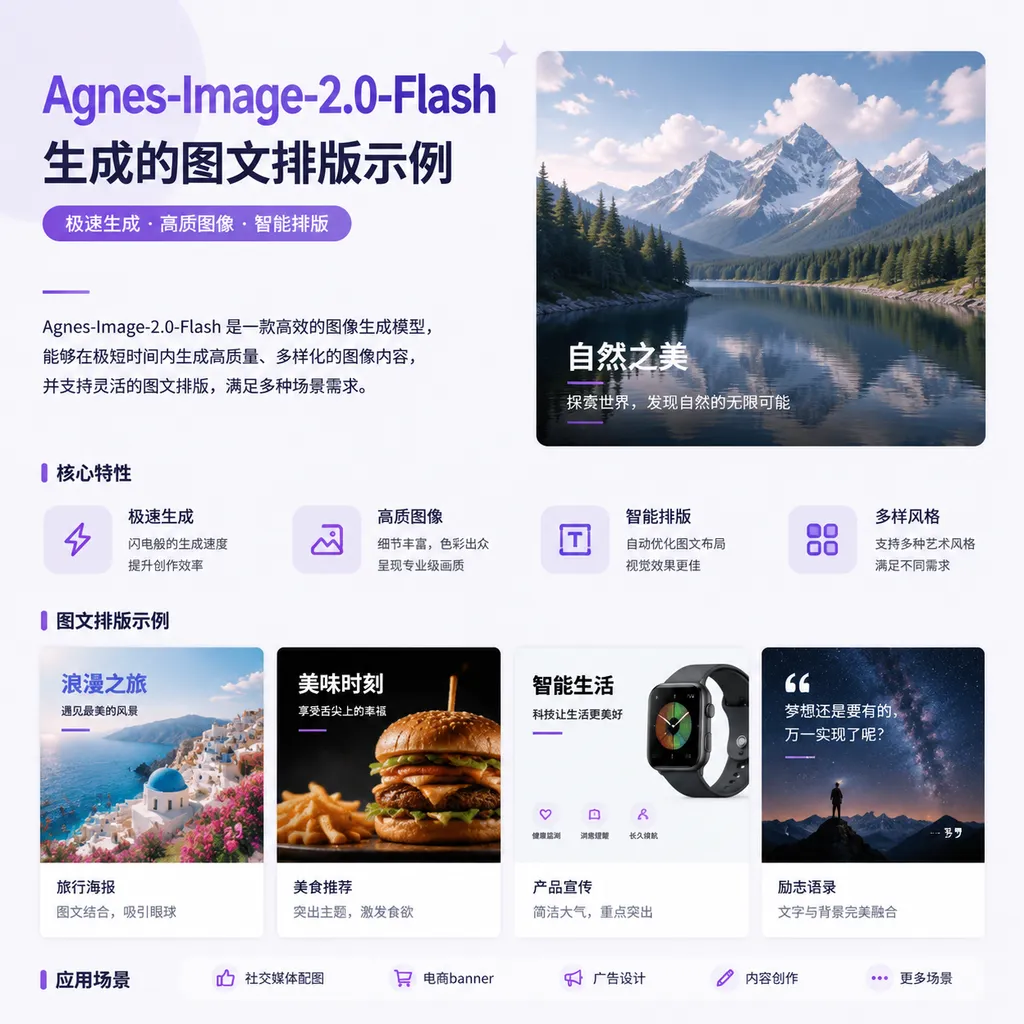
Agnes-Image-2.0-Flash: Surprisingly Strong at Layout and Infographics
On the image side, the easiest thing to showcase is a “cyberpunk rainy night in Tokyo” concept. Agnes-Image-2.0-Flash’s official example includes “wet reflective pavement, pink-blue neon lights, a lens extending through the alley, anime rendering.” It nails the ambiance, but that’s table stakes nowadays.
What really stands out is its ability in infographics and text-image layout. One official prompt is for a vertical tutorial screenshot for a mobile social app:
- Status bar shows 14:30, 5G, Wi-Fi, full battery
- Main title: dark brown bold “Chocolate Latte Zero Failure Tutorial”
- Subtitle: “Chocolate Latte Recipe”
- Light beige background, fresh minimalist Japanese vibe
- Main image: glass cup of chocolate latte showing layers — bottom chocolate syrup, middle coffee-milk blend, top milk foam with chocolate bits sprinkled
- Cup rim decorated with cinnamon stick and mint leaves
The challenge isn’t about “looking good” but following detailed instructions—miss any element (title, layering, icons, spacing, decorations) and it fails. That ability is critical for content creators making cover images for WeChat articles, short videos, courses, and corporate materials. Judging by official samples, Agnes-Image-2.0-Flash has been heavily optimized for this vertical.
It’s also listed in Artificial Analysis’s Image Editing Leaderboard.
Agnes-Video-2.0: Pushing Toward “Narrative” Video Generation
The video model is arguably the most interesting of the three.
An official prompt for a 16:9 landscape, 15-second “Dragon Flame” video breaks down structurally:
- 0–3s: Top-down view of an ancient cavern, lava slowly flowing like a river, walls lined with stalactites
- 3–7s: Mid-shot — a dragon slowly opens its eyes, golden vertical pupils, ruby-like scales
- 7–11s: Close-up — pupils contract, lava starts to boil and bubble
- 11–15s: Wide shot — dragon raises head and roars, rocks fall, wings spread generating fierce wind
Plus enhancers: “dragon VFX, fire physics, scale detail, cinematic quality, 4K resolution.”
You can see that Agnes-Video-2.0 is targeting narrative scenes—short films, ads, MVs, storyboards—not just animating stills. It even supports native audio generation. An English prompt example specifies: [SOUNDS]: Corn rustle, breathing, insects, meaning it synthesizes ambient cornfield sounds, breathing, and insect noise.
This model also appears on Artificial Analysis’s Image-to-Video Leaderboard (With Audio).
Integration: Three Approaches
Agnes offers three main access paths for different developer profiles:
1. Direct API call: Log in to platform.agnes-ai.com, create a key, follow the documentation. Fully OpenAI-compatible protocol.
2. Packaging as a Skill in Workbuddy: Configure Agnes Image 2.0 or Agnes Video 2.0 as Skills to generate images/videos directly in conversations—ideal for non-coders.
3. Set as Default Model in Local Agent Platforms (e.g., Hermes): Key configs include:
- API Key
- Custom provider
- Endpoint:
https://apihub.agnes-ai.com/v1 - Model name:
agnes-2.0-flash
For Chinese developers, OpenAI Hub-type aggregators let you access Agnes alongside GPT, Claude, Gemini, DeepSeek—all via a single key, avoiding multi-account hassle.
Why Free Now?
This move only makes sense within the Agent-era cost structure.
A simple chat request might use a few thousand tokens. But an Agent workflow—planning, searching, tool use, coding, testing, retries—blows that up by orders of magnitude. Costs can multiply ten or a hundred times.
That leads to an awkward state:
- Before you even validate PMF, API bills arrive.
- Before revenue appears, model costs mount.
- Every Agent experiment burns money—from prototype to iteration.
In such conditions, developers hesitate to run frequent tests, especially costly multimodal trials. Agnes’s free access removes the barrier—allowing anyone to build, test, and get workflows running.
To put it simply: attract users, build ecosystem, worry about monetization later. This isn’t new—DeepSeek, Qwen followed similar playbooks—but offering text, image, and video simultaneously for free is unprecedented in recent years.
How to See This Move
Free APIs aren’t cost-free—they shift cost from front-end to back-end. The key thing for developers isn’t “saving money”; it’s that Agnes is betting full-modality workflows will define the next competitive frontier.
Over the past two years, AI competition focused on “stronger”: parameters, benchmarks, flashy launches. The next phase will emphasize “more usable, more affordable, easier to integrate.”
In multimodal contexts, competition is about workflow continuity:
- Text plans the tasks
- Image generates materials
- Video provides the dynamic expression
- Tools sync across tasks
- Failures self-correct
If any link breaks, the workflow collapses. Agnes is betting that one integrated system covering all modalities will be smoother than three separate best-in-class models patched together. Whether that holds true depends on what developers decide over the coming months.
Points worth watching:
- Stability & concurrency: Free use = traffic surge. Can Agnes’s infra handle it? That’s the first retention test.
- Rate limits: What does “indefinite free” mean in practice—QPS, TPM, daily limits? Determines usability for heavy users.
- Ecosystem maturity: SDKs, docs, community, example projects—all non-model assets that make devs embed it long-term.
- Future monetization: High benchmark scores don’t guarantee workflow reliability. Post-free pricing will matter.
Industry shifts rarely come from elite tech few can afford—but from basic capabilities used widely, repeatedly, and reliably within working pipelines. Agnes’s move is a big one; now we’ll see if it can handle the follow-up demand.
References
- Starting today, indefinitely free! World’s first full-modality API launch by a Top 10 AI Lab – Zhihu — QuantumBit’s full report on Agnes AI’s free multimodal API launch
- Stop paying for API Keys! 2026 Complete Free AI Model Collection – Zhihu — Overview of domestic and global free AI model API access methods


