
Qwen3.7-Plus Launch: The Foundation of a Multimodal Intelligent Agent Takes Shape
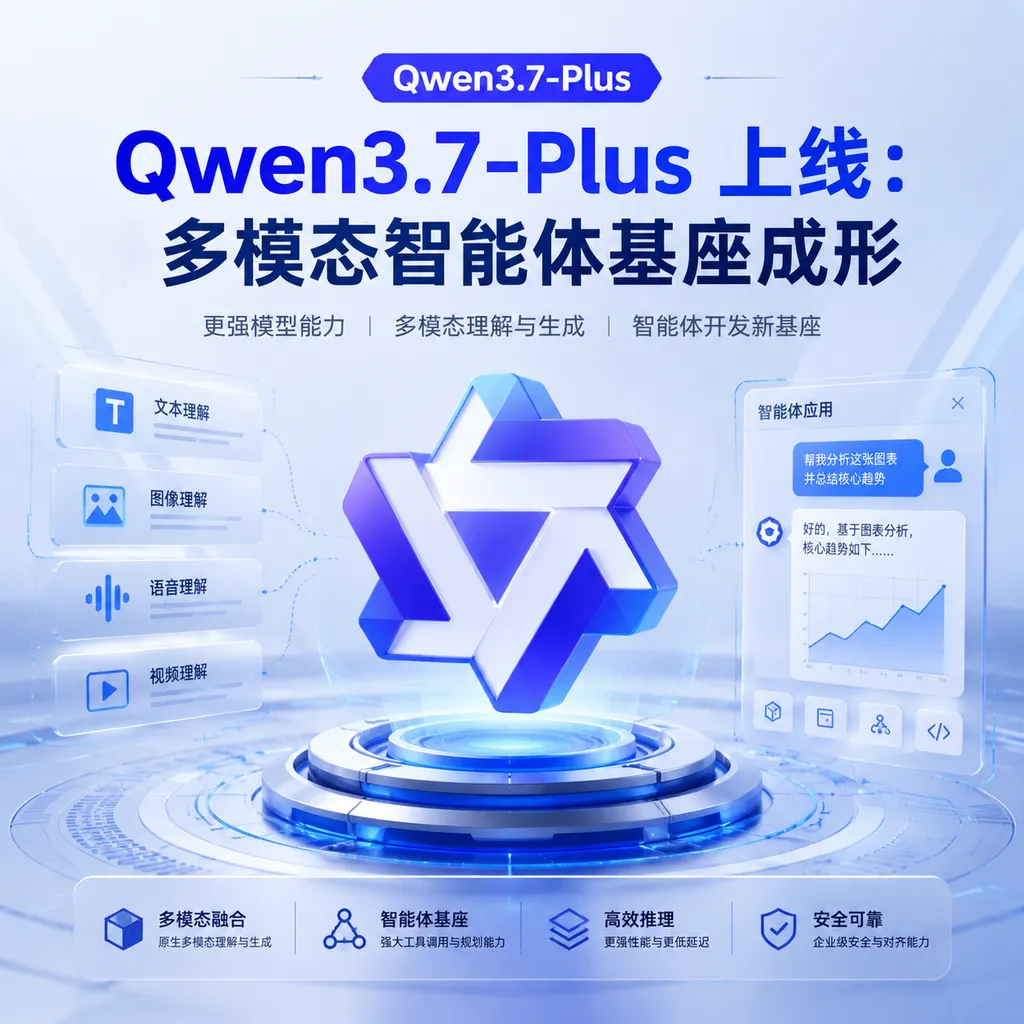
Alibaba Cloud released **Qwen3.7-Plus** today, featuring multimodal reasoning and visual agent capabilities. The Bailian API is now open for access. Following **Qwen3.7-Max** on May 20, this is the second major member of the Qwen 3.7 series, completing the capability landscape from programming agents to visual agents.
Today, Alibaba launched Qwen3.7-Plus on the Bailian API. It’s been just over ten days since Qwen3.7-Max debuted at the Alibaba Cloud Summit, and now the second shoe of the 3.7 series has dropped—this time focusing on the multimodal agent foundation.
If Qwen3.7-Max, released on May 20, highlighted “35-hour autonomous long-range tasks, 1000+ tool calls, and chip kernel self-evolution” for heavy programming-agent scenarios, then today’s Plus version addresses another challenge: when an agent needs to understand screens, the world, or video streams—who provides the foundation?
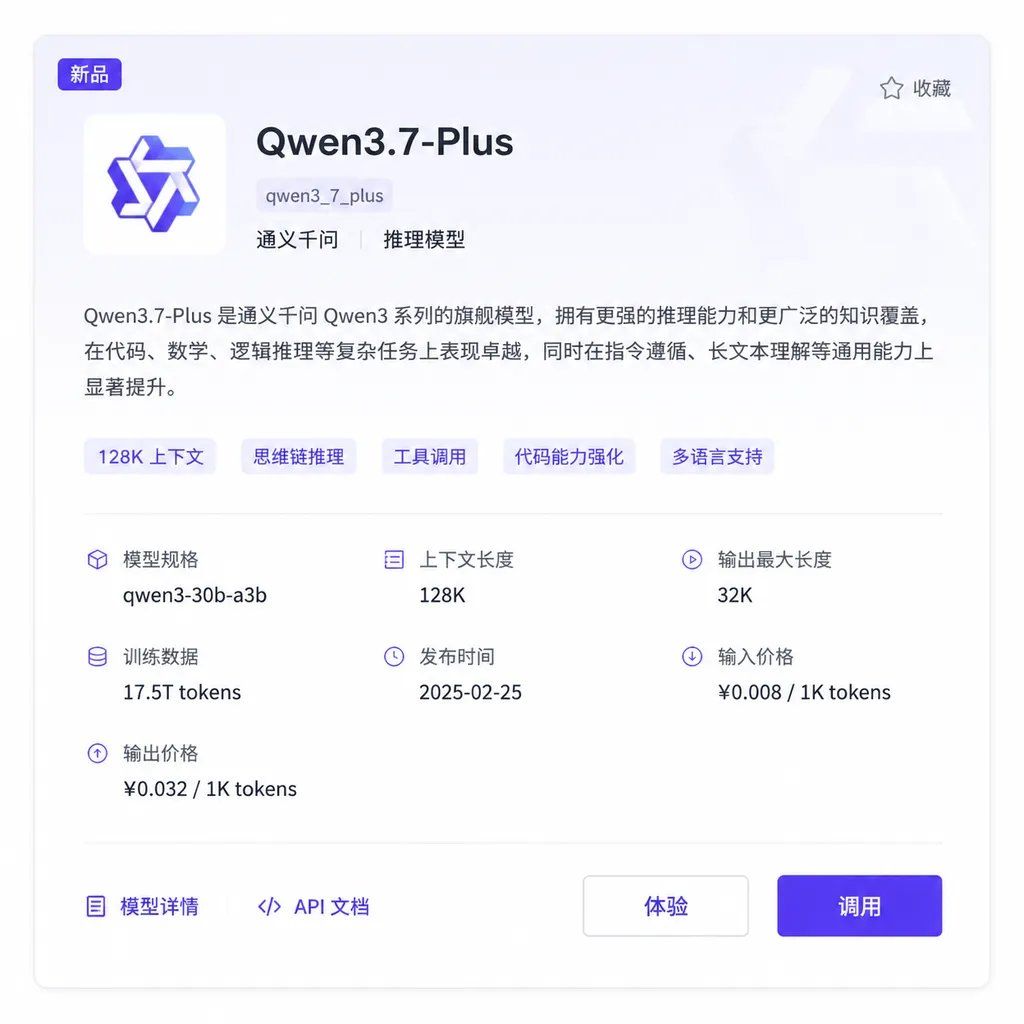
What’s upgraded this time
Based on official information and community feedback after getting API access, the changes can be broken down into three layers:
Layer one: multimodality. The visual understanding abilities from the Qwen3-VL-Plus lineage are further integrated into the 3.7 backbone, merging reasoning and non-reasoning modes. This iteration actually began back in the 3.5 Omni generation, but there was always a gap between the VL and mainline models. Qwen3.7-Plus fills that gap, meaning you no longer have to decide “should this request go through a VL model or an inference model?”—now it’s all in one endpoint.
Layer two: agent-native. The 3.7 series was designed for the agentic era from the beginning—tool-call stability, state retention in long contexts, and robustness in multi-step planning were all verified by the Max version. Plus inherits the same training paradigm but offers cost and latency more suited for scalable deployment. Max is the “brain”—fine for tasks running several hours; Plus is the “hands and feet”—high-frequency, concurrent, and fast.
Layer three: visual agents. This is the most notable improvement. Previously, when building GUI agents, computer-use systems, or video-understanding agents, developers either relied on Claude’s Computer Use or combined VL + reasoning models themselves. Qwen3.7-Plus merges visual perception, spatial reasoning, and action planning in one model—directly comparable to what Anthropic is doing, but at about one-tenth the cost.
How it complements Max
Alibaba’s product-line segmentation is increasingly clear. Here’s a table showing the current positioning of the 3.7 series:
| Version | Positioning | Typical Scenario | Context | |----------|--------------|------------------|----------| | Qwen3.7-Max | Flagship / Complex task brain | Long-range programming agents, chip optimization, research automation | Long context, intensive reasoning | | Qwen3.7-Plus | Multimodal / General-purpose agent | Visual agent, office automation, RAG, customer service | Balanced | | Qwen3.7 (upcoming) | Lightweight / High concurrency | Edge, endpoint, batch processing | Cost-prioritized |
This hierarchy is isomorphic to OpenAI’s o3 / GPT-5 / mini and Anthropic’s Opus / Sonnet / Haiku. Alibaba has finally clarified “which model do I need?”—helpful, since earlier Qwen versions (VL, Coder, Omni, Max, Plus, Flash) were confusingly numerous, forcing developers to check tables to choose.
Hands-on experience
The Bailian API endpoint went live this morning, and several developers have already run basic visual understanding tests. One representative feedback case: provide a scanned document with complex tables + handwritten notes + seals, and get structured output. The 3.7-Plus shows obvious improvement over 3.6-Plus, especially for tasks like “handwriting recognition + contextual association,” which previously required dedicated OCR pipelines.
Another surprising improvement is temporal reasoning in video understanding. Given a 30-second screencast video, it describes each step and predicts the next intent—not just frame-by-frame narration but causal reasoning: “At second 12, the user tried to click but failed because the button was disabled, so next they’re likely to find the settings.” This kind of reasoning is close to what’s needed for deployable GUI agents.
Of course, not all news is good. For pure text-heavy reasoning, Plus is weaker than Max—as intended. If your scenario involves math competition–level problems or long-chain code generation, Plus isn’t optimal.
Its position on the Arena leaderboard
When Qwen3.7-Max launched, Alibaba revealed that it ranked above Kimi-K2.6, DeepSeek-v4-pro, and GLM-5.1 on the Arena global blind test leaderboard, approaching GPT, Claude, and Gemini’s strongest models—making it the top domestic model.
That statement was actually quite modest—the word “approaching” suggests Alibaba understands there’s still a gap, but it’s no longer generational. From Qwen2 to Qwen3.7, in a little over two years, the distance between China’s closed-source flagship models and the global top tier shrank from “out of reach” to “within reach.” That’s one of the biggest industry shifts in the past 18 months.
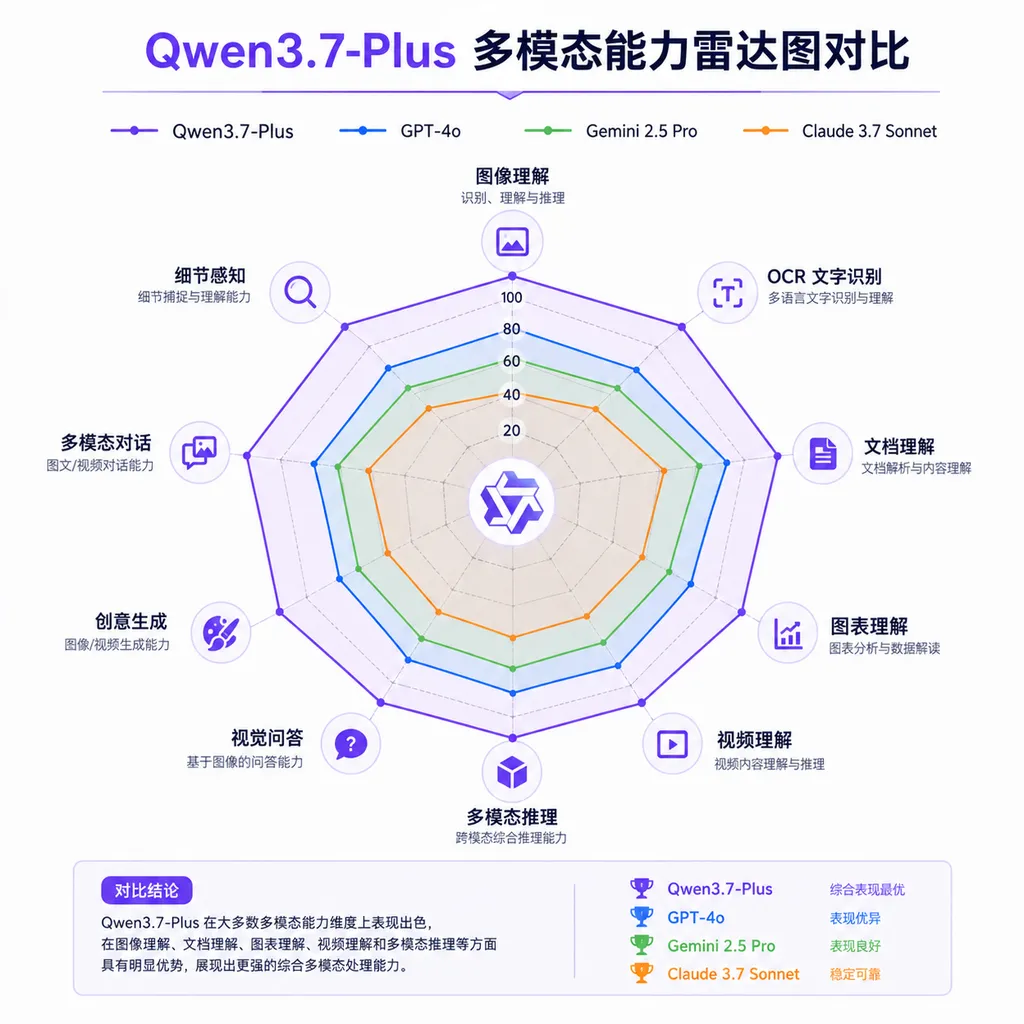
Plus, being differently positioned, hasn’t competed on overall rankings yet. But in multimodal subcategories (MMMU, MathVista, VideoMME, etc.), Alibaba’s internal test data shows it’s reached Gemini 2.5 Pro levels. Third-party reproductions will take some time.
Pricing and integration
Alibaba continues the same strategy from the Qwen3.7-Max launch—50% off pay-as-you-go inference until June 22. This generous discount incentivizes developers to test and validate business use cases before committing long-term.
Invocation on the Bailian platform is unchanged—just replace the model field with qwen3.7-plus. The OpenAI-compatible format layer has been updated: if your code previously accessed GPT-4o, switching the base_url and model name is enough.
Teams already using aggregator platforms like OpenAI Hub have instant access to Qwen3.7-Plus as well—direct domestic connection, no routing required. A single key can call Qwen3.7, GPT-5, Claude, Gemini simultaneously, making A/B testing of prompts simple. Evaluating which performs better and costs less is far more reliable than comparing benchmark numbers.
Industry implications
Looking at the broader picture, Alibaba’s release rhythm for the 3.7 series is quite interesting:
- May 20: Max launch, alongside chip–cloud–model–inference full-stack technology framework.
- Late May: Peripheral models go live—Qwen3.5-LiveTranslate, Wan2.7-Image, Wan2.7-R2V, Qwen3-TTS-Flash, etc.
- June 1: Plus release, completing the multimodal agent foundation.
This is not simply “we released a new model,” but “we released an entire infrastructure stack for the agent era.” The model is only the middle layer—below it are self-developed chips and cloud systems; above it are agent development platforms and application templates. Alibaba is building AI the way it builds cloud—selling capability stacks, not just models.
OpenAI’s path is constrained (tied to hardware and cloud dependencies), Anthropic can’t quite move forward (no self-owned cloud), Google flows smoothly (TPU + GCP + Gemini + Workspace), and Alibaba is now pursuing the Google-style route—with deeper localization.
Advice for developers
If you’re working on the following types of products, start evaluating Qwen3.7-Plus today:
- GUI automation / RPA agents — visual understanding + tool invocation are key; Plus is currently the best domestic fit.
- Multimodal RAG — parsing and Q&A for PDFs, scans, tables, mixed text-image documents; Plus’s OCR-free comprehension is sufficient.
- Video content understanding / short-video review — clear progress in temporal reasoning.
- Customer service / conversational bots — if users upload images (e.g., screenshots, product queries), Plus is simpler and cleaner than combining a text model with a separate VL model.
Conversely, if your scenario involves heavy reasoning (code generation, math, research), choose Max. For pure high-concurrency text tasks (abstracting, translation, classification), wait for the standard or Flash version of Qwen3.7 later in June.
The 3.7 series isn’t complete yet. Given Alibaba’s pace over the past year, Coder and Omni versions are likely on the way. Alibaba is playing a long game.
References
- Qwen3.7-Plus Release Discussion – linux.do — First-hand community release news and early developer test feedback


