
Ali Meoo integrates the entire WeChat Mini Program workflow, enabling direct deployment of generated dialogues.
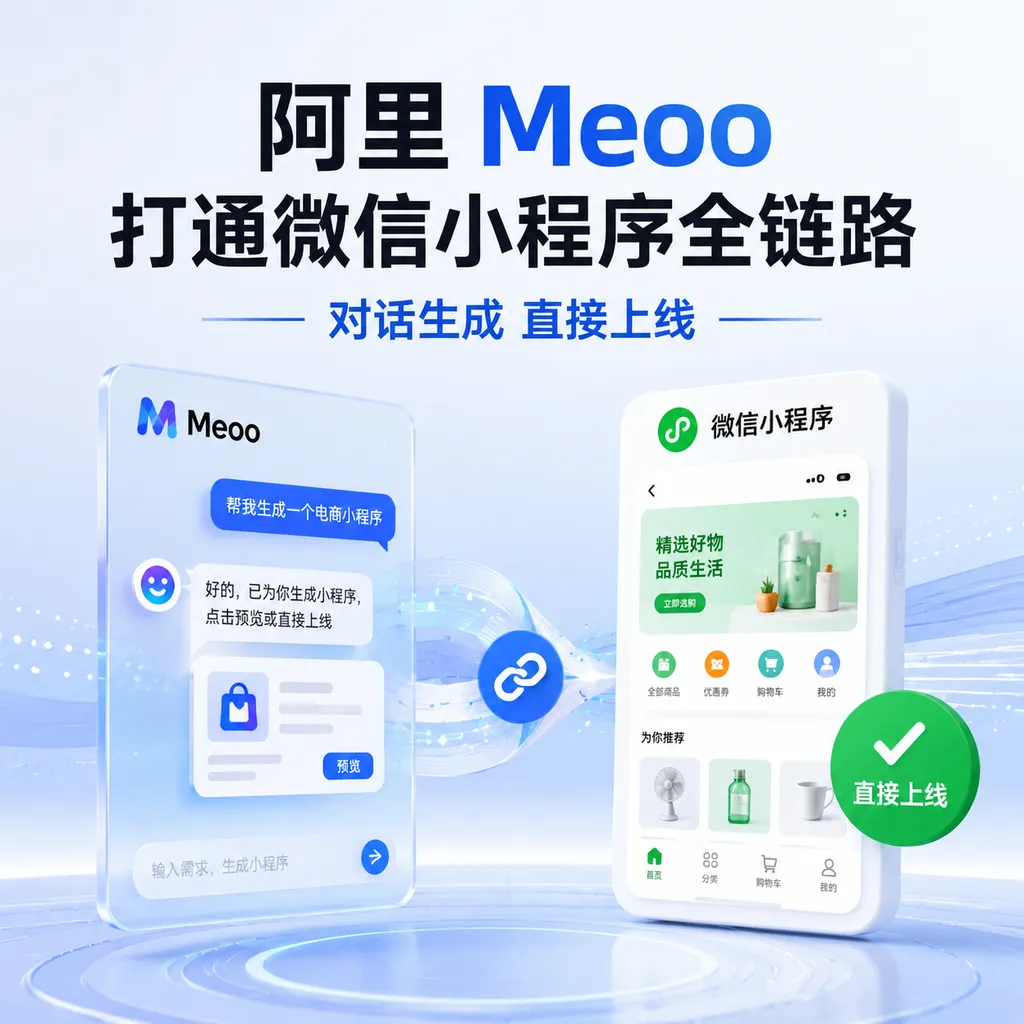
Ali Meoo has launched the WeChat Mini Program generation feature today. Users can create, review, and publish Mini Programs simply through natural language conversations, enabling a complete workflow from development to launch and further lowering the application development barrier for non-technical users.
Ali Meoo Integrates Full WeChat Mini Program Development Pipeline, Conversational Generation Directly Goes Live
Ali Meoo (秒悟) today launched a WeChat Mini Program generation feature, enabling integration with WeChat login and connecting the full pipeline from creation and review to publishing. Users don’t need to write code—through natural language conversations, they can develop group-buying mini programs, event registration pages, fitness check-in tools, and other applications, and directly publish them into the WeChat ecosystem.
This is another step on Meoo’s “generate and go live” journey after supporting one-click deployment of web applications to Alibaba Cloud. Compared to other AI programming tools, Meoo’s differentiation lies in not helping programmers code faster, but in allowing non-technical users to skip programming entirely.
From Conversation to Live: Full WeChat Mini Program Pipeline
The core logic behind Meoo’s WeChat Mini Program generation feature is straightforward: users describe their needs in natural language, the AI generates code and completes configuration, then automatically submits the mini program for WeChat review and publishes it live. The entire process requires no code interaction, no server configuration, and no understanding of mini program development standards.
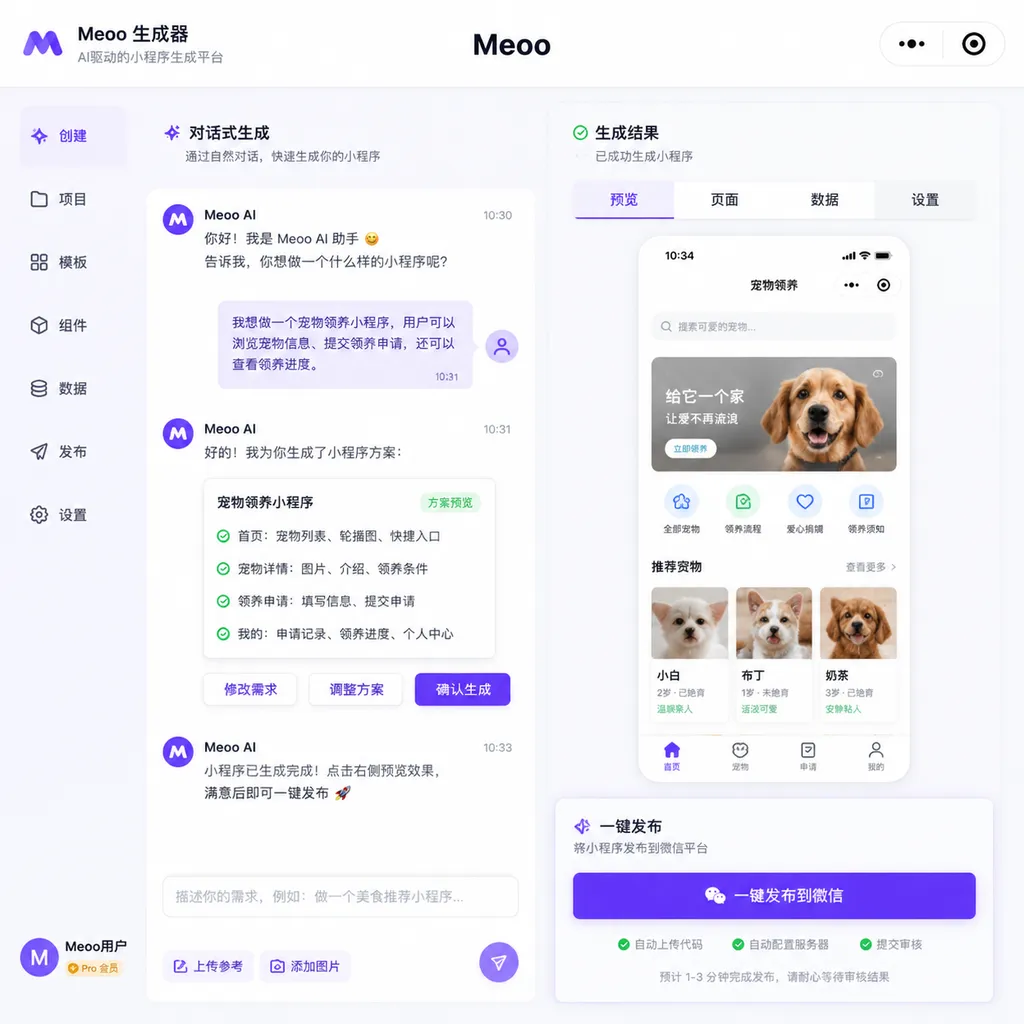
Specifically, the feature covers the following steps:
- Requirements understanding and code generation: Users describe what kind of mini program they want. Meoo, based on a multi-model aggregation architecture (GPT-4o, Kimi K2.5, GLM-5, Claude Sonnet 3.5), generates front-end pages, back-end logic, and database structures.
- WeChat login integration: Automatically configures Open ID retrieval and user info authorization processes. No manual AppID and AppSecret application required.
- Review and publishing: Generated programs are directly submitted for WeChat Mini Program review, then published with one click upon approval. Users can share and use them via mini program QR codes.
- Cloud hosting: Back-end services are automatically deployed to Alibaba Cloud Function Compute (FC), data stored in RDS or OSS. No need for users to purchase servers or configure domains.
The key to this process is automating the most tedious parts of mini program development—developer credential verification, code package upload, version management, and the review process. For non-technical merchants or creators, work that previously required outsourcing or developer help can now be done through conversation.
Meoo’s Technical Architecture: Four-Model Aggregation + Swarm Agents
Meoo doesn’t just throw user requirements at a single large model—it uses multiple models working together, with a Swarm Agent mechanism processing different modules in parallel.
Currently, Meoo integrates four mainstream models:
| Model | Vendor | Main Capabilities | |-------|--------|-------------------| | GPT-4o | OpenAI | Code generation, architecture design | | Kimi K2.5 | Moonshot AI | Long-context reasoning, complex requirements breakdown | | GLM-5 | Zhipu AI | Multi-round dialogue, intelligent error correction | | Claude Sonnet 3.5 | Anthropic | Code debugging, logic optimization |
The Swarm Agent approach means multiple AI agents handle front-end, back-end, database, UI design, and other distinct tasks in parallel. Each agent can call different models, choosing the most suitable for the task type. After generation, automatic testing and secondary optimization occur—if one module fails, other agents take over and fix it.
Advantages of this architecture include speed and fault tolerance. Simple mini programs (like message walls or check-in tools) can be generated and published within 1–2 minutes; complex e-commerce or booking systems can complete a first version within 10 minutes. Even if one model’s code has bugs, the Swarm mechanism automatically calls other models to fix them, eliminating the need for user debugging.
Comparing Competitors: Meoo Is About “Development Without Programmers”
Many AI programming tools have launched over the past two years, but their positioning differs fundamentally from Meoo.
Cursor targets professional developers via an AI IDE, focusing on code completion, refactoring, and debugging to improve coding efficiency. Users must understand code, know how to configure environments, and deploy apps. Cursor helps programmers code faster; Meoo enables non-programmers to eliminate programmers.
Bolt.new and Lovable are Meoo’s closest competitors, both offering natural language app generation. However, they usually produce 60–70% of a solution, requiring developers to complete the rest (database migrations, API debugging, SSL certificate setup) before production. Because Meoo integrates the full Alibaba Cloud infrastructure pipeline, it goes further toward “generate and use”—users don’t need to grasp server, domain, or CDN concepts; clicking publish puts it live.
Bolt.new and Lovable still have advantages in ecosystem maturity and community presence in overseas markets. Meoo’s limitation is that generated apps are tied to Alibaba Cloud—migrating to AWS or self-hosting requires manual code export and reconfiguration. Meoo also doesn’t currently support outputting source code for secondary development, which limits appeal for technical users.
Replit Agent offers a complete cloud IDE environment, suitable for experimenting ideas with a technical background. Meoo hides all technical details, making it more suitable for purely non-technical users. Replit’s strengths lie in openness and extensibility; Meoo’s in low barriers and deep Alibaba Cloud integration.
v0 (Vercel) focuses on front-end UI component generation, producing polished React + Tailwind code but without back-end logic or deployment. Meoo offers full-stack generation + deployment, though single-page UI polish may not match v0. They are more complementary than competitive.
The Practical Meaning of WeChat Mini Program Generation
WeChat’s mini program developer landscape is polarized: big companies and mature teams employ professional developers; SMEs and individual creators either outsource or use templates. Meoo targets the latter—those with business needs or creative ideas, but no technical skills and unwilling to outsource simple functions.
Example scenarios:
- Local merchants: Want a group-buying mini program or a membership points system, but outsourcing costs tens of thousands, templates lack flexibility. Describe needs via Meoo, generate a usable mini program in minutes, almost no cost.
- Event organizers: Need a registration page or voting mini program, but won’t use it after the event ends. Generate with Meoo, use and discard without long-term maintenance.
- Independent developers: Want to validate a product idea without setting up infrastructure. Generate an MVP quickly via Meoo, decide whether to deepen development after validating demand.
- Internal enterprise tools: Finance, HR, operations departments need simple data entry or approval tools. Build with Meoo themselves without occupying development resources.
From Alibaba’s internal usage data, over 10,000 employees use Meoo, 80% from non-technical roles. This shows “enabling non-technical users to solve simple needs themselves” is a real use case.
Yet the WeChat Mini Program generation feature has limitations. It suits relatively standardized functions (forms, lists, check-ins, bookings); complex business logic or highly customized UIs reduce code quality and maintainability. WeChat’s review process itself is uncertain—automatic submission notwithstanding, users may face rejection due to content, category, or credentials. Additionally, Meoo-generated mini programs are bound to Alibaba Cloud; switching cloud providers or self-hosting later involves high migration costs.
Meoo’s Business Logic and Competitive Moat
Meoo’s business model remains unclear. Public information shows it’s still free—users can generate and deploy without paying, consuming only Alibaba Cloud computation and storage resources. This is unsustainable, and future monetization may take one of the following approaches:
- Usage-based billing: Charge by number of generated apps, API calls, cloud resource consumption—similar to Vercel or Netlify pricing.
- Subscriptions: Offer free and paid tiers; free tier limits apps and traffic, paid unlocks more functions (custom domains, higher concurrency, code export).
- Alibaba Cloud ecosystem binding: Use Meoo as a customer acquisition tool for Alibaba Cloud, monetizing by prompting users to consume other services (CDN, object storage, databases).
Meoo’s competitive moat lies mainly in two areas. First, deep integration with Alibaba Cloud infrastructure. Other AI programming tools either don’t deploy (Cursor, v0) or require user-configured cloud services (Bolt.new). Meoo bundles ECS, RDS, OSS, Function Compute, domain services, SSL certificates, CDN acceleration—users needn’t understand these to put apps online. This “generate and go live” experience is hard for other tools to replicate.
The second is multi-model aggregation + Swarm Agent architecture. A single model’s code generation has limits, and different models excel in different areas (GPT-4o in architecture design, Kimi K2.5 in long-context reasoning). Through multi-model collaboration and auto-error correction, Meoo achieves quality and speed advantages. However, this moat isn’t high—other vendors could adopt similar architecture.
Meoo’s weakness is current support only for web apps and WeChat mini programs, not native mobile apps (iOS/Android), desktop apps, or other platforms (Douyin mini programs, Alipay mini programs). And the Alibaba Cloud binding means migration costs for AWS, Tencent Cloud, or other users are high.
What This Means for Developers
If you’re a professional developer, Meoo is unlikely to replace your work. Its code quality, maintainability, and performance optimization lag behind human-written code, and it doesn’t support complex logic or deep customization. Meoo functions more like a prototyping tool or internal tool generator, rapidly building MVPs or solving non-core needs.
If you’re an independent developer or small team, Meoo can greatly reduce time costs. For example, validating a product idea previously required days setting up front-end, back-end, and database; now, you can generate a usable version in minutes, check demand, and decide whether to deepen development. Or build a simple admin dashboard or data entry tool for a client faster than coding manually.
For non-technical users, Meoo’s value is even clearer. It lowers the barrier for “turning ideas into apps” to a historic minimum. Previously, you had to learn programming, frameworks, deployment, or pay for outsourcing; now, you just describe your needs in natural language. While not perfect, for simple business cases (forms, lists, check-ins, bookings) it’s already sufficient.
With Meoo’s WeChat Mini Program generation feature live, the most immediate impact may be further shrinking the low-end demand in the mini program outsourcing market. For standardized, low-customization mini programs (group-buying, registration, check-in), users can generate them themselves, bypassing thousands-to-tens-of-thousands outsourcing costs. Outsourcing teams may shift to more complex, more customized requirements, or transform into Meoo service providers, optimizing and maintaining Meoo-generated apps.
References
- 36Kr – Ali Meoo Supports Conversational Generation of WeChat Mini Programs, Connecting Creation, Review, and Publishing Pipeline – Official newsflash, confirming launch time and core capabilities.
- Zhihu – I Developed and Launched an App in 1 Minute, Who Needs to Learn Programming with Ali Meoo – User test case, showing complete process from requirement to launch.
- SegmentFault – From Idea to Launch in 1 Minute: How Ali Meoo Redefines “Development for All” – Technical architecture deep dive, including multi-model aggregation and Swarm Agent mechanism explanation.


