
Huawei Cloud Smart Orchard is live: One-click access to mainstream models like DeepSeek and Kimi
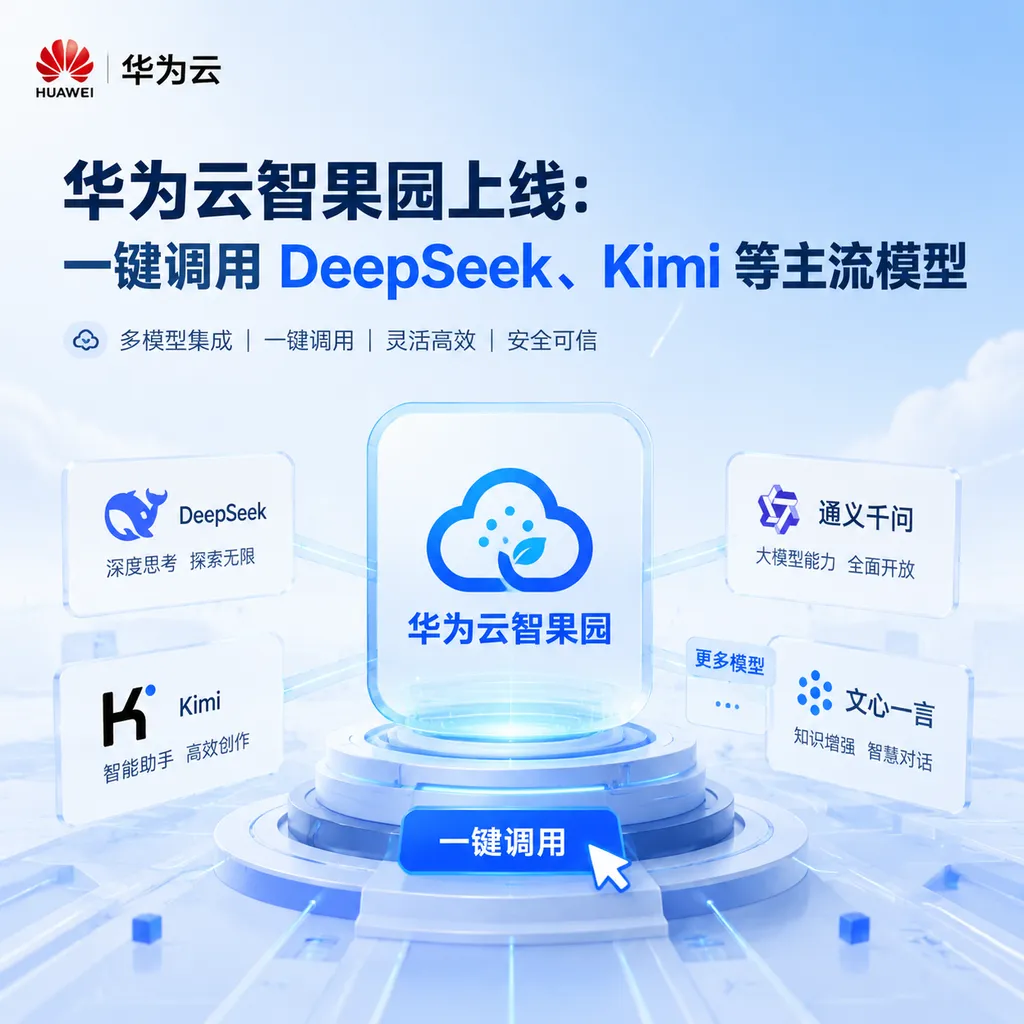
At the INSPIRE Innovators Conference, Huawei Cloud launched the Agentic AI portal **"Smart Orchard"**, integrating 15+ mainstream large models, supporting rapid customization of agents via the AgentArts platform, and offering a matching Token Plan subscription program.
Huawei Cloud “Smart Orchard” Goes Live: One-Click Access to Mainstream Models like DeepSeek, Kimi
At the INSPIRE Creator Conference on June 5, Huawei Cloud launched a new cloud portal for the Agentic AI era called “Smart Orchard.” The core selling point of this product is: a single entry point to invoke mainstream models from multiple providers, quickly build agents via the AgentArts platform, and package Huawei Cloud’s various capabilities as callable Skills and CLI commands.
From a product positioning perspective, Smart Orchard targets agent development platforms like OpenAI’s GPTs or Anthropic’s Claude Projects, but Huawei Cloud is taking a “cloud services + agents + multi-model” bundled approach. This thinking is relatively novel among domestic cloud providers — Alibaba Cloud and Tencent Cloud currently focus on their own model services and function computing, without a unified portal specifically designed for agent development.
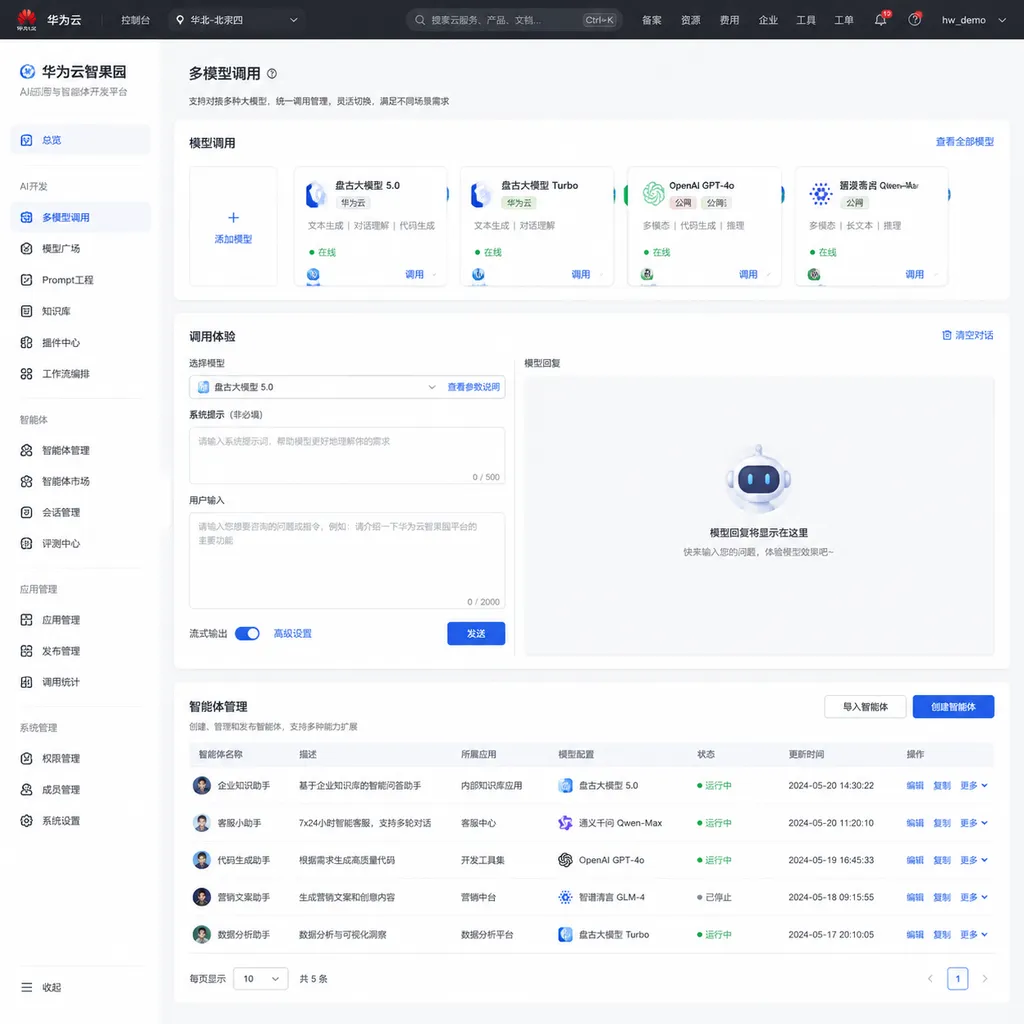
Integrates 15+ Mainstream Models, Model Routing Accuracy of 95%
Smart Orchard’s most direct function is model aggregation. According to official information, it currently supports one-click invocation of:
- DeepSeek-V4-Pro
- Zhipu GLM-5.1
- Moonshot Kimi-K2.6
- Qianwen Qwen-Image
- Huawei Cloud’s own Pangu series of models
This model pool covers mainstream scenarios including text generation, image understanding, and long-text processing. Huawei Cloud also mentioned at the conference that the underlying ModelArts Next platform integrates intelligent model routing, supporting three scheduling strategies:
- Cost Priority: Automatically select the cheapest available model
- Performance Priority: Match the strongest model based on task complexity
- Balanced Mode: Find a middle ground between cost and performance
Official data says scheduling accuracy exceeds 95%, enabling enterprises to reduce average model invocation costs by 20%. This routing logic is similar to third-party aggregation services like Martian or OpenRouter, but Huawei Cloud has built it into the cloud platform’s foundations, theoretically offering greater stability for large-scale usage.
For developers, multi-model aggregation has two practical values:
- Lower switching costs: No need to rewrite adapter code when integrating new models
- Flexible cost control: Use cheaper models for simple tasks, stronger models for complex tasks — avoiding a one-size-fits-all approach
There is a notable shortcoming: supported models are mainly domestic, with no presence yet of top overseas models like GPT-4o or Claude 3.5 Sonnet. For scenarios requiring top reasoning capabilities (e.g., complex code generation, mathematical reasoning), overseas model APIs would still need to be integrated separately.
AgentArts Platform: Enterprise-Grade Agent Development Tool with 90% Open-Sourced Core
The second core of Smart Orchard is the AgentArts enterprise-grade agent platform, now in public beta. Huawei Cloud has focused on four tracks in agent engineering:
1. Long-Cycle Task Support
Traditional agents have limited context windows and struggle with complex tasks spanning multiple days. Huawei Cloud uses the AMS agent-specific memory storage solution, with NPUs directly connected to context storage units, offering PB-level memory capacity. With KV Cache layered pooling technology, agents can maintain long task continuity while reducing reasoning costs.
This is critical for enterprise scenarios. For example, a project management agent must track task progress, meeting records, and document revisions over weeks or months. Traditional approaches either rely on frequent reads/writes to external databases (high latency) or discard old context (loss of continuity). Huawei Cloud’s storage solution offers dedicated optimization at the infrastructure level.
2. Enterprise-Grade Security
Huawei Cloud released a dedicated data security zone and AI confidential computing solution, using hardware encryption, HYOK (Hold Your Own Key), and data capsules to ensure that enterprise cloud data sovereignty is controllable. This is essential for industries like finance, healthcare, and government with stringent data security requirements.
Official data notes Huawei Cloud has had no major security incidents for 1,037 consecutive days. This record is top-tier among domestic cloud providers, but also indirectly highlights enterprises’ ongoing security concerns with cloud AI services.
3. Industry Knowledge Integration
Huawei Cloud simultaneously launched the “Industry AI Dream Factory,” covering four vertical zones: Smart Healthcare, Embodied Intelligence, Intelligent Manufacturing, and Scientific Computing. Each zone comes with a preloaded industry knowledge base and dedicated agents.
For example, in the Smart Healthcare zone, Huawei Cloud partnered with Ruijin Hospital to develop a smart pathology solution that has been deployed in 20+ hospitals, ranging from top-tier to county-level institutions. In the Embodied Intelligence zone, the world’s first full-process embodied intelligence development platform, CloudRobo, enables robot devices to connect to the cloud in hours and deploy algorithm models in minutes.
These vertical zones’ effectiveness will depend on deployment-case data, but in terms of product form, Huawei Cloud has clearly layered its general agent platform and industry-specific solutions.
4. Full-Link Observability
In production environments, agents often encounter task failures, model invocation exceptions, and cost overruns. The AgentArts platform offers end-to-end visual monitoring, letting developers see agents’ decision chains, tool invocation logs, and token usage in real time.
This is particularly useful during debugging. Traditionally, debugging involved reading logs and guessing issues; now developers can directly see “why the agent acted this way” and “where it got stuck,” greatly improving troubleshooting efficiency.
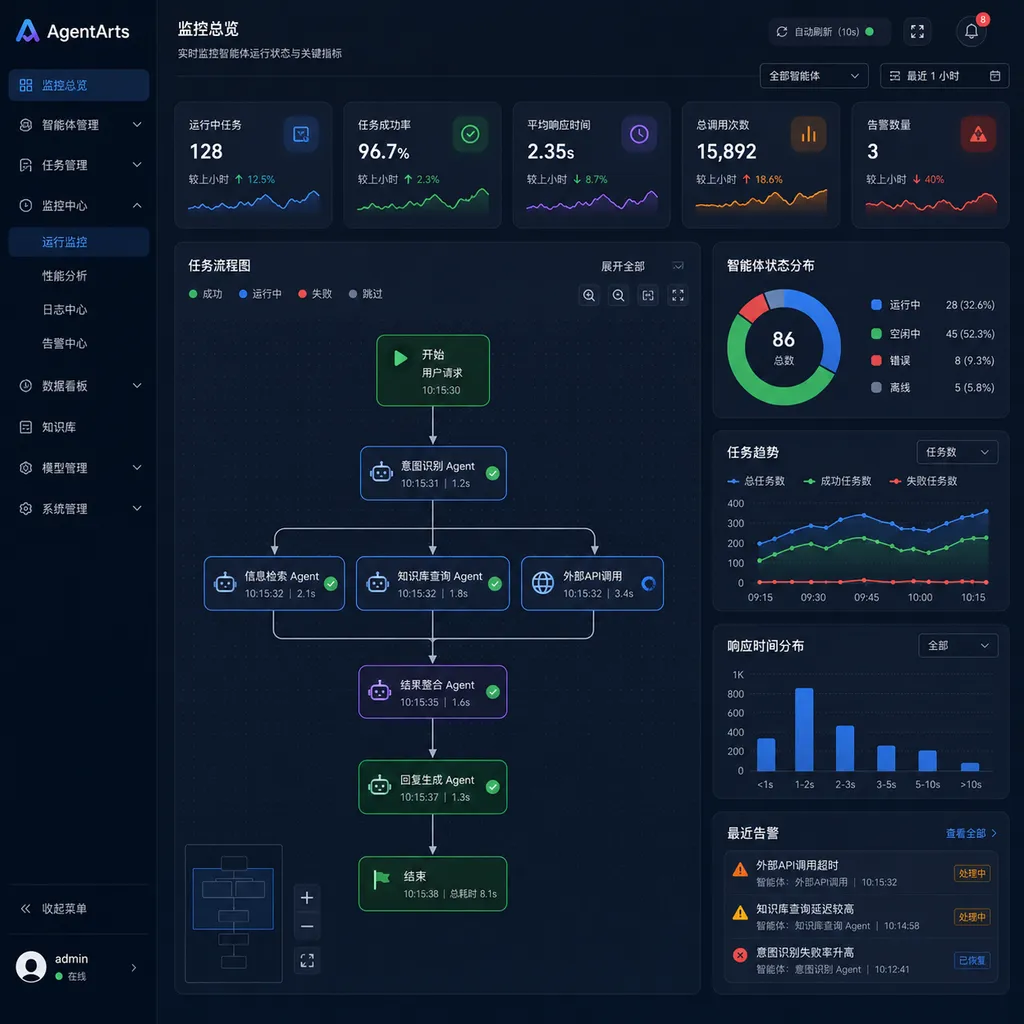
Notably, Huawei Cloud open-sourced the AgentArts core as openJiuwen, with over 90% overlap between the open-source and commercial cores. This open-source strategy is similar to Meta’s Llama and Mistral AI: attract developers first, then monetize via cloud services. Developers can validate solutions on the open-source version before deploying on cloud, lowering trial-and-error costs.
Token Plan Subscription: Pay-As-You-Go or Monthly Package?
Smart Orchard comes with a Token Plan subscription, covering mainstream models and AI tools. Subscription-based pricing isn’t new in domestic cloud providers — Alibaba Cloud’s Bailian platform and Tencent Cloud’s Hunyuan have similar packages.
From a business model standpoint, subscriptions benefit both providers and enterprises:
- Providers: Stable cash flow, lower customer acquisition costs
- Enterprises: Predictable costs, avoiding sudden high bills
However, subscriptions have pitfalls: if actual usage is far lower than package capacity, you’re wasting money; if usage exceeds the package, overage rates are usually higher than the package’s unit cost. The key is whether Huawei Cloud’s package design is reasonable and offers flexible scaling.
Specific pricing for Smart Orchard hasn’t been disclosed yet; once commercialized, its cost-effectiveness can be compared to other providers.
Technology Base: New “Agentic Infra” Paradigm
Smart Orchard is backed by Huawei Cloud’s “Agentic Infra” paradigm introduced at INSPIRE, centered around “efficient token factory + continuous learning + unified intelligent scheduling + autonomous security.” Huawei Cloud launched four infrastructure products:
1. AICS Lingqu Intelligent Computing Cluster
Based on Lingqu ultra-high-bandwidth networking, it can build clusters with over 100,000 cards, totaling 200 EFLOPS. Key metrics:
- Token generation latency under 10ms
- 5 million tokens/sec throughput per thousand-card cluster
- 99.95% online service stability
This performance is among the top domestic computing clusters, matching Alibaba Cloud’s Feitian AI Compute and Tencent Cloud’s HCC. True value lies not in specs but in scheduling efficiency and fault recovery — only verifiable in large-scale production environments.
2. AMS Agent-Specific Memory Storage
As mentioned earlier, with NPU direct connections and KV Cache layered pooling, this supports multi-day ultra-long-cycle tasks. Similar in concept to OpenAI’s long-term memory, but Huawei Cloud adds hardware acceleration at the infrastructure layer, theoretically with better performance.
3. CCE Volcano Next Unified Scheduling Engine
By sharing training and inference resource pools and integrating fragmented compute resources, overall utilization increases by over 30%. The gain comes from hybrid load scheduling — training and inference resource demands fluctuate asynchronously, allowing peak-load balancing.
4. AgentSphere Secure Runtime Base
Equipped with lightweight sandbox technology, enabling 100ms environment startup and mass creation of 100,000 agents per minute. For SaaS agents, this is important: users don’t have to wait minutes for environment initialization, improving experience.
Together, these products form Huawei Cloud’s “Silicon-Based Black Soil” — a concept emphasized by Huawei Cloud CEO Zhou Yuefeng, highlighting differentiation through software-hardware-chip collaborative innovation. With continued iteration of Huawei’s Ascend NPU chips, this “black soil” will deepen.
Zhou also noted an interesting point: Huawei’s “Tao’s Law” of AI compute growth favors Huawei Cloud, which cannot build a “mixed-brand” silicon base, so it focuses on deep integration of its self-developed tech stack. This may limit ecosystem compatibility short term, but long term, if self-developed chips catch up to or surpass NVIDIA, Huawei Cloud could build a moat in cost and performance.
Ecosystem Strategy: Partnership with 20+ Leading Model Vendors
At the conference, Huawei Cloud announced the “Hundred Models, Thousand Forms, Cloud Win-Win” ecosystem plan, partnering with Zhipu, DeepSeek, Minimax, Kimi, StepVerse, Baidu, Meituan LongCat, iFlytek Spark, and 20+ top model vendors.
The logic is: Huawei Cloud doesn’t do exclusive binding, but provides a “neutral platform + infrastructure.” Model vendors deploy services on Huawei Cloud, which provides compute, storage, and scheduling capacity, with revenue sharing.
This is similar to AWS Bedrock or Azure AI Studio, but competition in China is more complex:
- Alibaba Cloud: Pushes its own Tongyi Qianwen, cautious on third-party model access
- Tencent Cloud: Combines Hunyuan model + selected third-party models, a middle path
- Huawei Cloud: Fully open, with relatively lower presence of its Pangu models
For model vendors, multi-cloud deployment is normal, but infrastructure capabilities, pricing, and revenue-sharing vary greatly across platforms. Huawei Cloud stresses “systematic business ecosystem” — attractiveness will depend on revenue share, traffic distribution, and joint operations.
How Does Smart Orchard Differ from Other Cloud Platforms?
Comparing Smart Orchard with major domestic and international agent development platforms:
| Platform | Model Support | Agent Capabilities | Infrastructure | Use Cases | |----------|---------------|--------------------|---------------|-----------| | Huawei Cloud Smart Orchard | 15+ domestic models | Long-cycle tasks, enterprise-grade security, industry knowledge base | Self-developed compute cluster + dedicated storage | Government, finance, healthcare — high security and compliance needs | | Alibaba Cloud Bailian | Tongyi series + selected third-party | Workflow orchestration, RAG, function calls | Alibaba Feitian architecture | SMEs, e-commerce, content creation | | Tencent Cloud TI | Hunyuan + open-source models | MaaS model service, vector DB | Tencent HCC compute | Gaming, social, enterprise collaboration | | OpenAI GPTs | GPT series | Simple, limited capabilities | OpenAI infrastructure | Individual devs, quick prototyping | | Anthropic Projects | Claude series | Long context, multi-modal, safety alignment | AWS/GCP hosted | Research, content analysis, complex reasoning |
Huawei Cloud’s differentiation:
- Government & Enterprise DNA: strong in security, compliance, on-premises deployment, and industry solutions
- Self-developed tech stack: software-hardware-chip synergy with potential in cost and scheduling efficiency
- Open ecosystem: not pushing its own models, friendlier to third-party vendors
Weaknesses:
- Model ecosystem: missing top overseas models like GPT-4o, Claude 3.5
- Developer community: less mature compared to OpenAI or Anthropic
- Product maturity: Smart Orchard is in public beta; real-world UX and bug fixes remain to be seen
Practical Value for Developers
Should you try Smart Orchard?
Best suited for:
- Government/enterprise projects with strict data security/on-premises requirements
- Long-cycle task support (e.g., project management, customer service agents)
- Quick access to multiple domestic models without manual API integration
- Industry knowledge base & pretrained agents (healthcare, manufacturing, research, etc.)
Less suited for:
- Needs top overseas models like GPT-4o, Claude 3.5
- Individual projects or small teams without enterprise-grade needs
- Tight budgets preferring pay-as-you-go over subscriptions
From a tech selection viewpoint, Smart Orchard is more like a “one-stop enterprise agent development solution” than “the most flexible agent tool.” If your project aligns with Huawei Cloud’s product positioning, onboarding will be easier; if your needs are highly customized, you may need to build your own stack.
Follow-Up Trends Worth Watching
- Actual pricing: Token Plan packages and rates will directly influence adoption decisions
- AgentArts deployment cases: currently focused on healthcare; other industries’ results still to be seen
- openJiuwen community activity: active contribution could boost commercial version maturity
- Overseas model integration: support for GPT, Claude would greatly boost competitiveness
- Interoperability with other clouds: enterprises often use multi-cloud; Smart Orchard’s ability to connect with Alibaba/Tencent services could affect adoption
Huawei Cloud’s launch of Smart Orchard is essentially a bid to seize the Agentic AI-era cloud service gateway. OpenAI has ChatGPT, Anthropic has Claude; cloud providers need a unified agent portal rather than making developers jump between APIs and consoles.
From a product form standpoint, Smart Orchard already checks the boxes: multi-model aggregation, agent development platform, industry solutions, subscription pricing. The next step is execution and ecosystem-building speed — in cloud services, launch is just the beginning; true competition lies in years of continual iteration and customer accumulation.
References
- Support for invoking Deepseek, Kimi and other models: Huawei Cloud launches “Smart Orchard” - IT Home — Official information on Smart Orchard product features and supported models


