
iFlytek to release SpaceMind Intelligent Spatial Agentic Architecture tomorrow

iFLYTEK will hold the 2026 SpaceMind Global Launch Event in Hong Kong on June 10, unveiling the SpaceMind intelligent spatial Agentic architecture ahead of the curve, bringing AI truly into real spaces such as homes, hotels, and offices, and simultaneously showcasing WallEX and a range of intelligent hardware.
iFLYTEK to Launch SpaceMind Tomorrow in Hong Kong: Intelligent Spatial Agentic Architecture Opens New Track for Spatial AI
June 9, 2026 — Just one day remains until the highly anticipated launch event. According to IT Home and multiple media reports, iFLYTEK will hold the 2026 SpaceMind Global Launch on June 10 in Hong Kong, officially unveiling the industry’s first intelligent spatial Agentic architecture designed for real physical spaces — SpaceMind. The official definition of this new architecture is a “Spatial AI Brain,” signifying that the application boundary of AI Agents will move beyond screen-based conversational interactions into real physical spaces such as homes, hotels, and offices, opening up an entirely new track for intelligent spatial Agents.

1. Launch Background: Why Hong Kong, Why Now?
iFLYTEK has chosen Hong Kong as the venue for its most important 2026 event and labeled it as a “Global Launch,” with a clear intent — to target international markets and establish SpaceMind as a globally influential standard for intelligent spaces. As an international finance and technology hub, Hong Kong serves as a natural bridge between mainland AI capabilities and overseas ecosystems.
From an industry perspective, since 2025, the global AI landscape has been shifting from a “large model capability race” toward “Agent deployment applications.” From OpenAI’s Operator to Anthropic’s Computer Use, and domestic vendors rolling out their own general-purpose Agents, AI Agents are emerging as the next growth driver after large models. However, most Agents today still operate within the digital domain — they can operate browsers, call APIs, and complete digital tasks but struggle to truly “understand” and “intervene” in the physical spaces we inhabit.
By launching SpaceMind, iFLYTEK is targeting this gap. As of June 10, 2026, the smart speaker market has been stagnating, and so-called “pseudo intelligence” in smart homes has been criticized for years. The market urgently needs a new architecture capable of truly embedding large model capabilities into physical spaces.
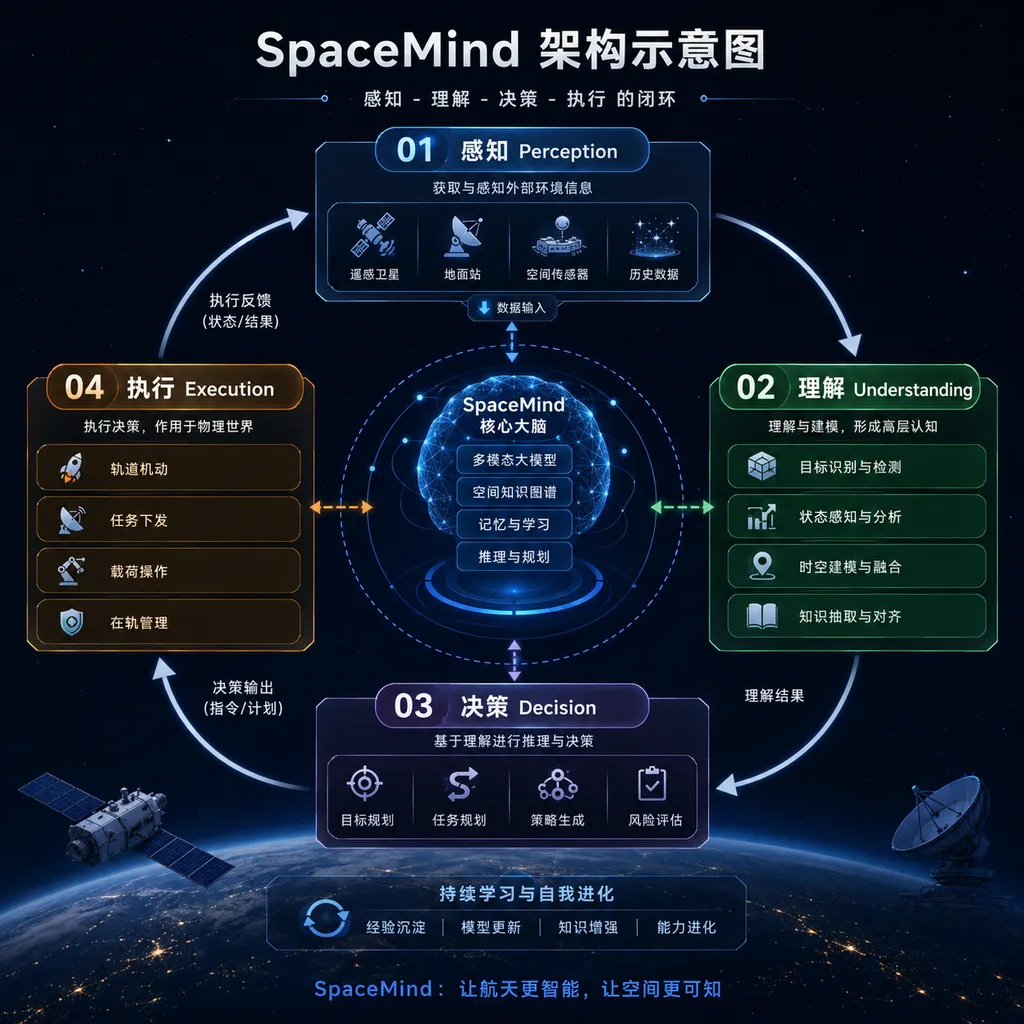
2. What is SpaceMind: Four Core Capabilities of the Spatial AI Brain
According to iFLYTEK’s official preview, SpaceMind is defined as an “Intelligent Spatial Agentic Architecture,” with the core mission of enabling AI to truly enter homes, hotels, offices, and other real spaces — making spaces not just passively “follow commands” but increasingly “understand you.”
The official summary of SpaceMind’s capabilities centers on four keywords:
- Perception: Understanding people, objects, and environmental states in the space through multimodal sensor fusion
- Understanding: Leveraging large model cognitive abilities to interpret user intentions, scene context, and long-term preferences
- Decision: Autonomous task path planning with cross-device and cross-service orchestration capabilities
- Execution: Calling hardware devices within the space to carry out real actions, creating a closed loop
Further, SpaceMind emphasizes three core differentiators from traditional smart home systems:
1. Autonomous Thinking
Traditional smart speakers/smart homes fundamentally operate in a “command-response” mode — the user says something, and the device does it. SpaceMind grants spaces the ability to “think autonomously,” meaning they can proactively plan actions based on current context. For instance, when the system senses that a user has returned home after a day of work, it can automatically adjust lighting, temperature, and music without the user having to repeat commands.
2. Real Memory
This is a key selling point that distinguishes SpaceMind from existing solutions. “Real memory” means the space has a long-term, reliable, personalized memory system. It’s no longer a forgetful assistant that loses its context after each interaction, but a “spatial companion” that remembers your habits, family relationships, and changing preferences. This memory spans devices, contexts, and time, enabling the space to truly “know you.”
3. Self-Learning
By continuously interacting with the user, SpaceMind can regularly improve its understanding of scenarios and the user, gradually evolving from a “general Agent” into an “Agent unique to this space and household.” This self-learning capability ensures that intelligent spaces don’t age over time; instead, they become increasingly attuned to your needs.
3. WallEX and a Series of Intelligent Hardware: Bringing AI into Real Spaces
An architecture alone is not enough — for AI Agents to truly enter physical spaces, they must rely on concrete hardware. According to the official preview, iFLYTEK will also showcase WallEX and a series of intelligent hardware during the launch.
Based on the name, “WallEX” is likely a core spatial deployment device acting as a hub for spatial perception and computation. Considering iFLYTEK’s past experience with smart office notebooks, voice recorders, translation devices, and smart hearing aids, it is expected that the hardware introduced this time will cover:
- Home scenarios: smart central control, environmental sensing devices, home robots
- Hotel scenarios: guest room AI concierge, smart guest control systems, service robots
- Office scenarios: meeting room AI assistants, smart desks, spatial collaboration terminals
This integrated software-hardware solution ensures SpaceMind is more than a concept in a presentation — it now has a real-world “body.”
4. Ecosystem Strategy: Dozens of Partners and SpaceMind AI Agent Innovation Contest
iFLYTEK understands well that “the success of a platform product lies in its ecosystem.” According to official information, dozens of global partners have already established strategic cooperation with SpaceMind. This means that from its launch, SpaceMind is not a closed system but an open foundational architecture for the industry.
More importantly, iFLYTEK will initiate the ‘SpaceMind AI Agent Innovation Contest’ during the launch, collaborating with global partners to build an intelligent space ecosystem. This contest carries multiple implications:
- Attract developers: Quickly gather third-party development capacity via competition to enrich SpaceMind’s application scenarios
- Explore scenarios: Intelligent spatial applications are vastly diverse and require exploration from developers across industries
- Establish standards: Capture best practices through the contest, gradually forming a development paradigm for intelligent spatial Agents
- Create a flywheel: More developers → more applications → better user experience → higher installed base → attract more developers
This approach resembles early-stage ecosystem building strategies for iOS App Store and WeChat mini-programs, reflecting iFLYTEK’s ambition to construct a platform-based ecosystem.
5. Industry Significance: Is the Intelligent Spatial Agent the Next Big Thing?
The launch of SpaceMind reflects deep industry thinking on the question of “Agent deployment.” From an industry evolution standpoint, we can see several clear trends:
1. From “Digital Agent” to “Physical Agent”
The Agent wave in 2024–2025 was mainly focused on the digital world — Code Agents, Research Agents, Browser Agents, etc. But the physical world offers a larger market. SpaceMind represents a pivotal step for AI Agents penetrating into physical spaces.
2. From “Single Device Intelligence” to “Space-Level Intelligence”
Over the past decade, most smart hardware has been “single-point intelligence” — smart speakers, smart locks, smart bulbs operating independently. SpaceMind emphasizes “space-level intelligence,” treating the entire space as the Agent’s “body” to be orchestrated as a unified whole.
3. From “Command-Based Interaction” to “Intention-Based Service”
SpaceMind’s goal to “make spaces increasingly understand you” essentially means evolving from “I say — it does” command-based interaction to “It understands — it does” intention-based service. This requires Agents to have proactivity, memory, and personalization capabilities.
4. Multimodal Large Models as the Foundation
The realization of SpaceMind depends on iFLYTEK’s continued investment in multimodal, long-memory, and reasoning capabilities of its Spark large model. As the fundamental cognitive engine, Spark provides SpaceMind with both IQ and EQ.
6. Challenges
Naturally, SpaceMind must overcome numerous challenges to succeed:
- Privacy and security: Space-level perception entails collecting significant amounts of personal data; privacy handling is key
- Hardware costs: Ordinary households must be able to afford it, so hardware costs must be kept low
- Cross-brand compatibility: The smart home ecosystem has long been fragmented; can SpaceMind connect mainstream brand devices?
- Real-world experience: How will “self-learning” and “real memory” be implemented in actual workflows to avoid being mere marketing slogans?
- Internationalization: Choosing Hong Kong for launch hints at going global, but localization challenges in overseas markets are substantial
7. Key Highlights to Watch at Tomorrow’s Launch
The following points are worth attention on June 10 in Hong Kong:
| Highlight | Focus Area | | --- | --- | | SpaceMind architecture breakdown | Technical architecture diagram, differences from traditional solutions | | WallEX hardware | Form, price, release schedule | | Partner list | Specific household, hotel, and office brands involved | | Innovation contest | Format, prizes, developer incentives | | Overseas strategy | Whether overseas versions will be released simultaneously | | Live demo | Can it showcase “real memory” and “self-learning” |
8. Conclusion
From “cognitive intelligence” to “spatial intelligence,” this launch of SpaceMind by iFLYTEK may not just be a product update but a redefinition of the intelligent space track. At a time when large models are evolving from “talking” to “doing,” whoever can first embed Agents into every real space we inhabit could define the next generation of human–machine interaction paradigms.
Tomorrow in Hong Kong, let’s look forward to SpaceMind’s official debut and see whether iFLYTEK can truly bring AI into the real lives of hundreds of millions of households.
References
- iFLYTEK to Launch Intelligent Spatial Agentic Architecture SpaceMind on June 10 — IT Home: IT Home’s first report on iFLYTEK’s SpaceMind launch event, including key official preview information


