
Volcano Ark 9.9 RMB Coding Plan is back, this time featuring MiniMax-M3.
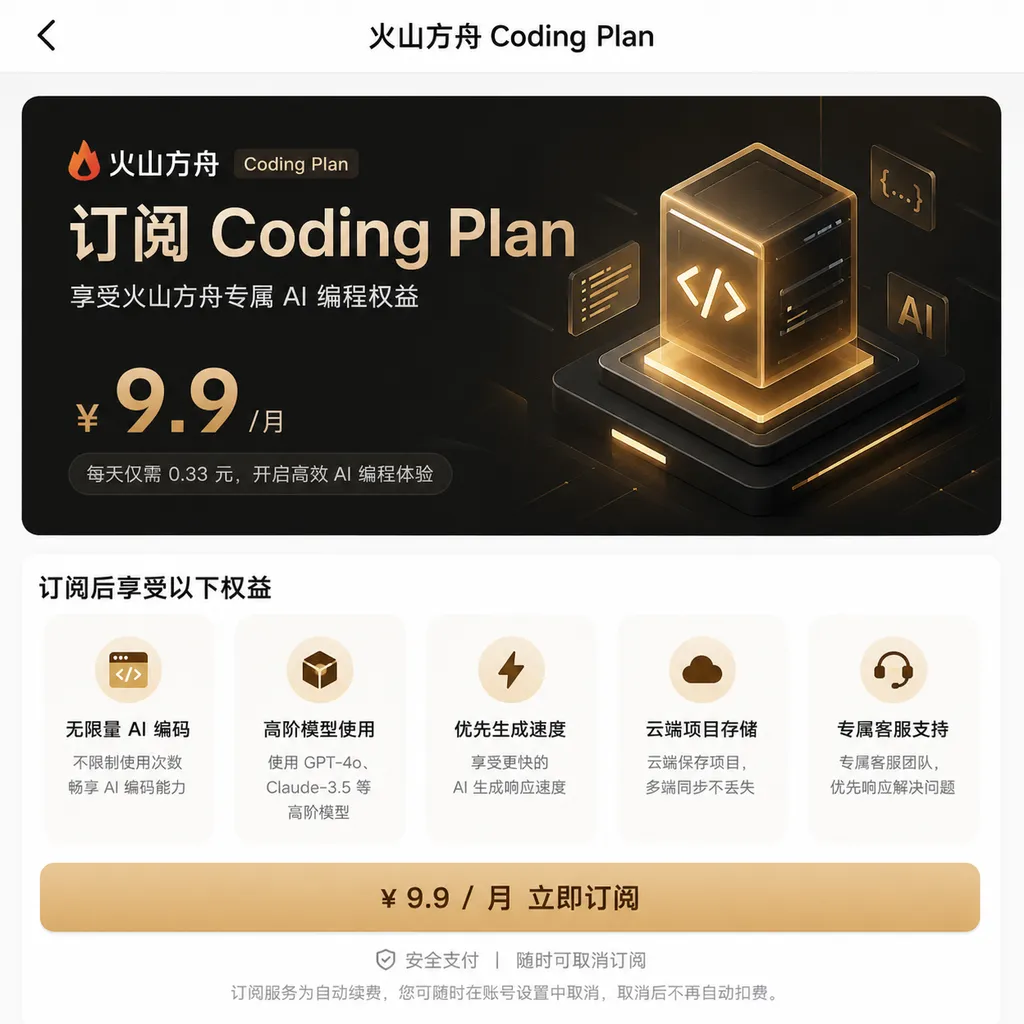
Volcano Engine Ark Coding Plan limited-time return: special subscription at ¥9.9/month, now supporting the latest MiniMax-M3 open-source model. Each account is limited to a one-month purchase. For developers who want to experience domestic AI coding models at low cost, this is another opportunity to grab a bargain.
The 9.9 Yuan Coding Plan Is Back
Early in the morning on June 9th, many developers received a text message push from Volcano Engine: the Ark Coding Plan limited-time offer is back—subscribe for one month at just 9.9 yuan, now supporting MiniMax’s newly released open-source M3 model.
Those familiar with Volcano Ark are no strangers to this pricing. At the end of last year, Volcano attracted a wave of developers with a 9.9 yuan Lite package, at that time allowing subscriptions of up to 6 consecutive months, bringing the yearly AI programming budget under 100 yuan. Later, on March 17th this year, the official announcement suspended this first-time purchase discount, reverting to the list price of Lite at 40 yuan/month and Pro at 200 yuan/month. Subsequently, the Pro package added ArkClaw and Hermes Agent, increasing the price significantly.
This comeback is clearly more restrained: only one-month subscriptions are allowed, you can’t stock up on six months like before, and slots are limited—first come, first served. From user feedback on linux.do, it seems there’s no rush yet, but the fact that the official team actively sent text message call-backs suggests this event is more about onboarding for MiniMax-M3’s launch rather than just clearing inventory.
The Star This Time: MiniMax-M3
The model pool of Volcano Ark’s Coding Plan is constantly updated. At the beginning of the year, the lineup featured Doubao Seed Code, the GLM series, MiniMax-M2, Kimi-K2, and the DeepSeek series. Later, GLM-5.1, MiniMax-M2.7, Kimi-K2.6, and the DeepSeek-V4 series were gradually integrated. This time, alongside the 9.9 yuan offer, the new addition is MiniMax-M3.
Tracing the path from M2 → M2.7 → M3, MiniMax’s iteration pace matches that of GLM and Kimi closely. M2.7 focused on Agent Harness capabilities—models breaking down tasks, calling tools themselves, and running multi-step processes autonomously. M3 continues along this path; according to community descriptions circulating, it mainly enhances three areas:
- Longer context and more reliable multi-file operations: comparable to GLM-5.1’s “8-hour long endurance,” aiming for cleaner cross-file refactoring and migrations in large codebases.
- More compact tool calls: when running in clients like Claude Code or Cursor, it reduces redundant “thinking tokens,” lowering token consumption.
- More engineering-oriented code generation: less flashy, more production-ready code that can be directly committed into projects.
This reflects a shared trend among domestic coding models this year—everyone realizes that merely stacking benchmark scores is meaningless. The real obstacles for developers are agents crashing after two hours due to a syntax error, or tokens running out before task completion.
One Plan Covers Six Model Families
For developers, what makes the Ark Coding Plan really appealing is not any single model, but the combination of model pool + Auto scheduling. With one subscription, you can freely switch among these models:
- Doubao-Seed-2.0-pro / lite / Code (ByteDance in-house)
- DeepSeek-V4 series
- GLM-5.1
- MiniMax-M3 (new this time) / M2.7
- Kimi-K2.6
- Doubao Embedding Vision
You can switch at a granularity as fine as per task—for example, let Claude Code use GLM-5.1 for large-scale refactoring, let Cursor use MiniMax-M3 for Agent workflows, and let DeepSeek-V4 handle daily commit message generation. Or simply enable Auto mode and let Ark handle the scheduling.
This “one key accesses many models” approach is similar to platforms like OpenRouter overseas or OpenAI Hub domestically—developers today least want to manage multiple sets of keys and SDKs across vendors just to change models. The difference is that Ark ties to ByteDance’s own compute power and the domestic model ecosystem, while OpenAI Hub aggregates models like GPT, Claude, Gemini, and DeepSeek under OpenAI-compatible protocols—better for teams needing both overseas closed-source flagships and domestic open-source models. Each route has its own use cases.
Compatible Toolchains
Ark Coding Plan is not an IDE subscription, nor bound to specific clients. Officially supported tools include:
- Claude Code
- Cursor
- Cline
- Kilo Code
- Roo Code
- OpenCode
- Hermes Agent (Ark in-house)
Configuration can be done in two ways. Using Ark Helper is recommended—it sets up Base URL, API Key, and model selection in one click, avoiding manual configuration errors. If you want to configure manually, clients compatible with the Anthropic protocol should point the Base URL to:
https://ark.cn-beijing.volces.com/api/coding
Then, fill in the API Key generated in the Ark console and specify the model name to start. Note: Coding Plan’s quota only works in designated coding tools and cannot be used as a regular API call. For API usage, you must purchase separate token packages—keep this distinction clear.
Is the Lite Package Enough?
The 9.9 yuan offer corresponds to the Lite package, with a list price of 40 yuan/month. Lite is designed for “moderate intensity development tasks,” and Pro offers five times the usage.
How does this tiering work in practice? Based on feedback from several long-term community users:
- If you code 2–4 hours daily, mainly using the model for completion, single-file refactoring, and writing tests, Lite is enough—you likely won’t hit the limit at month’s end.
- If you run fully automated agents like Claude Code, with tasks taking tens of minutes and spanning over a dozen files, Lite can be depleted in days—you’ll need Pro.
- Response times slow during peak hours (8–11 pm), as Volcano admits. For scenarios needing high real-time responsiveness, plan accordingly.
The best approach for this 9.9 yuan month is to treat it as a trial—spend a week running MiniMax-M3, GLM-5.1, and Kimi-K2.6 on your real projects, to see which suits your coding style and tech stack best. When the price reverts to 40 yuan next month, you’ll know which model deserves your tokens.
Several Important Details
Before buying, there are a few rules worth noting, gathered from the official event page and community posts:
- This special offer only allows a one-month subscription, unlike before when you could stockpile six months.
- Same phone number, ID, and account ID count as “the same user”—multi-account exploitation is blocked.
- No cancellations or refunds—think carefully before ordering.
- Auto-renew defaults to the list price (40 yuan). If you only want one month, remember to turn off auto-renew before expiry.
- Input and output will be anonymized by Volcano and used for model training—teams concerned about data privacy should be cautious.
- The referral rewards program is ongoing—invite friends to order, they get 10% off, and you get a 10% voucher, with no limit.
The Competition Among Domestic Coding Models Has Changed
Looking back at the evolution of the Coding Plan over the past year, a clear trend emerges.
At the start of the year, competition was about single-model scores: who had better HumanEval, who had better SWE-bench. Then it shifted to agent capabilities: who could autonomously complete a full task without crashing midway. By this stage in 2026, it’s about ecosystem density and cost-effectiveness—how many models fit in your package, how many clients it runs on, and how low the per-token cost can go.
Volcano Ark’s move to push MiniMax-M3 to developers at 9.9 yuan is essentially ecosystem distribution. MiniMax gets real coding scenario feedback, Volcano gets subscribers, and developers get a cheap trial opportunity. This win-win approach will likely keep intensifying.
For teams developing domestically with no urgent need for GPT/Claude, this 9.9 yuan deal is worth hopping on for a month. For multi-model mixed-use scenarios, whether it’s Volcano Ark’s coding-focused subscription or OpenAI Hub’s aggregation of domestic and overseas models under the OpenAI protocol, the experience is now vastly improved compared to a year ago. Having more models than you can choose from is not a bad thing for developers.
References
- linux.do: Volcano Ark Launches Another 9.9 Token Plan, This Time Adding MiniMax-M3 — Original community post with screenshot and official link
- Zhihu Column: MiniMax 2.7, GLM 5.1, Kimi 2.6 All in One Package — Ark Coding Plan model pool updates and real-world usage体验


