
HarmonyOS 7 upgrades the intelligent agent framework to 2.0, opening up 20+ AI capabilities
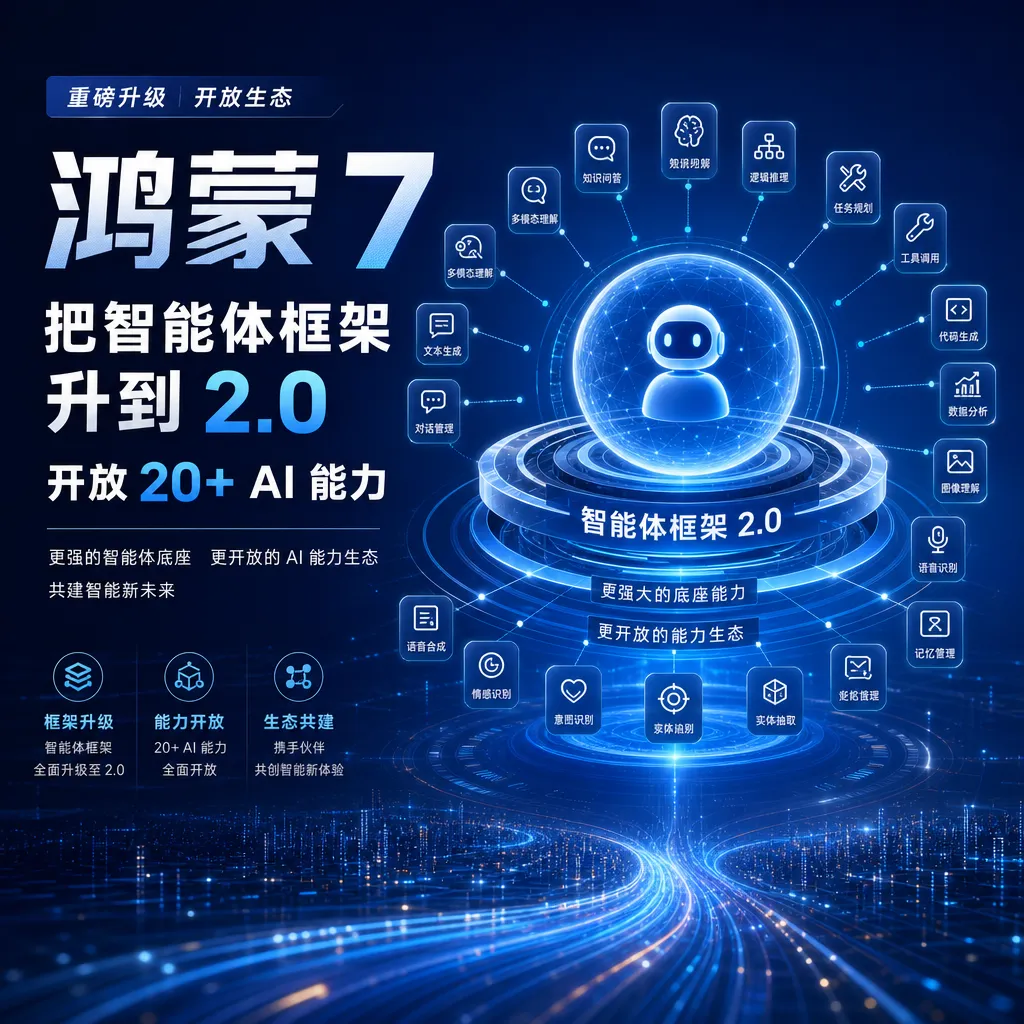
At HDC 2026, Huawei released HarmonyOS 7, upgraded the Harmony Intelligent Framework to 2.0, opened up 20+ AI capabilities, and integrated Xiao Yi with 200+ types of system-level data. From GUI to LUI migration, HarmonyOS this time has taken a more aggressive approach than both Android and iOS.
HarmonyOS 7 Upgrades Intelligent Agent Framework to 2.0, Opens 20+ AI Capabilities, Xiaoyi Takes Over 200+ System Data Points
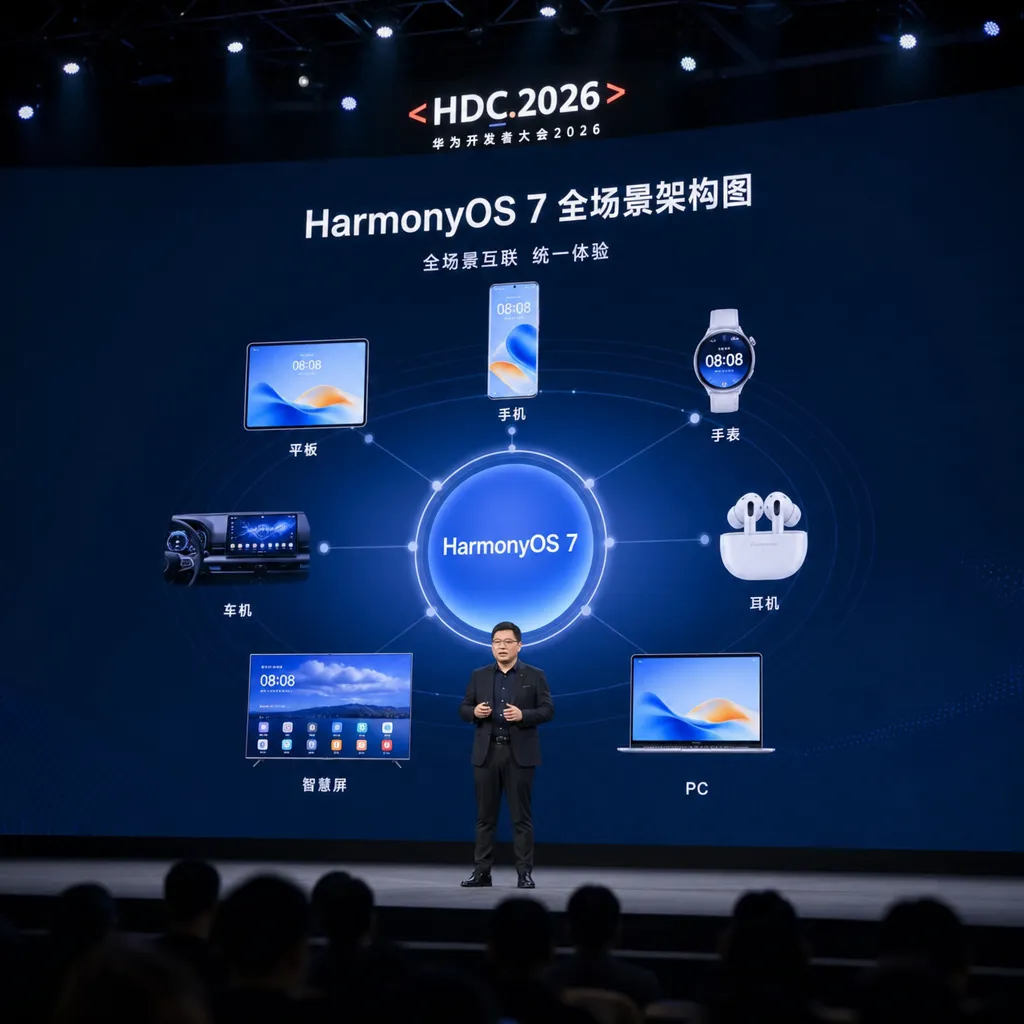
On June 12, at Huawei’s HDC 2026 Developer Conference, Richard Yu unveiled HarmonyOS 7. On the surface, it’s the usual annual operating system update, with the standard five keywords — “Immersive, Intelligent, Smooth, Secure, Convenient” — rolled out. But there’s really only one thing worth dissecting — the Harmony Intelligent Agent Framework has been upgraded to 2.0, with over 20 AI capabilities opened, and Xiaoyi integrated into more than 200 system-level data points.
This is more aggressive than it looks. At last year’s HDC 2025, HarmonyOS just planted the flag for the “Agent Era,” pushing HMAF (Harmony Agent Framework) as the base. This year, in just 12 months, the framework has evolved directly to 2.0, plus a full-scenario spatial computing UI. Clearly, HarmonyOS aims to gain a lead in the paradigm shift from GUI → LUI.
First, the conclusion: what exactly changed in this upgrade
According to official statements, HarmonyOS 7 has two main lines:
- Harmony Spatial Computing: Includes spatial aesthetics, spatial media, spatial interaction — clearly laying UI groundwork for future devices like headsets, foldables, in-car large displays.
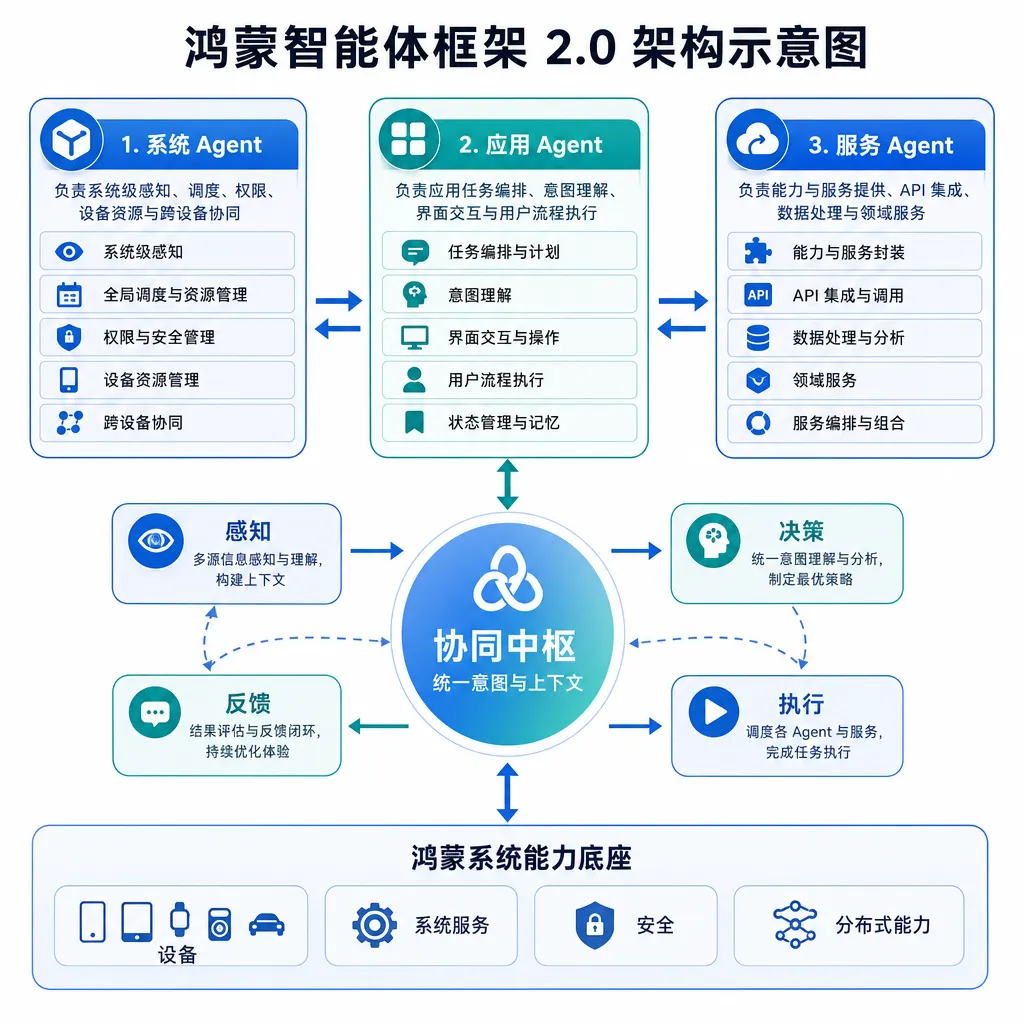
- Harmony Intelligence: Harmony Intelligent evolves fully toward the Agent architecture — three key elements: Agent-friendly system architecture, Harmony Intelligent Agent Framework 2.0, and the system-level intelligent agent Xiaoyi.
What developers should focus on is the second line. Intent as a Service, 20+ AI capabilities opened, more flexible integration methods, higher development efficiency — these are the four official tags for framework 2.0. Combined with Xiaoyi’s “200+ system-level data sources,” “always-on intelligent sensing engine,” and “strong memory and context understanding,” the whole chain — from sensing, scheduling, execution to memory — is now integrated into system scheduling.
Put simply, HarmonyOS has officially transitioned from “OS with an AI assistant attached” to “OS itself as an Agent orchestration platform.”
The real changes in Framework 2.0
1. Intent as a Service: Developers no longer “write apps,” they “declare intents”
The Intent Framework (Intents Kit) existed last year, but it mostly served Xiaoyi’s semantic routing, requiring developers to manually break functions into atomic intents and register them with the system.
Version 2.0 turns this into a “service.” Developers only need to declare an ability description, and the system will automatically handle intent normalization, parameter extraction, and context binding. In other words, where you used to spend a week mapping the intent tree, writing schemas, and running test cases, now it’s closer to “write a prompt + a function signature.”
This is a key shift. Compared to Apple Intelligence’s App Intents or Android’s Assistant Actions, HarmonyOS lowers the declaration granularity — it doesn’t require developers to pre-enumerate intents, instead pushing intent parsing responsibility to Xiaoyi’s system-side large model. Developers just expose “what I can do”; how user utterances trigger it is handled by the system.
This cuts development costs and clearly increases ecosystem control — all routing goes through Xiaoyi.
2. 20+ AI capabilities opened: from model APIs to device-cloud collaboration
Huawei didn’t list the capabilities item-by-item in the main keynote, but based on last year’s Xiaoyi Open Platform with its 50+ system plugins, plus this year’s on-device model progress in the Pura 80 and Mate X7 series, the capabilities likely fall into these categories:
- Multimodal understanding: ASR, TTS, OCR, image/video understanding, document parsing
- Generative: text generation, image generation, text-to-table, long-text summarization
- On-device sensing: scenario recognition, behavior prediction, location semantics, device collaboration status
- Memory & personalization: user profiling, conversation context, cross-app memory sharing
- Agent toolchain: workflow orchestration, A2A scheduling, MCP tool integration
It’s noteworthy that in HarmonyOS 6, MCP compatibility was built into the Intent Framework; 2.0 aligns further on tool invocation protocols — meaning developers can directly attach an existing MCP Server to run within the Harmony Intelligent Agent ecosystem without writing a separate adaptation for HarmonyOS.
This is the right move — at the AI tool protocol layer, whoever aligns with the de facto standard first lowers ecosystem migration costs.
3. More flexible integration: four ways to connect with Xiaoyi
Continuing last year’s “four integration schemes,” 2.0 refines the granularity:
- Pure LLM conversation: lightest — suits knowledge Q&A, customer service Agents
- Workflow: visual drag-and-drop — suits moderately complex multi-step tasks
- Multi-Agent collaboration (A2A protocol): make your Agent a sub-Agent under Xiaoyi’s orchestration
- Deep system integration: direct calls to system-level capabilities, on-device models, sensing engine
This layered design’s key benefit: small developers can start with a single prompt, while large enterprises can do deep device-cloud collaboration. Compared to OpenAI’s GPTs and Anthropic’s Skills, this setup is more “OS-native,” with wider capability invocation boundaries.
4. Development efficiency: Xiaoyi Open Platform’s “car factory” role grows
Developers will most directly feel this through the toolchain. Over the past year, Xiaoyi Open Platform accumulated: 50+ system plugins, visual workflows, prompt auto-optimization, multi-device real testing. In 2.0, this toolchain moves further toward one-stop integration, covering the full process from design, development, debugging, launch to distribution.
In short: Launching an Agent on HarmonyOS is becoming the same as launching an app to the app store.
Xiaoyi’s 200+ system-level data points — the hidden advantage this time
If Framework 2.0 is for developers, Xiaoyi’s upgrade is for users, but also the easiest moat to overlook.
What does 200+ system-level data points mean? Xiaoyi can read calendars, locations, movement, health, device status, app usage habits, cross-device collaboration states — essentially all “on-device context.” Add the official “always-on intelligent sensing engine” — a service continuously running in the background to predict user intents.
Together with “strong memory and context understanding,” Xiaoyi’s architecture now does three things:
- Sense: continuously perceive user status via the on-device engine
- Remember: build long-term memory across sessions and apps
- Predict: offer candidate services before the user even makes a request
This architecture essentially implements Andrej Karpathy’s “GUI → LUI” vision at the OS level. Apple Intelligence in iOS 18 does similar things, but Apple’s privacy architecture and model size constraints slow its rollout compared to HarmonyOS.
Horizontal comparison: HarmonyOS’s position
A cross-sectional view of major OS vendors’ AI strategies:
- Apple: Apple Intelligence is conservative — privacy-first, less capability openness; third-party Agent integration is unclear
- Google: Gemini Nano + AICore — strong on model layer, less aggressive on application-layer Agent orchestration than HarmonyOS
- Microsoft: Copilot + Windows — strong desktop presence, absent on mobile
- Huawei: HMAF 2.0 + Xiaoyi — complete solution combining system-level Agent scheduling, application Agent collaboration, on-device sensing
HarmonyOS’s advantage: no historical baggage. No need to fit legacy app models — intents, Agents, A2A protocol can be written directly into the OS base. Phones, tablets, PCs, car systems, smart screens, wearables share the same architecture — cross-device Agent collaboration is natural.
Its disadvantages are clear: overseas ecosystem is unsolvable short term, low global developer participation; model-wise, despite Pangu, capability ceiling lags behind GPT-5, Claude, Gemini. These two factors mean HarmonyOS’s Agent ecosystem ceiling will likely stay in the domestic market.
How developers should integrate
If you already have a HarmonyOS app, recommended priority:
- Declare intents first: break core functions into 3-5 high-frequency intents, register with Intent Framework 2.0
- Connect A2A: wrap the app as a sub-Agent so Xiaoyi can orchestrate it
- Attach MCP tools: reuse MCP Server if you already have one
- Integrate sensing deeply: invoke on-device sensing engine based on scenarios (travel, health apps benefit most)
- Go on Xiaoyi Open Platform: complete launch and traffic distribution integration
According to the official “Tiangong Plan” (last year’s announcement of ¥1 billion investment to support HarmonyOS AI ecosystem), early adopters will likely get traffic boosts. Pioneer cases like Shenzhen Airlines “Shenhang Feifei,” Ximalaya “Xiaoya,” and Eastmoney “Miaoxiang” came from HarmonyOS 6; after 2.0, the second wave’s window will shrink — the earlier you act, the greater your bargaining power.
A quick assessment
In HarmonyOS 7’s update, Framework 2.0 is the most substantial part. Spatial computing is more about future storytelling; AI capability openness is what can be converted to developer value now.
Huawei’s strategy in recent years has been “build the ecosystem thickness first, then talk experience and differentiation.” HarmonyOS 5/6 pushed device scale past 27 million+ (as of HarmonyOS 6 launch, daily increments over 100,000). By HarmonyOS 7, scale is basically solved — differentiation must come from AI. Deepening the Intelligent Agent Framework is the inevitable next step.
For developers, this is a clear benefits window — for the first time HarmonyOS makes ‘app intelligence transformation’ a full-toolchain, traffic-distributed, commercializable proposition. In the domestic market, no other OS vendor-led Agent ecosystem exists yet.
By the way, if you’re doing multi-model comparative testing (pulling GPT, Claude, Gemini, DeepSeek for the same Agent evaluation), tools like OpenAI Hub unify interfaces, eliminating the hassle of switching Keys — one OpenAI-compatible endpoint connects mainstream models, with direct domestic access, convenient for teams iterating purely Agent applications.
As for HarmonyOS 7’s public beta timing and device list, based on past cycles, they’ll be released gradually in July–August. Mate, Pura, and nova series are likely first.
References
- Huawei HarmonyOS 7 Launch: More immersive, intelligent, smooth, secure, convenient — IT Home — HDC 2026 on-site debut report of HarmonyOS 7
- Huawei HarmonyOS 6 Intelligent Agent Framework enhances AI Agent experience, opens plugin market for third-party uploads — IT Home — Background from last year’s HDC 2025 launch of Harmony Intelligent Agent Framework, useful for understanding the roadmap to 2.0


