
Doubao Online Task Mode: From Dialogue Assistant to Full-Chain Agent
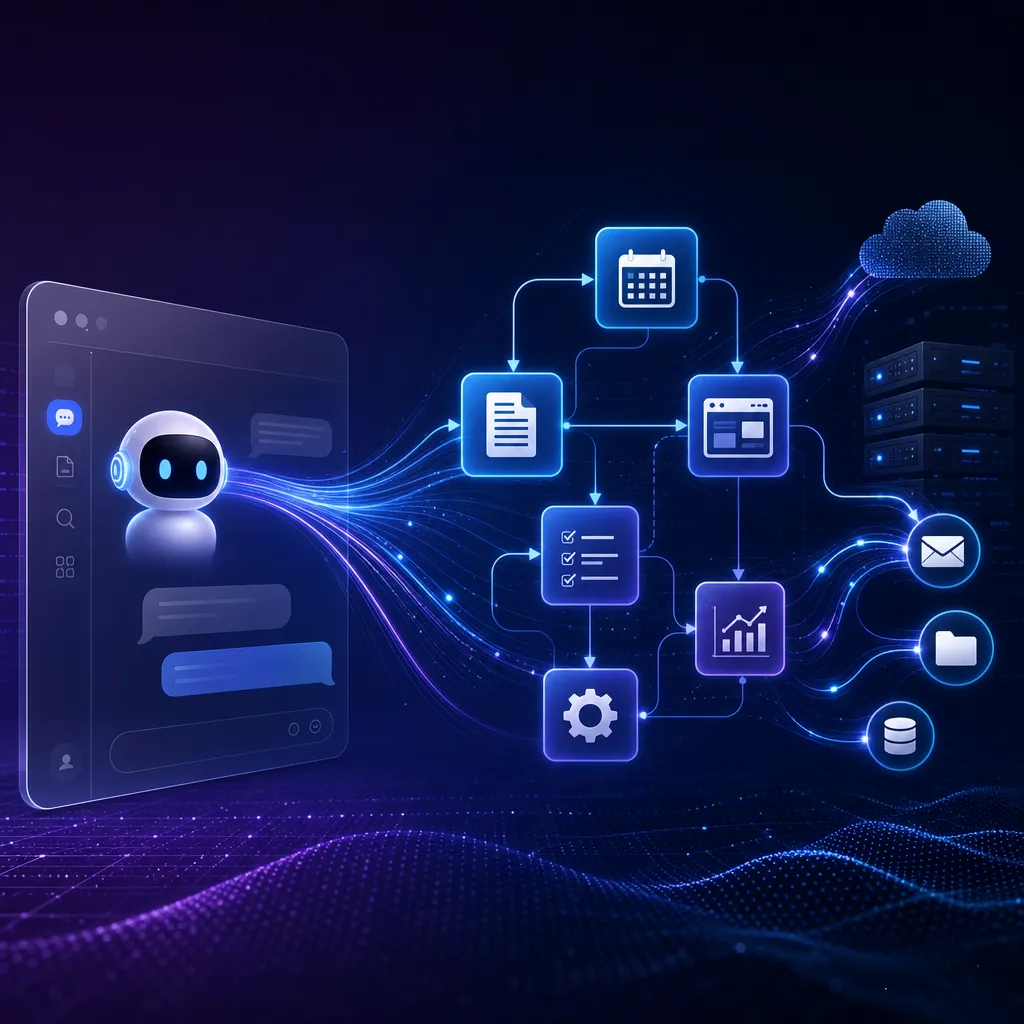
Byte Doubao has widely launched the "Task Mode" today, with the original "Thinking Mode" upgraded to "Expert Mode." The three modes have clearly defined roles, marking Doubao's shift in product positioning from a conversational assistant to a full-chain AI Agent.
Doubao Launches Task Mode: From Conversational Assistant to Full-Chain Agent, ByteDance Has Figured It Out This Time
On June 12, ByteDance's Doubao rolled out "Task Mode" on a large scale to all users. Open the app, and the mode switch bar at the top has changed from the previous "Quick / Thoughtful" to "Quick / Expert / Task" — just two days ago it was still a paid beta feature, and today it’s fully released.
The key point isn’t just an extra Tab, but a change in product positioning. The original "Thoughtful Mode" has been renamed "Expert Mode," and the new "Task Mode" is explicitly positioned as an Agent. In other words, Doubao is no longer just a chat assistant that can write, answer questions, and create content — it’s starting to actively “get things done” on its own.
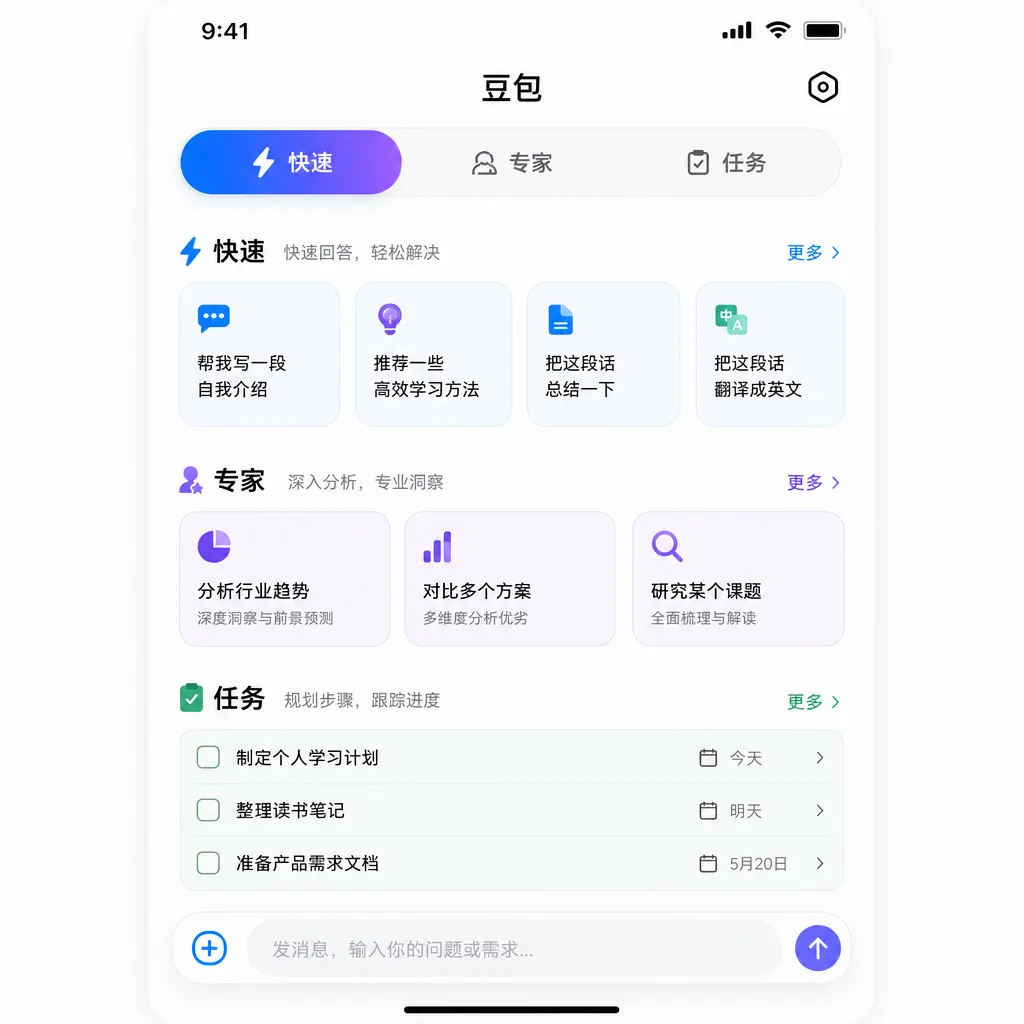
How the Three Modes Divide Roles: A Thorough Role Separation
Over the past year, domestic AI assistants have looked fairly similar — an input box, a deep-thinking toggle, a web access toggle. Doubao’s adjustment essentially separates two things — “how deep I want this answer to be” and “how complete I want the output to be” — into two different paths.
According to the official statement, each mode has its focus:
- Quick Mode: Instant Q&A, look up something, ask for a fact, quickly generate images — prioritizes response speed, aimed at most high-frequency daily scenarios.
- Expert Mode: Renamed and upgraded from the original "Thoughtful Mode," powered by the recently released Doubao Large Model 2.0 Pro with a native Agent architecture, specializing in deep reasoning, long-form text, and hardcore scenarios like legal logic verification.
- Task Mode: Full-fledged Agent form — you give it a goal, it decomposes it, plans, calls tools, and produces a deliverable.
This separation is interesting. Expert Mode is about “thinking deeply,” Task Mode is about “finishing the task,” and they don’t overlap. Previously, if you asked a model to “write a competitor analysis PPT,” it either gave you a text draft or started a prolonged multi-turn conversation to clarify details. Now, the logic is: Expert Mode gives you a high-quality analytical report draft, Task Mode gives you a ready-to-use PPT file.
This approach resembles ChatGPT’s separation of GPT-4o, o-series reasoning models, and the later Operator/Agent modes — but Doubao has moved the entry point to the top of the main interface. This is a product decision, not a technical decision. It means ByteDance believes ordinary users can already understand that “I want AI to think” and “I want AI to execute” are two different things.
What Task Mode Can Actually Do: From No-Code Webpages to Scheduled Reports
The official core capability list covers several common “AI hard-to-land” scenarios:
1. No-Code Webpage Creation
Generate a personal portfolio page or event landing page within minutes. This is similar to products like v0 or Bolt.new, but Doubao’s advantage is that you don’t have to jump to an external tool — just enter your requirements in the app, and it assembles the HTML/CSS/JS and gives you an accessible URL. For operators, marketers, and product managers who “want a page but don’t want to find frontend developers,” this is genuinely useful.
2. One-Click PPT Generation
This ability isn’t new — Gamma, Tome, and WPS AI all do it. But Task Mode’s difference lies in the “automatic information retrieval” step — it first searches online for data, viewpoints, and cases, then builds the framework. In other words, the PPT isn’t just model-generated out of thin air; it comes with citations and factual grounding. For industry report creators, this saves the most painful step: gathering information.
3. Data Visualization Analysis
Upload an Excel file, and Doubao automatically produces bar charts, line charts, and funnel charts. Behind this is tool invocation plus code execution capability — essentially the same line of thought as ChatGPT’s Code Interpreter. For domestic users, being able to use it directly in a Chinese app without VPN or foreign currency payment is a key way to lower the barrier.
4. Scheduled Tasks
This, in my view, is the most underrated but potentially most valuable capability in Task Mode. You can have Doubao “grab industry news every day at 8am and compile them into a briefing” or “summarize weekly sales data every Friday afternoon” — this marks the shift from AI that “only works when poked” to AI that “self-schedules.”
Scheduled tasks sound simple but are tricky to implement — involving task persistence, state management, failure retries, and context recovery. ChatGPT’s Scheduled Tasks only launched last year. Doubao’s ability to keep pace shows ByteDance has invested heavily in Agent engineering.
The Meaning of a Full-Chain Agent: From “Step-by-Step Guidance” to “Goal Delivery”
The official description of Task Mode contains a line worth rereading:
"Unlike traditional AI conversational single-step Q&A, it can complete the full chain from task decomposition, step planning, tool invocation to result delivery autonomously."
In plain language: You no longer need to handhold it like an intern, explaining each step — just tell it what you want.
This is the fundamental difference between an Agent and a Chatbot. A Chatbot is single-step — you ask, it answers, repeat. An Agent is a closed loop — it plans its own path, calls tools, checks whether intermediate results match expectations, and rolls back to retry if necessary. The capabilities involved include:
- Task decomposition: Breaking a vague goal into executable subtask sequences.
- Tool invocation: Knowing when to search, when to execute code, and when to generate files.
- Long-context management: Maintaining “memory” of the original goal throughout multistep execution chains.
- Error recovery: Bypassing or resolving failures along the way.
Doubao makes these capabilities usable for consumers thanks to the technical foundation of its latest Doubao Large Model 2.0 Pro. According to ByteDance’s Seed team, the Seed2.0 series has been systematically enhanced for long-chain tasks, instruction following, and complex document parsing, with strong results in BrowseComp-zh, HLE-text, and other base Agent evaluations. Embedded into the app layer, this becomes today’s Task Mode.
Pricing Strategy: Free for Basics, Paid for High-Intensity Tasks
On June 3, Doubao issued an official statement clearly defining the pricing boundaries:
- Permanently free: Everyday Q&A, basic writing, simple image generation, regular conversation — i.e., most users’ high-frequency needs remain free.
- Paid features: PPT generation, data analysis, software development, financial analysis — high-intensity, high-compute professional scenarios.
Prices have three tiers:
| Version | Monthly | Yearly | |---------|---------|--------| | Standard | ¥68 | ¥688 | | Enhanced | ¥200 | ¥2048 | | Professional | ¥500 | ¥5088 |
Compared to ChatGPT Plus at $20/month (~¥145), the ¥68 standard tier is clearly cheaper. The ¥200 Enhanced tier likely matches ChatGPT Pro’s mid-level, while the ¥500 Professional tier targets heavy professional users.
This pricing reflects a pragmatic judgment: domestic users’ willingness to pay is stratified. The ¥68 tier suits light-paying users who “occasionally make PPTs or run data analyses.” The ¥5088 tier is for professionals who “earn their living with it daily,” with the middle tier in between. This layered pricing is better at leveraging conversion than a single flat price.
Comparing to Competitors: Doubao’s Strategic Position
Looking horizontally, domestic AI apps are racing toward Agent capabilities:
- Kimi’s exploration version has long experimented with Agent functions, focusing more on information retrieval and deep research.
- Yuanbao builds Agents within Tencent’s ecosystem, relying on WeChat and WeCom private-domain data.
- Tongyi targets enterprises, embedding Agent skills into the Bailian platform and DingTalk.
- DeepSeek is still focused on the model itself, with limited application moves.
Doubao’s positioning is subtle: it is the first domestic major-player product to place an Agent-oriented “Task Mode” entry directly at the top of a consumer app’s main interface. This is a product-level signal — ByteDance believes Agents aren’t just for developers, but for ordinary users too.
However, in reality, Task Mode’s current coverage is still limited, focused on standardized outputs like web pages, PPTs, and data visualizations. The truly “open-ended Agent” — e.g., booking flights, handling emails, cross-app orchestration — isn’t here yet. To take that step, Doubao would likely need to connect with ByteDance’s own mini app ecosystem, Douyin Life Services, or even Feishu — a more complex engineering and organizational challenge.
Implications for Developers
Doubao App’s capability upgrade is essentially a concentrated release of Doubao Large Model 2.0 Pro’s abilities at the product level. For developers, the underlying Seed2.0 series models are fully open via Volcano Engine API, covering Pro / Lite / Mini general Agent models plus a dedicated Code model.
For teams building Agent applications, key capabilities to note include:
- 256K ultra-long context + native context management API: Reduces information loss in multistep tasks.
- Enhanced instruction following: Greater stability in multi-constraint, multistep scenarios.
- Native tool invocation + code execution support: Cuts down engineering effort on manual assembly.
If you need to call GPT, Claude, Gemini, DeepSeek, and Doubao within one project for horizontal comparison or routing, OpenAI Hub (openai-hub.com) also supports Doubao models — one key to call all mainstream models, with domestic connectivity and OpenAI format compatibility — saving hassle with multiple accounts and endpoints.
Final Thoughts
At first glance, Doubao’s update simply adds a new mode and renames another — but fundamentally, it’s ByteDance’s repositioning of its AI assistant: from a “chat about anything” general-purpose assistant to a dual-track product of “think deeply” + “finish the job.”
This is a tough product decision — either you believe users are ready to understand “Agents are not Chat,” or you keep hiding behind a simple input box. ByteDance chose the former, handing users the choice.
This decision carries risk: many users may still not know when to use “Task Mode” versus “Expert Mode.” But in terms of domestic AI product evolution, this step is inevitable, and those who move early will reap the rewards once Agents truly become mainstream.
The next thing worth watching: will Task Mode open up to developer extensions? Will there be entries for custom tools and workflows? If yes, Doubao will no longer be just an app, but a true Agent platform.
References
- Doubao "Task Mode" large-scale launch, "Thoughtful Mode" upgraded to "Expert Mode" - IT Home: Core source of this article, containing details on Doubao’s three-mode switching, scheduled tasks, and tiered pricing.


