
Seedance 2.5 Release: 30-Second Instant Output, Byte to Redefine AI Video
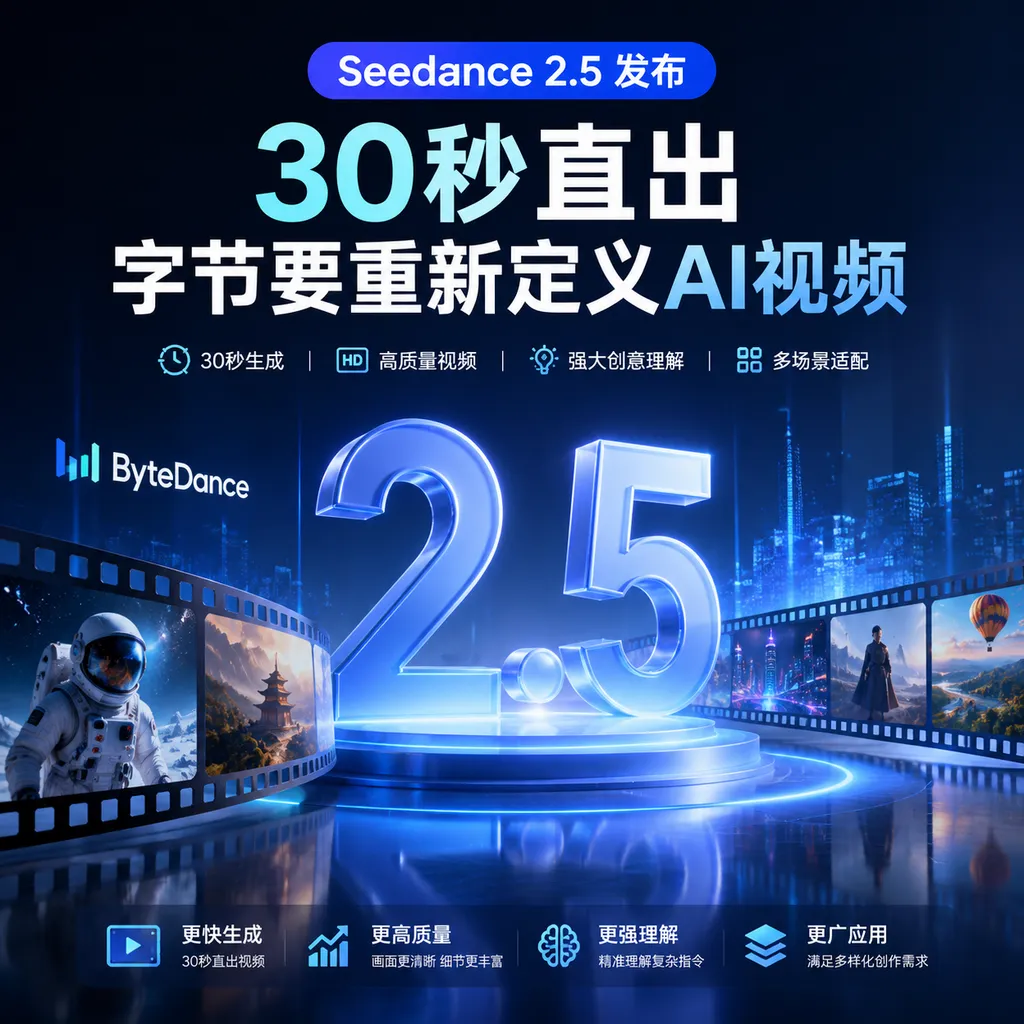
ByteDance announced Seedance 2.5 at the Volcano Engine Conference, supporting direct output of single 30-second videos and input of 50 fully-modal assets. It also announced a collaboration with Stephen Chow to launch an AI copyright commercialization platform, officially going online in early July.
Seedance 2.5 Release: 30-Second Direct Output, ByteDance to Redefine AI Video
ByteDance unveiled its new trump card today.
At the 2026 Volcano Engine FORCE Conference, Volcano Engine President Tan Dai officially announced the Doubao video generation model Seedance 2.5. This is not a routine version update—30-second single-segment direct output, simultaneous input of 50 fully multimodal assets, fine-grained local editing—almost blowing the competitors’ ceilings right off.
Currently, Seedance 2.5 is in global enterprise beta testing and is expected to officially launch in early July.
More interestingly, at this conference, ByteDance also previewed, for the first time, its AI Copyright Commercialization Platform, with the first collaborator being Stephen Chow. Yes, that Stephen Chow.
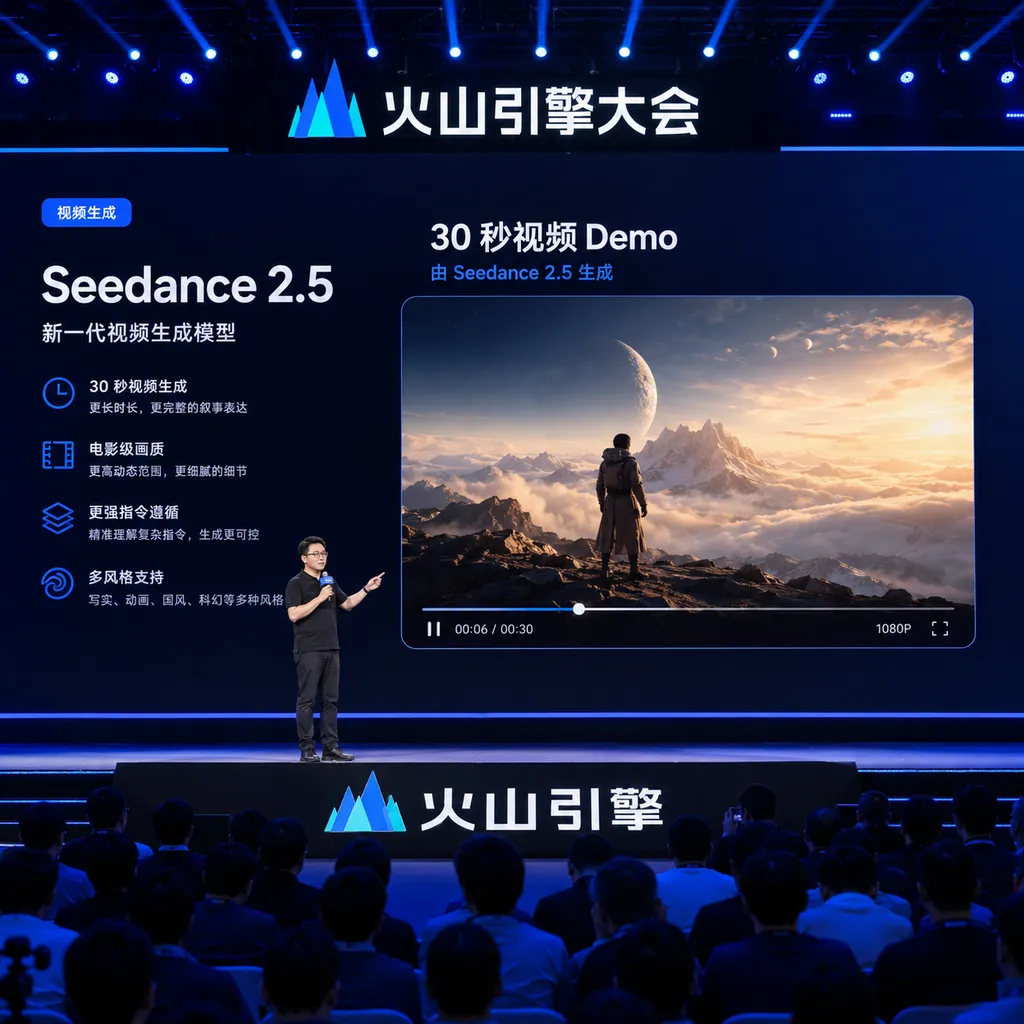
Three Core Upgrades, Each a Slap to Competitors
Duration Doubled: A Quantum Leap from 15 Seconds to 30 Seconds
Let’s start with the most direct upgrade.
Seedance 2.0’s single-segment video limit was 15 seconds—already top-tier in the industry. Most AI video tools top out at 10–20 seconds; to make longer videos, you must stitch clips together—stitching brings “character morphing,” “scene jumps,” and narrative breakage.
Seedance 2.5 directly doubles the limit to 30 seconds.
This is more than a numbers game. What does 30 seconds mean? A complete commercial, a Douyin viral clip, a critical scene in a short drama—all achievable in a single generation. No stitching means character consistency, lighting style integrity, and continuous motion trajectory.
For brand TVC teams, this is a productivity leap. Previously, a 30-second commercial might require generating 3–4 segments and stitching/color grading; now it’s one go.
Asset Capacity Explosion: From 12 to 50
Seedance 2.0 supported up to 12 reference assets per project. Version 2.5 takes this to 50.
And they’re “fully multimodal”—images, video, audio, text.
What does this mean?
Say you’re making a brand short film series. You can simultaneously upload: brand logo, product shots, spokesperson photos, reference video clips, background music, narration text, style reference images, storyboard scripts… AI can “digest” all materials at once, maintaining consistency during generation.
Previously, you’d either generate segment-by-segment with manual alignment or forgo complex context understanding altogether. Now the model directly “builds memory”; 50 assets equal 50 constraints—output results become naturally more controllable.
For advertising agencies, MCNs, and film studios, this is a true workflow revolution.
Fine-Grained Editing: Local Changes Without Ruining the Whole
The third upgrade leans toward “practicality.”
What’s the most frustrating part of AI video generation? You generate a perfect 15-second video except that in the last second a character’s hand gains an extra finger. What now? Regenerate—and the first 14 seconds might be ruined.
Seedance 2.5 supports local content modification: you can change a specific region or timeframe without altering the entire video.
This is “layer thinking” in video editing—treating generation results as editable layered assets, not a one-shot deal.
Additionally, Seedance 2.5 supports 3D white model input. If you have a ready 3D skeletal animation or scene model, you can use it as a reference, enabling AI to generate video according to preset motion trajectories and spatial structures. This is especially useful for game CG, virtual human animation, industrial visualization.
Seedance 2.0 Synchronous Upgrade: Native 4K Arrives
Alongside 2.5, ByteDance announced a major Seedance 2.0 upgrade: native 4K video generation.
What does this mean? Previously, 1080p videos shown on 4K screens needed upscaling or suffered blur. Native 4K means the model generates directly at 4K resolution—pixel-level detail retention—no “blow-up distortion.”
For big-screen applications—outdoor ads, cinema trailers, tradeshow displays—this is essential.
ByteDance’s strategy is clear: 2.0 serves the “image quality” segment, 2.5 targets the “productivity” segment. Dual product lines in parallel to cover different needs.
Stephen Chow Joins: First Shot of AI Copyright Commercialization
The most surprising part of this conference wasn’t model upgrades—it was the debut of the AI Copyright Commercialization Platform.
ByteDance announced Stephen Chow as its first partner.
How does it work? Based on Seedance video generation tech and official authorized templates, users can recreate Stephen Chow’s classic movie clips on Douyin, JiMeng, and JianYing.
For example, you can have “Zhi Zun Bao” speak your lines via AI, or swap backgrounds and costumes in A Chinese Odyssey scenes.
Tan Dai revealed that template usage exceeded 100,000 creations on the day of release.
The business model is clear:
- Copyright holder benefits: classic IP gains new monetization channel with active paid usage
- Platform benefits: differentiated content attracts creators, building an ecosystem moat
- User benefits: official authorization removes infringement risk
In the long run, this could be the most significant commercial innovation in AI video. Currently, AI-generated content copyright ownership is murky; ByteDance is pioneering “official authorization + profit sharing.”
If successful, more celebrities/IP holders might join. Imagine officially authorized “Marvel AI remixes,” “Disney AI fan works”… it’s a huge market.
Competitor Comparison: Can Sora, Runway, Pika Still Compete?
Placing Seedance 2.5 into the industry’s coordinate grid shows subtle shifts in competition.
| Model | Single-Segment Limit | Asset Input Limit | Native Resolution | Audio Generation | Local Editing | |-------|----------------------|-------------------|-------------------|------------------|--------------| | Seedance 2.5 | 30 sec | 50 multimodal | 4K (2.0) | Yes | Yes | | Sora | 20 sec | Limited | 1080p | No | Partial | | Runway Gen-3 | 10 sec | Limited | 1080p | No | Yes | | Pika 2.0 | 15 sec | Limited | 1080p | No | Partial | | Kling 1.6 | 15 sec | Limited | 1080p | Yes | Partial |
From the numbers, Seedance 2.5 clearly leads in duration and asset capacity.
But numbers are one thing. In practice, “controllability” and “consistency” matter more—whether AI can truly grasp your intent and maintain stable output throughout the whole video.
According to ByteDance, Seedance 2.5 greatly improves complex interaction scenes, multi-person motion, long script comprehension. Verification awaits post-launch testing.
Another key point: pricing.
Seedance 2.0 costs 0.023 RMB/1,000 tokens (image-to-video)—mid-low among peers. 2.5’s price isn’t announced yet, but given ByteDance’s pricing tradition, it likely won’t be outrageous.
For developers, Seedance can be integrated via Volcano Engine API or third-party API platforms.
Technical Details: Power of Unified Multimodal Architecture
Technically, Seedance’s core innovation is unified multimodal audio-video joint generation.
What does this mean?
Traditional AI video generation is “segmented”: generate visuals, then audio, then combine. Each step uses separate models—coordination is manual or rule-based.
Seedance puts video and audio in the same model for joint generation. Visual rhythm influences audio beats; audio mood influences visual tone. This “native integration” yields a more natural, immersive audio-visual experience.
For Seedance 2.5, key technical features include:
1. Multimodal Reference Understanding
The model can understand text, images, video, audio simultaneously, maintaining cross-modal consistency. For example, a character photo, a reference video, and narration text—it knows “same person,” “same scene,” “same story.”
2. Complex Motion Modeling
Multi-person interactions, high-speed motion, physical collisions—longstanding AI video challenges. Seedance 2.5 optimizes motion physics accuracy, with official demos of martial arts fights, dance ensembles showing noticeably smoother motion.
3. Stereo Sound
Seedance 2.0 supported audio generation but only mono. 2.5 upgrades to stereo, simulating spatial positioning—e.g., a character walking left to right with footsteps shifting from left channel to right.
4. Storyboard Script Understanding
A professional-grade feature: give the model a storyboard script (images + text descriptions); AI understands shot size, camera movement, visual content, generating a complete video in order.
This bridges the huge gap between storyboard and final shoot—AI can quickly produce “dynamic storyboards” for directors and clients to preview.
Application Scenarios: Who Benefits Most?
Beyond tech, let’s talk usage.
Seedance 2.5’s upgrades mean different things to different users:
Advertising & Marketing
30-second single-segment + 50 asset inputs—practically made for TVC production.
A typical case: brand provides logo, product shots, spokesperson photos, slogan, reference clips. Previously split into multiple tasks; now fed all at once—the output is more consistent in style and tone.
With native 4K output, big-screen and elevator ad scenarios can directly use AI-generated assets.
Short Dramas / Short Videos
Douyin, Kuaishou’s short drama tracks are saturated. Production cost is core competitiveness.
Seedance 2.5’s local editing greatly reduces “revision” costs. Actor expression wrong? Swap expression. Background error? Local redraw. No full reshoot/regeneration.
If Stephen Chow IP collaboration succeeds, more celebrity IPs may open up authorization—new content blue ocean for short drama creators.
Games / Animation
3D white model input lets Seedance 2.5 plug into existing 3D workflows.
Game studios can use exported skeletal animation as reference to generate “live-action” or different art styles; indie animation teams can use simple 3D models as base for AI to detail/render.
This doesn’t replace 3D art—it accelerates prototyping and lowers previsualization costs.
E-Commerce & Live Streaming
Virtual hosts, product showcase videos, scenario-based ads… e-commerce needs lots of AI video with high consistency.
50-asset input allows AI to “remember” brand’s visual guidelines, host image traits, product specs. Batch generation yields more uniform styles, reducing manual QA costs.
Unresolved Issues
With all strengths, some limitations remain.
Per ByteDance, Seedance 2.5 is “far from perfect.” Known shortcomings:
- Multi-person lip sync: when multiple roles speak, lip-audio alignment isn’t precise
- Occasional audio distortion: some scenes cause noise or breakage
- Complex edit stability: local edits need more reliability
- Text rendering accuracy: on-screen text (signs, subtitles) still has room for improvement
Moreover, while 30 seconds is the longest yet, generating full short films (3–5 min) still requires multi-segment stitching. Seamless/automated stitching may be next focus.
Industry Impact: ByteDance’s AI Video Ambition
In broader context, ByteDance’s AI video layout is quite complete:
- Model layer: Seedance series, iterating from 1.0 to 2.5
- Application layer: JiMeng AI, JianYing, Doubao—covering C-end creation scenarios
- Platform layer: Volcano Engine—API & cloud services for B-end clients
- Ecosystem layer: AI Copyright Commercialization Platform—solving compliance & monetization
This is full “infrastructure + application + ecosystem” play.
Comparatively, OpenAI’s Sora is crawling toward commercialization; Runway and Pika focus overseas; domestic Kling is chasing but slower. ByteDance’s domestic lead widens.
Most importantly, ByteDance has Douyin as a “super distribution channel.” AI-generated content can directly enter Douyin’s feed, forming “creation-distribution-monetization” loop—others lack this ecosystem advantage.
Final Thoughts
From Seedance 1.5’s “audio-visual integration,” to 2.0’s “multimodal joint generation,” to 2.5’s “30-second direct output + 50 asset input”—ByteDance’s AI video tech iteration speed is indeed fast.
But tech is only part. Stephen Chow collaboration’s copyright commercialization exploration might be the most imaginative part—if successful, AI video business models will evolve from “tool fee” to “content + copyright + distribution” ecosystem.
After the early July official launch, Seedance 2.5’s real performance awaits mass user validation. But today’s release shows ByteDance has widened its lead in the AI video track.
For developers and creators, this is good news—the fiercer the competition, the better the products, and the cheaper the prices.
Let’s wait for July.
References
- ITHome: ByteDance AI Video Generation Model Seedance 2.5 to Launch in Early July – onsite conference report, core parameters & Stephen Chow collaboration details
- Linux.do Discussion: Seedance 2.5 Release Info Summary – community discussion & supplementary info


