
Dream Music Generation 1.0 is live — one-click generation of 6-minute audio
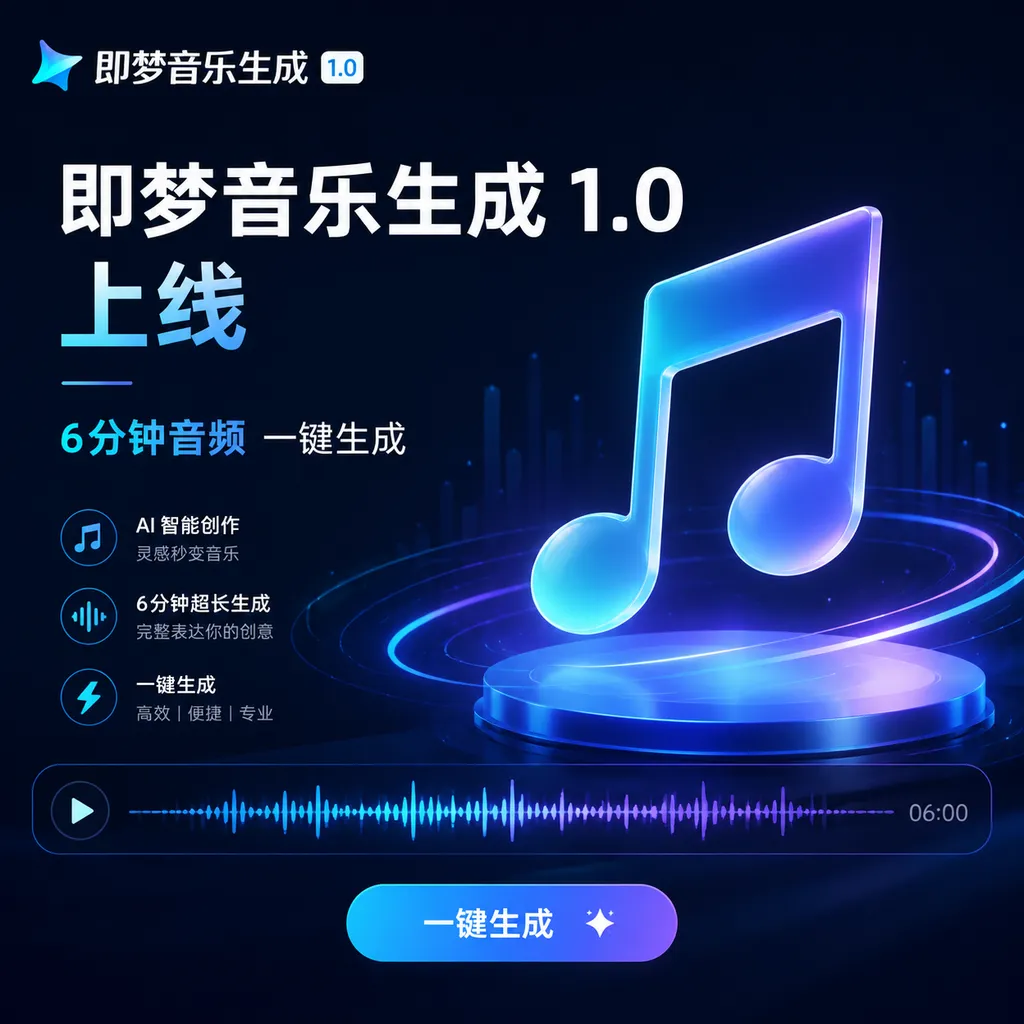
The JiMeng App has quietly launched a music generation module, featuring the brand-new 1.0 music generation model, supporting audio output of up to 6 minutes. This is another step for ByteDance in completing its AI content generation capabilities. From video to music, JiMeng is building a complete AI creative ecosystem.
JiMeng Music Generation 1.0 Goes Live — One-Click 6-Minute Audio Generation
ByteDance’s JiMeng app has quietly launched a music generation module, equipped with a brand-new 1.0 music generation model that supports audio generation of up to 6 minutes.
No press conference, no teaser posters — this feature simply appeared silently in JiMeng’s function list.
6 Minutes — What Can You Do With It?
A 6-minute audio generation length puts it in the top tier of today’s AI music field. For comparison, Suno currently supports up to 4 minutes, and Udio up to 2 minutes. JiMeng’s 1.0 version goes straight to 6 minutes, enough to cover the length of a full song.
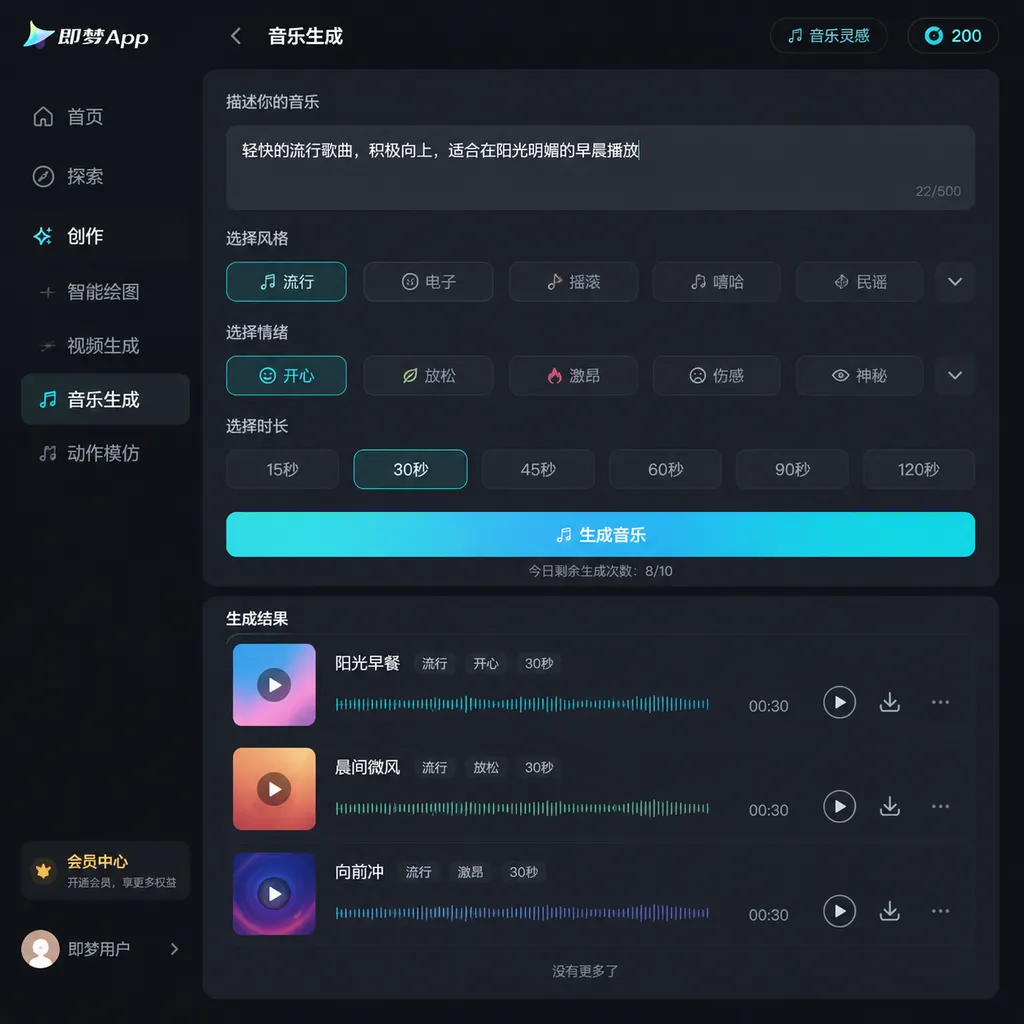
For short drama and short video creators, this length means they can generate a complete soundtrack in one go without having to stitch segments together. For those wanting to make AI music MVs, combined with JiMeng’s own Seedance video generation capabilities, it’s theoretically possible to accomplish the entire process from music to visuals within a single app.
Some developers are already experimenting with a workflow of “DeepSeek writing lyrics + JiMeng generating music + JiMeng generating MV,” reportedly producing an MV with original music in under 10 minutes. Of course, quality is another matter.
ByteDance’s Content Generation Puzzle
Looking back at ByteDance’s layout in the AI content generation space, the launch of the music module fills the last major missing piece.
Text generation: Doubao — already one of China’s most active AI chat products
Image generation: JiMeng’s image model — from early experimentation to now quite mature
Video generation: Seedance series — especially the sensational Seedance 2.0 this year, which made waves in AI video
Music generation: Now with the 1.0 music model
What does this mean? In theory, a creator can complete the whole journey from idea to finished product entirely within ByteDance’s product matrix, without hopping between platforms.
This is consistent with ByteDance’s typical product strategy — forming a closed loop through a product ecosystem and keeping users within its own environment. Douyin, Jianying, JiMeng, Doubao, plus Volcano Engine’s API services — covering C-end to B-end, creation to distribution — the chain is becoming increasingly complete.
The Current State of AI Music
Frankly speaking, AI music generation has never been particularly hot in China.
Overseas, Suno and Udio are two star products, both securing significant funding this year. Suno completed another round in March, reportedly valuing them at over USD 1 billion. They are ahead in user base and commercialization progress.
Many Chinese companies are working on AI music — NetEase Tianyin, Kunlun Wanwei’s Tiangong Music, and various startups — but none have broken into mainstream awareness.
The reasons are simple:
- Unresolved copyright issues: Can AI-generated music be used commercially? Who owns the copyright of training data? Globally, there are no clear answers. Suno and Udio are both facing copyright lawsuits.
- Limited commercial scenarios: The biggest current use for AI music is short video BGM — a low-quality-demand, low willingness-to-pay scenario.
- Technical bottlenecks: AI-generated music still lags in emotional expression, structural completeness, and stylistic consistency. Fine for casual listening, but far from professional-grade works.
ByteDance’s advantage in music generation is not mainly technical — it’s in usage scenarios. Douyin has massive daily demand for BGM in short videos; Jianying users need music; Seedance-generated videos need soundtracks. Building an in-house music generation model reduces dependence on external music libraries and offers differentiated creation experiences.
The Meaning of Version 1.0
The “1.0” label itself conveys a message: this is the formal release — not an experimental feature.
Interestingly, when will the Doubao app integrate this music generation capability? At present, unknown. Judging by past integration between JiMeng and Doubao, it’s likely to be rolled out gradually once the model stabilizes. As ByteDance’s main AI entry point, Doubao has a larger user base, but also higher stability requirements.
From a product iteration standpoint, ByteDance’s AI products tend to “upgrade quietly.” Doubao’s version updates rarely get big promotions, but features steadily grow stronger. JiMeng’s music generation launch follows the same pattern — release first, let users try it, then iterate based on feedback.
Audio-Visual Joint Generation: The Next Battleground
Seedance 2.0’s viral success early this year hinged on a key ability: “sound and image generation together” — the model can generate visuals and corresponding sound effects simultaneously, with audio synced to the visuals, eliminating post-production dubbing.
This capability is a major breakthrough in AI video. Traditional AI video workflows go: generate visuals first, then add sound/music. Two steps, two tools, with manual syncing in between. Seedance 2.0 merges the process, significantly improving efficiency.
But Seedance 2.0’s “sound and image together” focuses mainly on sound effects, not music — it can generate footsteps, ambient sounds, dialogue mouth movements, but not a background score matching the video’s emotional tone.
Now with JiMeng’s independent music generation model, the next likely step is integrating video and music generation to achieve true “audio-visual joint generation” — input text, output a video with original BGM.
Kuaishou is also working in this direction. They mentioned audio-video co-generation in product updates this year, but the specific effects are not yet widely released.
Whichever company makes this capability truly useful first will gain an edge in AI short dramas and AI advertising scenarios.
What This Means for Creators
If you’re a short video creator, short drama producer, or self-media content maker, JiMeng’s music generation feature is worth watching.
The advantages are obvious:
- No more hunting for free BGM or worrying about copyright
- Can generate custom music matching your video content
- If integrated with Seedance, workflow will be smoother
But limitations are clear:
- Being version 1.0, quality ceiling is not high
- Style diversity and controllability remain unknown
- Commercial licensing terms must be reviewed carefully
My advice: Try it, but don’t rely on it completely. AI-generated music is already good enough for short video BGM scenarios, but if you need high-quality music or plan to use it in formal commercial projects, it’s best to combine it with professional music production.
The Second Half of AI Content Generation
From a broader perspective, AI content generation is entering a new phase.
The first half’s keyword was “single-point breakthrough”: text models, image models, video models, music models — each developing independently, proving their capabilities.
The second half’s keyword is “multi-modal integration”: different modalities’ generation capabilities start merging so users can input one requirement and AI outputs a complete finished product.
ByteDance’s layout is clear: Doubao handles entry and text; JiMeng, visuals and audio; Volcano Engine, API services; Douyin and Jianying, distribution and tools. None may be the absolute best in isolation, but combined they form a closed loop.
This approach pressures single-point companies. A startup may create better music generation than JiMeng, but if JiMeng’s output is “good enough” and integrated with video generation and distribution, why would users install another app?
In Conclusion
The launch of JiMeng’s 1.0 music generation model is not a big news event. No major technical breakthroughs, no stunning demos — just a completion of a product feature.
But its significance lies in: ByteDance’s AI content generation puzzle now has one more completed piece.
When a company owns text, image, video, and music generation abilities — and can link them in one product — user experience and workflow efficiency improve substantially.
For developers, if you’re making AI content creation tools, ByteDance’s integrated strategy is a serious competitive threat worth studying. For creators, an extra option is always good — give it a try.
As for how far music generation itself can go, let’s wait for more user testing before drawing conclusions. It’s 1.0 — expectations are fine, but keep them modest.
References
- JiMeng app launches music generation module — up to 6 minutes — new 1.0 music generation model — Linux.do community thread, original news source
- AI music frenzy! DeepSeek + JiMeng, generate original music MV in 10 minutes — Zhihu column, JiMeng AI music creation workflow sharing


