
JiMENG Seedance 2.0 Launches with Native 4K, Aiming for Film-Level Production
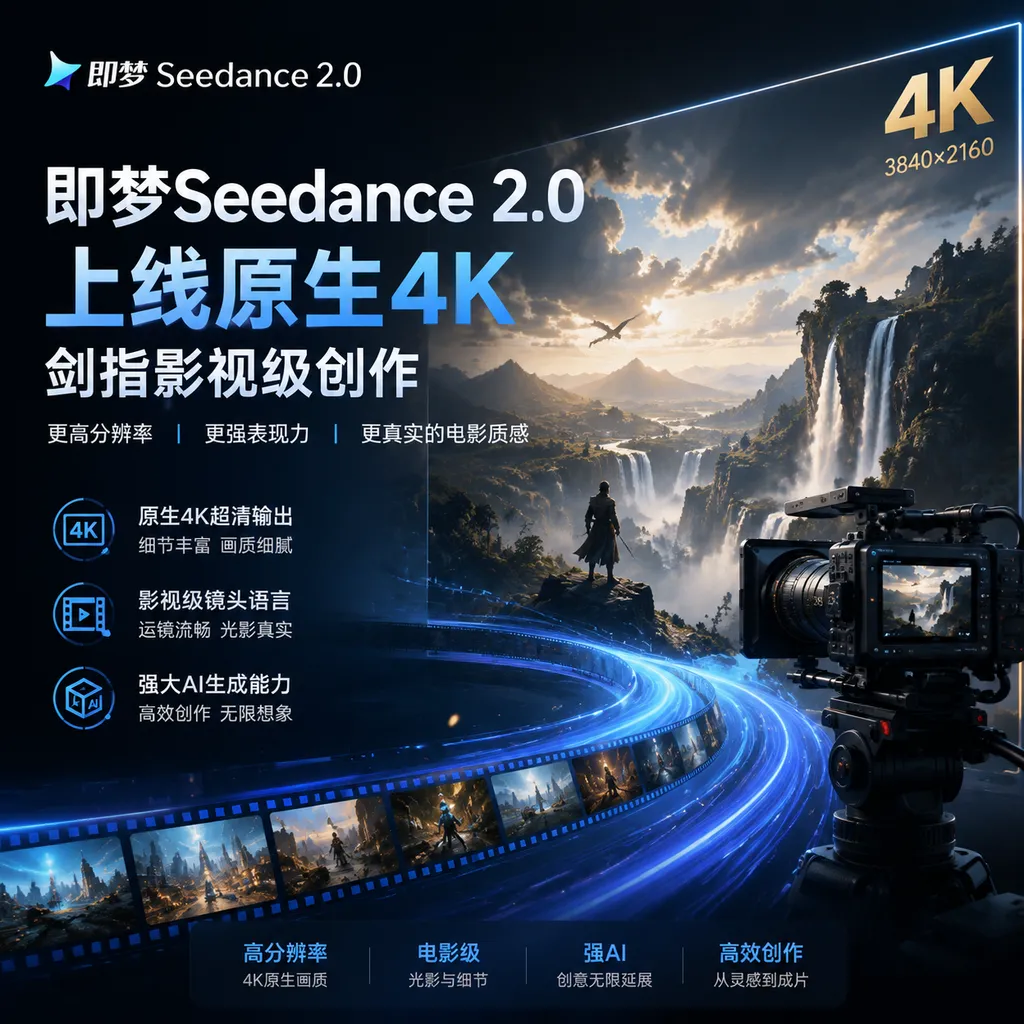
On June 23, Dream AI web version Seedance 2.0 VIP officially launched native 4K video generation. Unlike post-production upscaling, native 4K preserves details from the source, targeting high-quality creative scenarios such as film post-production, advertising, and brand visuals.
JiDream AI Pushes Video Generation to Native 4K
On June 23, the Seedance 2.0 VIP channel of JiDream AI's web version under ByteDance quietly launched a feature that caught the attention of the film and advertising industries — native 4K video generation. Note: it’s “native,” not “upscaled to 4K.” The difference between the two is significant.
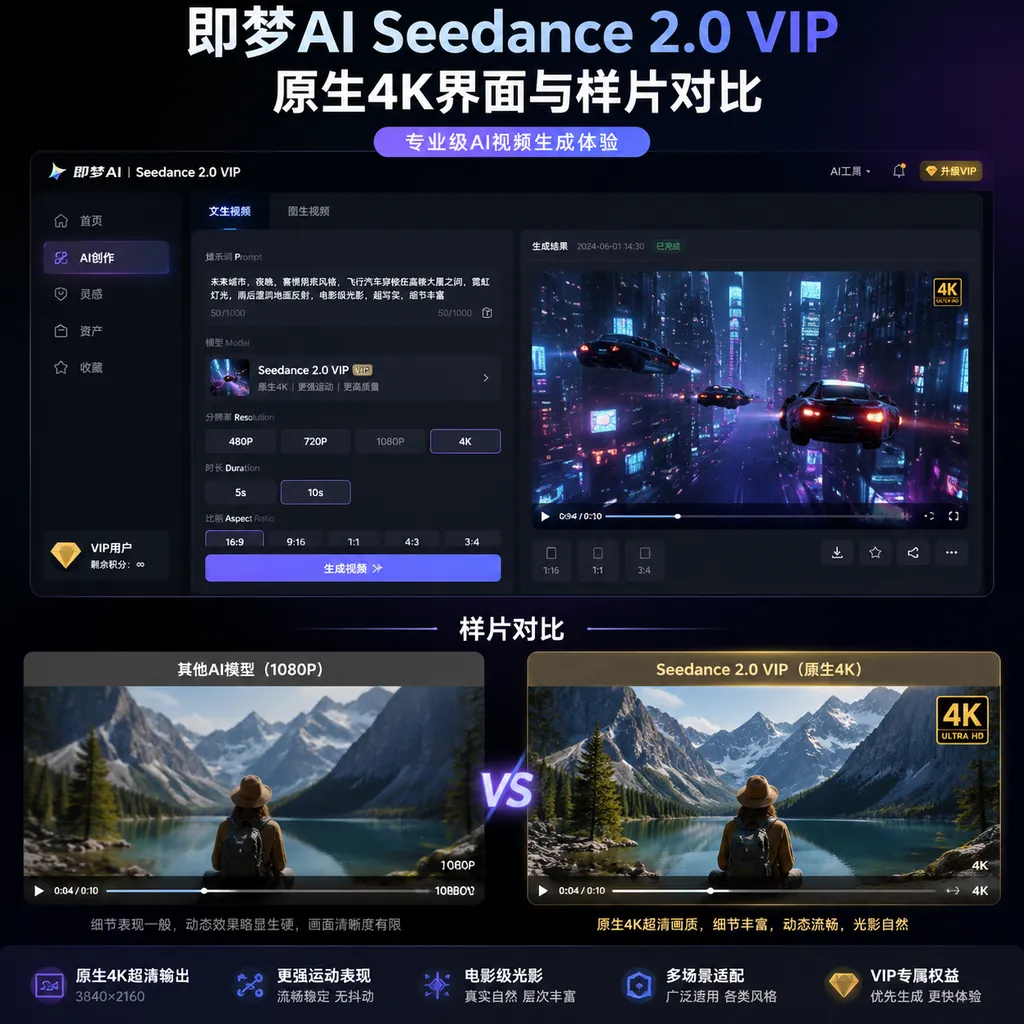
For those who have worked in post-production, upscaling is essentially guessing: the model takes 1080p material and uses algorithms to fill in 4K pixels, with most details “fabricated.” When dealing with high-frequency information such as hair strands or fabric textures, the result is either a blurred mess or overly sharpened with a plastic feel. Native 4K means the diffusion process itself is sampled at 4K resolution, so the model organizes the visuals from the start in a higher-dimensional latent space. The difference will be noticeable in two types of content: first, high-density textures — hair strands, wool fabrics, embroidery, architectural structure lines; second, light and shadow gradation — skin subsurface scattering, metal reflections, fog and particles.
This upgrade is available only to Seedance 2.0 VIP users and only on the web. From a product roadmap perspective, this step was inevitable. Since the launch of Seedance 2.0 in February this year, the model had already reached industry-leading levels in motion modeling, multimodal references, and audio-video joint generation, with the only remaining shortcoming being the resolution limit — 2K is sufficient for short videos and social media distribution, but to enter film post-production pipelines or produce brand commercials, 4K is practically a ticket to entry.
From Upscaling to Native: Why This Step Matters
Over the past year, video generation models in China and abroad have been skirting the edge on the “4K” issue. Most products do this: the base model generates at 720p or 1080p, then an upscaling model is applied at output to boost the resolution. The advantage is saving computing power — training and inference for 4K video cost more than four times that of 1080p, and temporal consistency needs separate handling; the drawback is that details are “fabricated,” not “computed.”
The challenges of native 4K are in two aspects:
- Training data: There must be a large enough corpus of true 4K video pairs, with annotation quality to match. The high-definition material accumulated over the past two years in Douyin and Jianying products, plus film acquisitions, makes ByteDance one of the few players capable of supporting this scale.
- Sampling efficiency: A single 4K frame has four times the pixels of 1080p; to produce output within a user-acceptable wait time requires sparse architectures and efficient sampling. The “extreme sparse architecture” mentioned in the Seedance 2.0 official technical report was likely laying the groundwork for this step.
Looking at the application side, what matters most in film post-production is not whether “it can produce 4K,” but whether “the produced 4K can be inserted into DaVinci or Premiere projects for continued color grading and effects work.” Native 4K shines here — the visuals lack the pseudo-textures caused by upscaling, offering greater color grading latitude, and when layering effects, underlying detail integrity prevents exposure of seams. This is why the official targets listed this time are “film post-production, brand visuals, advertising marketing” rather than the vague “high-definition creation.”
How It Fits Into the Existing Product Line
Since its official release in February, Seedance 2.0 has been rolled out across JiDream AI, Doubao, and Volcano Ark. Some details of this 4K upgrade are worth breaking down:
| Dimension | Previous Seedance 2.0 | VIP Native 4K Version | |-----------|-----------------------|-----------------------| | Max Resolution | 1080p~2K | Native 4K | | Access Points | JiDream APP/web, Doubao, Ark | JiDream web (VIP) | | Target Users | General creators | Professional: film, advertising | | Billing Mode | Credits | VIP subscription |
This is clearly a tiered operations move. Regular users continue using Credits at the 2K tier, while professional users subscribe to VIP for 4K — the same approach Midjourney used early on by making high resolution and Relax Mode member perks. For ByteDance, the benefit is attracting new C-end users without disruption, while obtaining a more stable cash flow from professional creators.
Reaction From the Film Industry
It’s worth noting that when Seedance 2.0 was first launched, Wu Kong: Black Myth producer Feng Ji’s comment — “the most powerful video generation model on the planet” and “the childhood era of AIGC is over” — spread widely in the industry. The speed of product iteration over the past four months has validated his point — going from 2K to native 4K took less than half a year.
Several short drama and advertising industry professionals previously gave specifics in media interviews: a traditional high-end product commercial takes half a month to produce and costs 1 million yuan; with AI, it may take just a few hours and cost tens of thousands. This disruption in cost structure could be brushed off in the 2K era with “image quality not sufficient for commercial use,” but with native 4K going live, that defense is thinner.
Of course, let’s not mythologize it. Early 4K samples circulating on social platforms still show the same old issues:
- Multi-subject consistency: With more than three main characters, facial and clothing details still drift
- Complex physics: For large crowds, explosions, and fluid high-frequency details, 4K may actually expose model penetration issues more clearly
- Text reproduction: The clarity and accuracy of in-frame text (signboards, subtitles) remain a weak spot
- Generation time: Wait times for the 4K tier are significantly longer; queuing for several hours during peak periods is not uncommon
A Few Judgments for Developers and Creators
If you are working on short videos/social media content, native 4K is likely unnecessary — after platform compression, the difference is negligible, making the 2K tier more cost-effective.
If you are working on advertising, brand films, or early-stage visualizations for film, this update is worth testing seriously. Focus on three things: whether texture details at 4K are truly better than 2K upscaling, whether color grading latitude can support LUTs, and the cost of integrating with existing editing projects.
If you are working on AI comics or AI short dramas, native 4K will change delivery standards — previously 2K delivery was the industry default, but once 4K becomes common, downstream platform acceptance thresholds will rise. Switching early lets you gain an advantage in production team ratings.
As for model-level competition, Keling 3.0, Sora, and Veo 3 are also striving on the 4K front. Seedance has taken the lead with native 4K this time; the next key milestone will be 4K + long duration + audio-video sync hitting full marks — this is what truly fits into the film industry pipeline. Judging from the multimodal joint generation architecture deployed in Seedance 2.0, ByteDance is likely to keep pushing down this path.
References
- JiDream AI launches Seedance 2.0 VIP native 4K version (36kr Newsflash) — First report on the release of the 4K feature


