
Grok 1.5 Video Generation: The Cost Battle Behind 0.15 RMB per Clip

The domestic API relay platform Bafang AI has launched xAI’s Grok Imagine Video 1.5 video generation model, reducing the batch production cost of 720p 15-second videos to 0.15 RMB per clip, directly igniting a price war in the AI video generation field.
In the past two days, Bafang AI posted a message on the forum: Grok 1.5 video model is now online, producing 720p 15-second videos, with a bulk rate of 0.15 RMB per clip.
How outrageous is this price? Let’s do the math. According to xAI’s official API pricing, the cost per second of video output is $0.08. For 15 seconds, that’s $1.2, equivalent to about 8.5 RMB. Bafang AI’s price of 0.15 RMB is less than 20% of the official price.
Of course, there’s room for bulk purchase negotiation, and the relay platform might also be subsidizing to attract users. Regardless, this price is indeed appealing to comic-drama studios and e-commerce teams.
What is Grok Imagine Video 1.5
First, let’s clarify the model itself.
Grok Imagine Video 1.5 Preview is a video generation model released by xAI on May 30, part of the Grok Imagine series. Note: this is different from the previously released Grok 1.5 LLM — one is a language model, the other is a video generation model, they just happen to share the same version number.
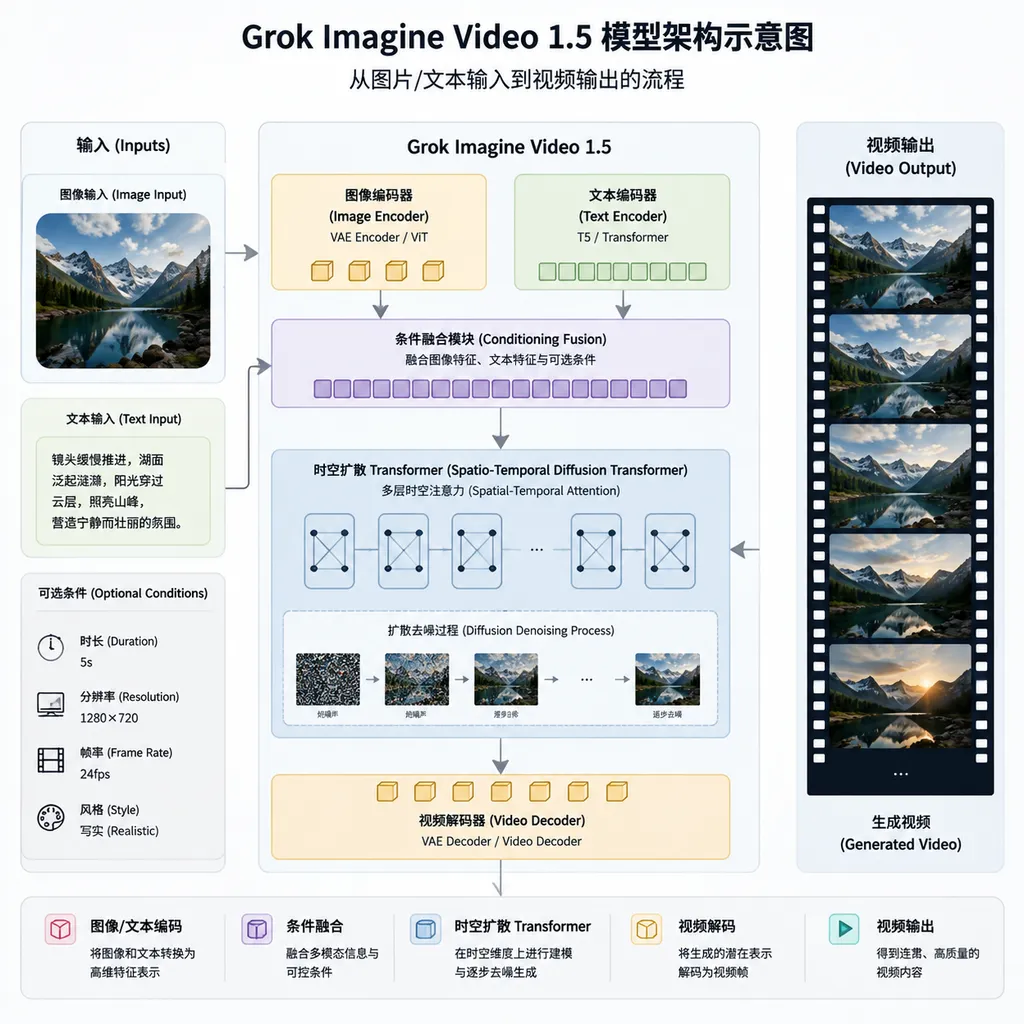
The model’s core capability is Image-to-Video, meaning you provide a static image and a text description, and it generates a video with motion. The official documentation highlights several features:
Native audio generation
This is Grok Imagine Video 1.5’s most noteworthy capability. It doesn’t generate video first and then add audio separately — it generates video and audio together, including:
- Background music and ambient sound effects
- Lip-synced dialogue (matching mouth movements to speech)
- Action sound effects (like creaky doors, footsteps)
In comparison, established players like Runway and Pika generate silent videos, with audio needing to be added later. Grok’s one-step approach can save substantial post-production work.
Video continuation
Videos are limited to 15 seconds, but you can extend them from the last frame. In theory, you can stitch multiple 15-second clips into longer content. This is especially useful for comic-drama storytelling.
Reference image guidance
You can provide reference images to control style, character appearance, and composition. For example, you can ensure that the same character image is maintained across all videos.
Technical specifications
Detailed parameters:
| Parameter | Specification | |------|------| | Model name | grok-imagine-video-1.5-preview | | Input format | Image + text / text only (text-to-video not currently supported) | | Output resolution | 480p / 720p | | Frame rate | 24fps | | Max duration | 15 seconds | | Official pricing | $0.08/sec | | Rate Limit | 60 RPM |
A pitfall to note: the official API page clearly states that the current preview version does not support text-to-video. You must supply a starting image. If your workflow relies entirely on text-to-video, this model currently won’t work for you.
Where did the 0.15 RMB price come from
Bafang AI’s quote is 0.15 RMB per 720p 15-second video, set as a bulk rate, with specific thresholds disclosed privately.
Let’s break down the price logic.
Official cost
According to xAI official pricing:
- Per second output: $0.08
- 15-second video: $0.08 × 15 = $1.2
- In RMB: ~8.5 (assuming exchange rate of 7.1)
Market comparisons
Here’s what other mainstream video generation services cost:
| Service | Pricing method | Approx cost | |------|----------|----------------| | Runway Gen-3 Turbo | Standard plan $12/month = 125 sec | $0.096/sec | | Pika Labs 2.1 | Pro plan $28/month ≈ 263 sec | $0.106/sec | | Luma Dream Machine | Plus plan $30/month ≈ 313 sec | $0.096/sec | | OpenAI Sora | Plus plan $20/month = 1000 sec | $0.02/sec |
Sora is the cheapest, but with lots of restrictions that make its actual usability questionable. Runway, Pika, and Luma are all around $0.1/sec.
Bafang AI’s 0.15 RMB/15 sec translates to 0.01 RMB/sec, about $0.0014/sec — almost 60 times cheaper than official pricing and an order of magnitude cheaper than Sora.
Price logic
Possible reasons for this inverted price:
1. Deep bulk discounts
Large API relayers can get enterprise-level pricing from upstream, much cheaper than retail. But a 60x difference is hard to explain with discounts alone.
2. User acquisition subsidies
More likely, the platform is burning funds to attract users. Low-price bulk rates to build stickiness and monetize later is a common strategy.
3. Conditions
0.15 RMB is a “bulk rate” — whether there’s minimum consumption, stability, or changing pricing remains uncertain.
Either way, as a user, you can take advantage while it lasts. Just be prepared for the likelihood that it won’t remain stable forever.
Application scenarios
Bafang AI’s promo highlights two main use cases: bulk comic-drama production and e-commerce short video material. These are indeed major current landing points for AI video generation.
Comic-drama/short-drama workflow
Comic-drama involves animating manga or images and adding voiceovers to make short videos. Key points:
- Static image source material requiring Image-to-Video
- Episodes are short (tens of seconds to minutes); 15-second clips suffice
- Large volume — dozens or hundreds per series
- Moderate quality requirements, no need for film-grade visuals
Grok Imagine Video 1.5’s native audio is valuable here. Traditional workflow is: video generation → voiceover → lip sync adjustment → final merge. Now you can produce an audio-equipped video in one step, saving voiceover work.
But check lip sync outcomes. Officially supported, but actual quality and Chinese language accuracy need testing.
E-commerce product videos
In e-commerce, the need is to turn product images into dynamic showcase videos. Examples:
- 360-degree product spins
- Usage scenario simulation
- Simple intro animations
Here, native audio isn’t as critical; priorities are:
- Fast generation for bulk output
- Product fidelity (no distortion)
- Consistency across multiple generations of the same product
720p is sufficient for most e-commerce platform specs.
Less suitable scenarios
Not optimal for:
High resolution needed: Max is 720p; skip if you need 1080p or 4K. ByteDance’s Seedance 2.0 supports higher resolution.
Pure text-to-video: API currently requires an initial image.
Extra-long video: 15 seconds max, with continuation possible, but continuity and cost are considerations.
High precision control: Officially supports “cinema-grade camera control,” but no detailed documentation in preview version.
Access method
To use this model through Bafang AI:
- Register a Bafang AI account (website: bafang.me)
- Top up API credits
- Call API to generate videos
API format, parameters, and callbacks aren’t publicly documented; contact customer service. Forum post mentions joining QQ group (964218642) for inquiries.
Tech-capable teams could connect directly to xAI’s official API. Model name is grok-imagine-video-1.5-preview, alias grok-imagine-video-1.5-2026-05-30.
Call example
If using an OpenAI-compatible API gateway (e.g., OpenAI Hub):
import requests
import base64

# OpenAI Hub config
api_base = "https://api.openai-hub.net/v1"
api_key = "your-api-key"

# Read starting image
with open("start_image.jpg", "rb") as f:
    image_data = base64.b64encode(f.read()).decode("utf-8")

# Build request
response = requests.post(
    f"{api_base}/videos/generations",
    headers={
        "Authorization": f"Bearer {api_key}",
        "Content-Type": "application/json"
    },
    json={
        "model": "grok-imagine-video-1.5-preview",
        "prompt": "Product slowly rotating, soft lighting, gradient background",
        "image": f"data:image/jpeg;base64,{image_data}",
        "duration": 15,
        "resolution": "720p",
        "fps": 24
    }
)

result = response.json()
print(result)
Note: Above code is illustrative using OpenAI-compatible format; actual parameter names and endpoints may differ.
Risks to consider
Before large-scale adoption, note these risks:
Price sustainability
0.15 RMB is almost certainly subsidized. Questions:
- How long will subsidies last?
- Will price changes be pre-notified?
- How will remaining credit refunds work?
Post mentions “refunds based on remaining monthly balance,” but actual execution remains to be seen.
Service stability
Relay platform stability depends on:
- Upstream API quota and stability
- Platform’s technical capacity
- Handling during peak concurrency
Bafang AI claims “enterprise-level concurrency” and “custom high-concurrency support,” but no specific SLA given. High-reliability needs warrant small pilot runs first.
Content moderation
xAI’s API has moderation; some prompts may be rejected. Relay platforms may add rules; rejection rates impact usability.
Quality consistency
Video generation inconsistency is common: same prompt run 10 times might yield 3 excellent, 3 acceptable, 4 unusable outputs. Waste rate affects actual costs.
Comparison with other options
Situating Grok Imagine Video 1.5 in the market:
vs Runway/Pika/Luma
Strengths of the “big three”: mature ecosystems, complete toolchains, rich community resources. Weakness: higher prices (~$0.1/sec) and no native audio.
Grok strengths: native audio, potentially cheap relayers. Weakness: new ecosystem, limited docs, preview-only.
vs Sora
Sora’s official price is lowest ($0.02/sec), but with many limits: generation caps, long waits, unclear commercial terms. Not friendly for bulk production.
Grok via relay is cheaper and less restricted, giving it an edge.
vs ByteDance Seedance
Seedance 2.0/2.5 is notable:
- Higher resolution support (1080p, 4K)
- Native audio, beat-synced music
- Max 30 sec (v2.5)
- Up to 50 reference materials supported
But Seedance is mostly offered via ByteDance’s own platforms (e.g., Jianying), API availability/pricing unclear.
Conclusion
Bafang AI’s release of Grok 1.5 video model boils down to two key points:
-
Grok Imagine Video 1.5 is a distinctive video model with native audio generation as its biggest differentiator. Specs (720p, 15 sec, Image-to-Video) suit comic-drama and e-commerce scenarios.
-
0.15 RMB per clip is extremely attractive, but likely a short-term subsidy. Good for cheap trial runs to build workflows, but don’t plan long-term around this price.
For AI video-generating teams, it’s worth a try — especially for bulk production needs with native audio requirements.
But don’t rush to go all-in. Preview status means features and stability are still evolving, and subsidized relay prices won’t last forever. Validate in small batches, then ramp up gradually.
References
- Bafang AI Grok 1.5 Video Model Launch Announcement - Original Linux.do forum post with pricing and contact info
- AI Video Generation Cost Comparison Analysis - Zhihu column discussing cost optimization for AI video generation


