Alibaba’s three‑in‑one move: QoderWork swallows Wukong and MuleRun

Alibaba has merged the three Agent product lines — QoderWork, Wukong, and MuleRun — into one, now overseen by Chen Yusen, born in 1992. A three-layer architecture of desktop + cloud + organization has taken shape, marking Alibaba AI-to-B’s shift from internal competition to concentrated effort.
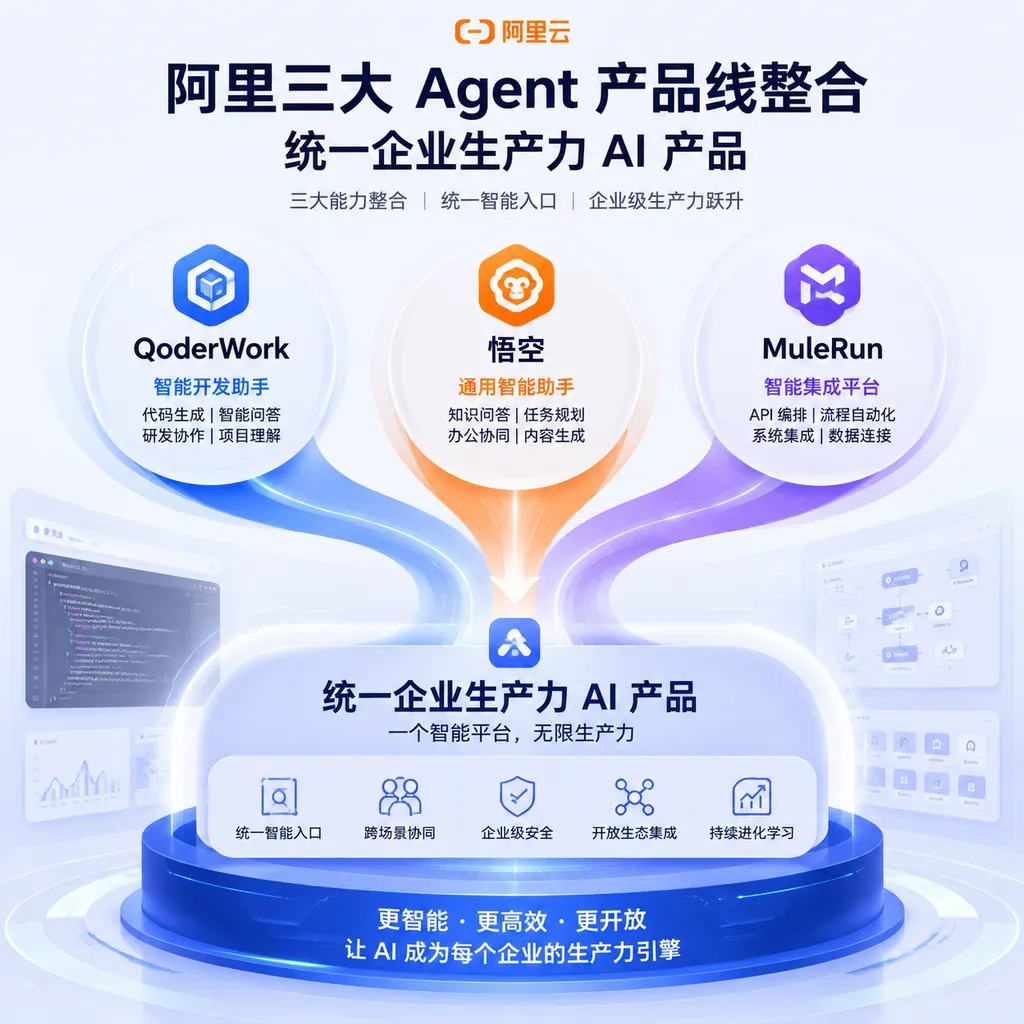
On July 2, Alibaba officially confirmed that it will merge its three enterprise-grade Agent products—QoderWork, Wukong, and MuleRun—into a new enterprise productivity AI product, to be overseen by Chen Yusen, who became DingTalk’s CEO in mid-June. By mid-July, the product line reorganization was largely finalized, and the team merger had entered the execution stage.
This is not a routine organizational adjustment. The three products represent three different technical routes in Alibaba’s enterprise Agent landscape—desktop localization, SaaS collaboration, and cloud execution. By choosing to merge them now, Alibaba is signaling a shift from “multi-point exploration” to “focused breakthrough.”
Three Products, Three Approaches
Let’s first clarify what each of these products does—otherwise, it’s hard to understand the intent behind the merger.
QoderWork is a desktop AI agent launched in January 2026 under Alibaba Cloud’s Qoder series. Its positioning is not a web-based Copilot or IDE autocomplete, but an Agent running directly on your computer—using natural language to manipulate local files and applications, create documents, run data, and organize folders. It follows the MCP protocol + local execution path and later introduced expert suites for finance, legal, and marketing, as well as IM integrations for DingTalk, WeChat, and Feishu. Wu Yongming stated internally that QoderWork ranks first among all Alibaba AI tools in DAU, WAU, and Token usage. It is the most market-validated of the three.
Wukong was released in March 2026 by DingTalk’s ATH business group and is officially promoted as “the world’s first enterprise-grade AI-native work platform.” It is natively embedded into DingTalk, allowing Agents to call thousands of DingTalk capabilities, complemented by an enterprise-level security sandbox and permission inheritance. The key concept here is compliance—in enterprise environments, integrating AI isn’t about capability but about permissions and auditing. Wukong addresses the challenge of “how to let AI operate safely in an enterprise.”
MuleRun (literally “Mule Runs Fast”) is the oldest, launched in September 2025. It was incubated internally by Chen Yusen, focusing on Agent execution engines and process reuse—users can teach an Agent an SOP and invoke it repeatedly. The product has progressed well internationally, serving users in 43 countries, with 34% of users paying over $200 monthly. In June, its team merged with Wukong’s to form the “New Wukong Team.”
Viewed together, the three products overlap in function but differ completely in their architecture philosophies: QoderWork is local-first, Wukong is SaaS-collaborative, and MuleRun is cloud-execution-first. The challenge of the merger isn’t combining UI elements, but fusing three technical routes into one coherent architecture.
Why Now?
The timing is intriguing. Looking backward, ByteDance’s Coze integrated with Feishu Agent, and Tencent’s WorkBuddy are both accelerating; looking forward, 2026 is widely predicted to be the first breakout year for desktop Agents. If Alibaba keeps its teams separate, it dilutes its resources and gives rivals an advantage.
The more immediate push is personnel. On June 11, Chen Yusen replaced Chen Hang as DingTalk CEO, becoming Alibaba’s youngest division CEO. Within a month, he also took charge of the new AI productivity product. This is a classic case of “giving both authority and responsibility to one person”—the three teams previously belonged to Alibaba Cloud, internal startups, and DingTalk, respectively. Now, uniting them under one CEO makes true integration possible rather than a nominal joint project.
Chen Yusen himself deserves a note. Born in 1992, a graduate of Zhejiang University’s Chu Kochen Honors College in the Qiu Shi Science Class, he founded cybersecurity company Chaitin Tech at 22, later acquired by Alibaba Cloud, and was recognized in Forbes Asia’s 30 Under 30. He’s not a parachuted manager but a product-focused tech geek, having built MuleRun from scratch. Assigning him all three products suggests Alibaba wants product-level integration, not administrative merging.
A Three-Layer Structure: “Desktop + Cloud + Organization”
Based on existing information, the most logical architecture for the new product would be a capability-layered structure, slicing the three products’ strengths into front, middle, and back layers:
- Frontend: QoderWork’s desktop interaction and local execution. This is the user-facing gateway—handling local file operations and cross-app orchestration. It has the most potential as an “OS-level entry point.” Wu Yongming previously positioned QoderWork as “the interface between large models and the digital world.”
- Mid-layer: MuleRun’s execution engine and process reuse. This layer manages Agents’ self-evolving abilities, SOP accumulation, and cross-task orchestration. When building MuleRun, Chen Yusen insisted on the “SOP-first, model-second” approach—hardcoding reusable processes instead of depending solely on model reasoning. This logic will likely carry over.
- Backend: Wukong/DingTalk’s enterprise data, organizational structure, and permission systems. Compliance, auditing, and organizational relationships—core infrastructure built up over years by DingTalk.
If this architecture works, it would be fascinating: the boundary between individual productivity tools and enterprise collaboration platforms disappears. Tasks you instruct your local Agent to perform could naturally integrate with company workflows, and enterprise tasks could flow seamlessly to local execution.
Competitively, ByteDance’s Coze + Feishu run in parallel; Tencent’s WorkBuddy focuses on collaboration; Microsoft’s Copilot is fully SaaS-based. If Alibaba truly integrates “desktop + cloud + organization,” it would achieve architectural differentiation—assuming it can pull it off.
The Challenges Ahead
Now the hard parts. This integration faces serious challenges:
Product DNA conflicts. QoderWork is local-first—emphasizing low latency and local data; Wukong and MuleRun are cloud-first—emphasizing collaboration and consistency. These differ fundamentally in data flow, permissions, and state sync assumptions. Either local advantage or cloud consistency must be partially sacrificed. There’s no free lunch.
Team culture integration. Alibaba Cloud’s engineering team, DingTalk’s SaaS team, and Chen Yusen’s startup team differ in workflow and KPI logic. Historically, cultural friction is Alibaba’s most common pitfall in internal mergers.
User migration risks. QoderWork users are its most active base. Any experience gap during integration could drive them to competitors. Alibaba claims a “seamless upgrade with unchanged benefits,” but in practice, “seamless” upgrades rarely are.
Business model restructuring. QoderWork is a personal productivity tool priced by Token or subscription; Wukong is enterprise collaboration software priced by seat; MuleRun targets international paid users. Unifying three pricing models into one—and balancing personal and enterprise versions—is a complex product management challenge.
A Bigger Signal
Beyond the products, this merger marks a consolidation of Alibaba’s AI-to-B strategy. Over the past two years, Alibaba pursued a competitive parallel strategy for Agents—Qwen, Qoder, Wukong, MuleRun, and the Bailian platform all running separately. This “horse race” approach works early on but becomes a liability when scale and focus are needed.
By mid-2026, the industry signal was clear: in enterprise Agents, the question is not “can it be done?” but “who secures the entry point first?” ByteDance, Tencent, and Microsoft are converging on the same target—a unified entry, unified account system, and unified Agent platform. Alibaba merging its lines into one is, at its core, a bid for that entry point.
DingTalk’s role may also shift. It used to be a collaboration tool with AI features layered on top; moving forward, it will likely become AI-native—not just with an AI assistant button, but structurally reengineered as an Agent-native product. Having Chen Yusen serve as both DingTalk CEO and head of the new AI product signals this intention.
For developers, short-term watch points include: whether QoderWork’s MCP protocol integration will open further, whether Wukong’s DingTalk capabilities will be API-ized, and whether MuleRun’s SOP workflows can be reused externally. These will determine whether the new product is “a bigger app” or “a true platform.”
If you’re building enterprise Agent applications that switch between multiple models and benchmark global performance, OpenAI Hub offers one key connection to GPT, Claude, Gemini, DeepSeek, and other leading models, fully compatible with the OpenAI format—helpful for reducing integration costs.
Short Commentary
Alibaba’s move is strategically sound—the timing and direction are right. Wait another six months, and it might be too late. But with integrations like this, correct direction doesn’t guarantee smooth execution, especially when melding three teams with such different backgrounds. The true test will come when the new product launches publicly at year’s end. While Alibaba says “seamless upgrade,” users will care more about “is it better than before?”—the ultimate exam question for any merger.
References
This article compiles information from 36Kr, Zhidx, Jiemian News, Sina Tech, DoNews, Sing Tao Daily, and other media coverage of Alibaba’s Agent product line integration, as well as official Alibaba statements.